
Vibrant India
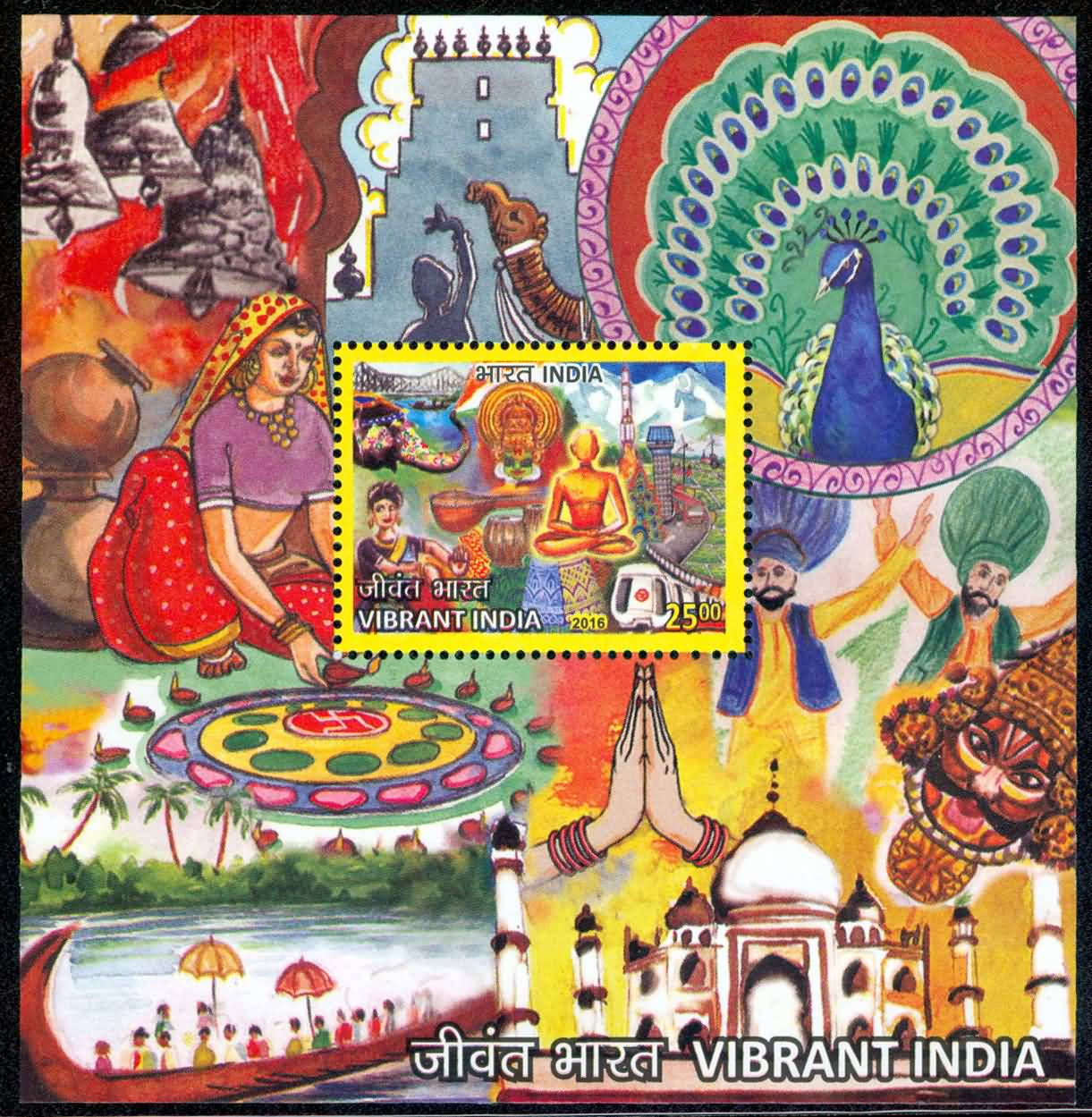
Technical Data
| Date of Issue | January 25, 2016 |
|---|---|
| Denomination | Rs. 25 |
| Quantity | 300,000 |
| Perforation | 13¾ |
| Printer | Security Printing Press, Hyderabad |
| Printing Process | Wet Offset |
| Watermark | No Watermark |
| Colors | Multicolor |
| Credit (Designed By) | Ms. Nenu Gupta |
| Catalog Codes |
Michel IN BL136 Stamp Number IN 2778 Yvert et Tellier IN BF123 Stanley Gibbons IN MS3123 |
| Themes | Elephants |
Ancient Civilization and National Growth
India is among the world’s oldest civilizations, celebrated for its vast and vibrant cultural heritage. Since gaining Independence 67 years ago, the nation has achieved significant socio-economic development across multiple sectors. Geographically located in the northern hemisphere, India extends from 8° 4’ to 37° 6’ north latitude and 68° 7’ to 97° 25’ east longitude. The mainland stretches 3,214 km from north to south and 2,933 km from east to west, and is bound by a 15,200 km land frontier. Its coastline—including the mainland and island territories of Lakshadweep and Andaman & Nicobar—measures 7,516.6 km.
Geographical Features and Natural Environment
India’s peninsula is naturally fortified from mainland Asia by the majestic Himalayas. The nation is surrounded by the Bay of Bengal in the east, the Arabian Sea in the west, and the Indian Ocean to the south.
The mainland consists of four major geographical regions:
- The Great Mountain Zone
- The Plains of the Ganga and Indus
- The Desert Region
- The Southern Peninsula
India’s environment—its lakes, rivers, forests, wildlife, and natural landscapes—forms the backbone of its cultural and economic life. With increasing population pressures, conservation and environmental protection have become national priorities. The government has launched numerous initiatives for safeguarding natural resources, protecting flora and fauna, promoting animal welfare, and combating pollution.
Cultural Heritage and Creative Diversity
Culture shapes the identity, unity and progress of a nation. India’s diversity is best represented by its multitude of traditions, beliefs and artistic expressions. The country has one of the world’s richest repositories of songs, dances, theatre, folk arts, crafts, rituals, literature, and performing traditions—collectively recognised as the Intangible Cultural Heritage (ICH) of humanity.
The Government of India has undertaken extensive programmes to preserve, promote and financially support individuals and organizations engaged in cultural activities, including performing arts, visual arts, and literary traditions.
Human Resource Development and Education
Education serves as the cornerstone of human resource development, essential for maintaining a balanced socio-economic structure. India has expanded its efforts across all levels of the education system—elementary, secondary, higher, technical, and adult education. Increasing emphasis on vocational training has enabled the development of a skilled workforce capable of meeting the evolving demands of a modern economy.
Agriculture and Rural Development
Agriculture and its allied sectors remain the primary source of livelihood for millions, especially in rural India. They contribute significantly to the country’s GDP. Sustainable agriculture—through soil conservation, natural resource management, and biodiversity protection—is vital for food security, rural employment, and environmental stability.
India has witnessed multiple agricultural revolutions, such as:
- Green Revolution (crop productivity)
- White Revolution (dairy development)
- Yellow Revolution (oilseed production)
- Blue Revolution (fisheries and aquaculture)
These milestones have strengthened rural growth and national food resilience.
Infrastructure and Energy Development
Infrastructure is a key driver of India’s economic progress. The government continues to introduce policies aimed at building world-class infrastructure, focusing on sectors such as:
- Power
- Roads and bridges
- Dams
- Urban development
Energy—both conventional and non-conventional—is essential for improving quality of life and sustaining industrial growth. India is actively promoting renewable energy sources, including solar, wind, bio-energy, and other emerging technologies, to meet rising energy demands responsibly and sustainably.
Science and Technology: A Tradition of Innovation
Science and technology have deep roots in Indian civilization. Ancient India pursued natural philosophy with vigor, laying the foundations for centuries of intellectual growth. The period of India’s Renaissance, aligned with the freedom movement, gave rise to pioneering scientists who shaped the nation’s scientific identity.
Post-Independence, the Government of India invested extensively in research institutions, higher education, and technological infrastructure. Today, scientific research and innovation continue to grow steadily, reinforcing the nation’s commitment to progress through knowledge and discovery.
Leave a Comment
You must be logged in to post a comment.