
Wild Flowers of India
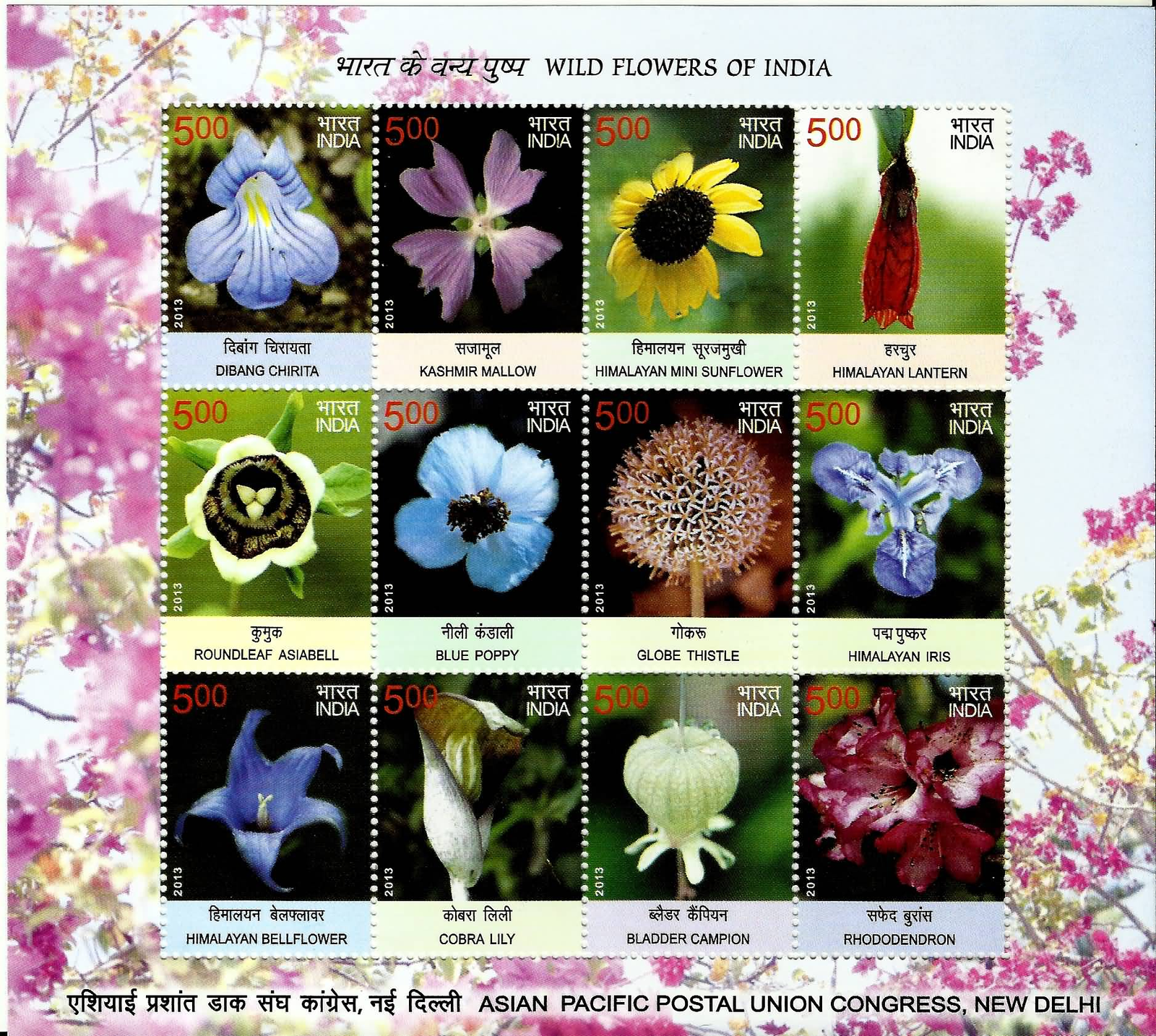
Technical Data
| Date of Issue | May 20, 2013 |
|---|---|
| Denomination | Rs. 60 |
| Quantity | 810,000 |
| Perforation | 13 |
| Printer | India Security Press, Nashik |
| Printing Process | Offset Lithography |
| Watermark | No Watermark |
| Colors | Multicolor |
| Credit (Designed By) | Smt. Alka Sharma |
| Catalog Codes |
Michel IN 2770-2781KB Stanley Gibbons IN 2949a WADP Numbering System - WNS IN093MS.2013 |
| Themes | Conferences | Flowers | Lilies (Flower) | Plants (Flora) |
Wild Flowers of India – A Philatelic Tribute
India’s botanical wealth is one of the richest in the world, shaped by its diverse climatic zones and varied topography. From the lush tropical rainforests to high alpine meadows, and from temperate woodlands to coastal wetlands, every corner of the country hosts species of exceptional beauty and ecological significance. There is scarcely a region in India that does not nurture a plant of rare charm or scientific interest.
Honouring this natural heritage, India Post presents a collection of commemorative stamps featuring twelve rare and exquisite wild flowers found across the nation. These stamps celebrate India’s floral diversity while underscoring the importance of its conservation.
Dibang Chirita
Botanical Name: Chirita dibangensis
Family: Gesneriaceae (Gloxinia family)
Named after the picturesque Dibang Valley of Arunachal Pradesh, Dibang Chirita is an erect herb distinguished by its delicate beauty. Its solitary flowers grow in the leaf axils and appear bluish-white from the outside, marked with two bright yellow lines on the lower palate and throat.
Kashmir Mallow
Botanical Name: Lavatera cachemiriana
Family: Malvaceae (Mallow family)
Endemic to the Western Himalayas, the Kashmir Mallow is admired for its elegant, ivy-shaped foliage and striking pink blossoms. Each plant bears single, funnel-shaped flowers that bloom from midsummer to autumn. Their obovate petals span 4–8 cm, making them a true highlight of Kashmir’s wild flora.
Himalayan Mini Sunflower
Botanical Name: Cremanthodium ellisii
Family: Asteraceae (Sunflower family)
A perennial herb standing 25–35 cm tall, this rare species bears nodding, sunflower-like flowers with dark central disks and narrow yellow rays. Found at elevations between 3,500 and 4,800 metres from Kashmir to Southeast Tibet, it blooms from July to September.
Himalayan Lantern
Botanical Name: Agapetes serpens
Family: Ericaceae (Rhododendron family)
This charming shrub, 40–60 cm in height, is known for its slender arching stems and tiny lantern-shaped blossoms. The flowers—shades of red, orange, or pinkish white—often display dark zig-zag markings. It thrives in the Northeastern Himalayas, especially Darjeeling and Sikkim, flowering between May and June.
Roundleaf Asiabell
Botanical Name: Codonopsis rotundifolia
Family: Campanulaceae (Bellflower family)
A perennial vine of the high Himalayas, the Roundleaf Asiabell produces graceful, greenish-white bell-shaped flowers accented with purple veins. Sepals are long, leaf-like and slightly hairy. Found at altitudes of 1,800–3,600 metres, it blooms during July and August.
Blue Poppy
Botanical Name: Meconopsis aculeata
Family: Papaveraceae
A rare jewel of the Himalayas, the Blue Himalayan Poppy captivates with its deep blue petals and vibrant yellow stamens. The flowers, often 5–11 cm across, grow in high-altitude regions from Uttarakhand to Kashmir, typically between 3,000 and 4,500 metres.
Globe Thistle
Botanical Name: Echinops niveus
Family: Asteraceae (Sunflower family)
This hardy, spiny herb features a sturdy stem topped with a dense spherical flower head measuring 6–8 cm. It grows in the Himalayan belt stretching from Kashmir to Nepal, at heights of 1,400–1,700 metres.
Himalayan Iris
Botanical Name: Iris kemaonensis
Family: Iridaceae
Found in the alpine meadows of the Himalayas at elevations of 3,000–4,000 metres, the Himalayan Iris is an elegant perennial with rhizomatous roots. Its tall stems bear stunning lilac to deep purple blossoms from April to June, making it one of the most graceful flowers of the region.
Himalayan Bellflower
Botanical Name: Campanula latifolia
Family: Campanulaceae (Bellflower family)
This perennial herb grows wild across the Himalayan region from Kashmir to Nepal. It produces large, pendulous, deep blue-purple bells arranged on tall spikes. Found between 2,000–3,500 metres, it flowers during the summer months.
Cobra Lily
Botanical Name: Arisaema wallachianum
Family: Araceae
The striking Cobra Lily is instantly recognizable by its curved, hood-like spathe—striped in shades of purple or bronze—which resembles a cobra’s raised hood. Distributed from Himachal Pradesh to Sikkim at altitudes of 1,800–4,300 metres, it blooms from July to September.
Bladder Campion
Botanical Name: Silene vulgaris
Family: Caryophyllaceae (Carnation family)
This perennial herb features slender, branching stems that rise 30–100 cm high. Its distinctive white-green flowers hang gracefully, each supported by an inflated, veined sepal tube that resembles a small bladder. The plant flowers from June to August.
Rhododendron
Botanical Name: Rhododendron arboreum
Family: Ericaceae
One of the Himalayas’ most iconic flowering shrubs, Rhododendron arboreum produces vibrant pink, bell-shaped flowers. Found from eastern Nepal to Arunachal Pradesh at elevations of 2,700–3,700 metres, it blooms from March to June. The foliage, silver or fawn beneath, adds to its appeal.
A Commitment to Conservation
Through these commemorative stamps on Wild Flowers of India, the Department of Posts reaffirms its dedication to preserving the nation’s botanical heritage. Each stamp serves as a reminder of the rich biodiversity thriving across India—and of the collective responsibility to protect it for future generations.
First Day Cover

Leave a Comment
You must be logged in to post a comment.