
Wildlife of the Western Ghats
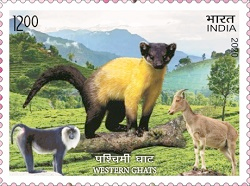
Technical Data
| Stamp Set | UNESCO World Heritage Sites in India - II |
|---|---|
| Date of Issue | March 16, 2020 |
| Denomination | Rs. 12 |
| Quantity | 500,000 |
| Perforation | 13¼ x 13¾ |
| Printer | Security Printing Press, Hyderabad |
| Printing Process | Wet Offset |
| Watermark | No Watermark |
| Colors | Multicolor |
| Credit (Designed By) | Sh. Brahm Prakash Sh. Pallab Bose |
| Catalog Codes |
Michel IN IN 3666A Stamp Number IN IN 3217 Yvert et Tellier IN IN 3343 Stanley Gibbons IN IN 3736 Phila-India IN IN 3703 |
| Themes | Animals (Fauna) | Mammals | Monkeys | UNESCO World Heritage Sites |
Introduction
The Western Ghats, also known as the Sahyadri (Benevolent Mountains), are one of India’s most remarkable natural treasures. Stretching parallel to the western coast of the Indian peninsula, this ancient mountain range is celebrated for its extraordinary biodiversity, ecological significance and influence on India’s climate.
Location and Extent
The Western Ghats cover an area of about 1,40,000 square kilometres, traversing the states of Kerala, Tamil Nadu, Karnataka, Goa, Maharashtra and Gujarat. According to UNESCO, the Western Ghats are older than the Himalayas, making them one of the world’s most geologically significant mountain systems.
UNESCO World Heritage Status
Recognizing their outstanding universal value, the Western Ghats were inscribed as a UNESCO World Heritage Site. They are also identified as one of the world’s eight “hottest hotspots” of biological diversity, underscoring their global conservation importance.
Biodiversity Hotspot
The Western Ghats support an astonishing range of life forms. The region is home to over 7,402 species of flowering plants, 1,814 species of non-flowering plants, 139 mammal species, 508 bird species, 179 amphibian species, 6,000 insect species and 290 freshwater fish species.
It is believed that many species in the Western Ghats are yet to be discovered. At least 325 globally threatened species are known to exist in this region, highlighting its critical role in global biodiversity conservation.
Influence on Climate and Monsoon
The Western Ghats play a crucial role in shaping Indian monsoon weather patterns. They intercept the rain-bearing southwest monsoon winds during late summer, causing heavy rainfall on the western slopes and influencing agricultural and ecological systems across large parts of India.
River Systems
Several major river systems originate in the Western Ghats, including the Godavari, Kaveri, Krishna, Thamiraparani and Tungabhadra rivers. Numerous streams arising from these mountains feed these rivers, carrying substantial volumes of water during the monsoon months and supporting millions of people downstream.
Ecological and Cultural Importance
Beyond biodiversity, the Western Ghats sustain livelihoods, agriculture and cultural traditions across peninsular India. They provide ecosystem services such as water security, climate regulation and soil conservation, making them indispensable to the region’s environmental stability.
Conservation Significance
The Western Ghats stand as a living laboratory of evolution and a vital natural heritage of India. Continuous conservation efforts are essential to protect their fragile ecosystems from growing environmental pressures.
Commemorative Postage Stamps
To highlight the global importance of this natural wonder, the Department of Posts is pleased to release Commemorative Postage Stamps on the Western Ghats, celebrating their status as a UNESCO World Heritage Site and India’s rich natural heritage.
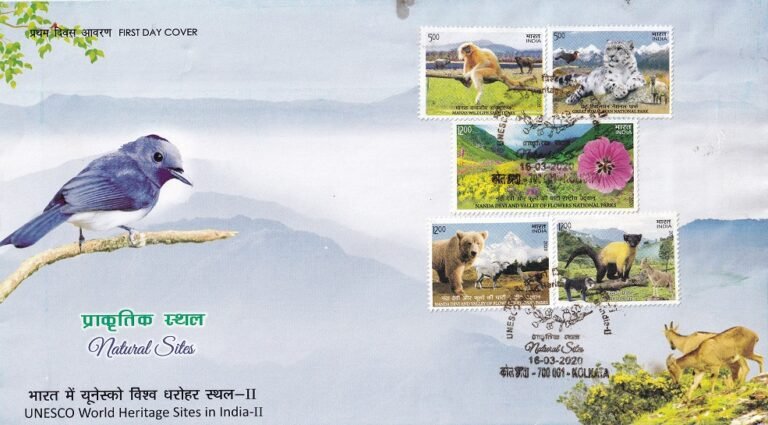
First Day Cover
Leave a Comment
You must be logged in to post a comment.