
World Classical Tamil Conference-Kovai 2010
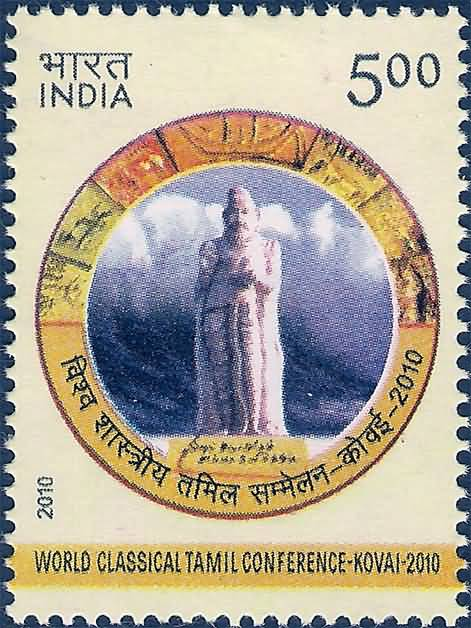
Technical Data
| Date of Issue | June 27, 2010 |
|---|---|
| Denomination | Rs. 5 |
| Quantity | 300,000 |
| Perforation | 13 |
| Printer | India Security Press, Nasik |
| Printing Process | Photo Gravure |
| Watermark | No Watermark |
| Colors | Multicolor |
| Credit (Designed By) | Smt. Alka Sharma |
| Catalog Codes |
Michel IN 2494 Stamp Number IN 2433 Stanley Gibbons IN 2727 WADP Numbering System - WNS IN039.2010 |
| Themes | Conferences | Famous people | Literary People (Poets and Writers) | Men | Saints | Statues |
Early Recognition of Classical Languages
For many centuries, only Greek and Latin were regarded as classical languages. In the 19th century, eminent scholars such as William Jones and Max Muller translated ancient Sanskrit texts, introducing the richness of India’s literary heritage to the Western world. As a result, Sanskrit too was elevated to the status of a classical language.
Establishing the Antiquity of Dravidian Languages
In 1816, the noted scholar Francis Whyte Ellis published his findings establishing that the Dravidian languages were fundamentally different from Sanskrit and possessed their own antiquity and independent status. Later in the 19th century, Robert Caldwell carried out extensive research and proclaimed that Tamil, among the Dravidian languages, was equally ancient, with a distinct diction and literary tradition uninfluenced by Sanskrit.
Contributions of Early Tamil Scholars
Even before Caldwell’s work, Tamil scholars proficient in Sanskrit had emphasized the uniqueness of Tamil. Madava Sivagnana Munivar of the 18th century compared the grammar and diction of Tamil and Sanskrit in his celebrated commentary on the prologue of the ancient Tamil grammar Tolkappiyam. His research highlighted distinctive features of Tamil such as morphophonemic rules, technical terminology, implied verbs, compound structures, rational and non-rational classification of words, thematic divisions, and unique metrical forms.
Sangam Literature: A Classical Treasure
The corpus of Sangam poetry, comprising 26,350 lines, elevates Tamil to the rank of one of the great classical languages of the world. Tamil possesses an indigenous literary theory of exceptional standard, including metrics, prosody, poetics, and rhetoric. Sangam poetry demonstrates refined diction, distinctive style, and a complete literary expression of culture. The renowned scholar Kamil Zvelebil described Sangam literature as a truly classical product, a view endorsed by many scholars.
Global Influence and Scholarly Recognition
Tamil words are found in several world languages, including Hebrew, Chinese, Japanese, Korean and Malay. Scholars such as Thomas Burrow and Murray Barnson Emeneau studied Dravidian elements in Vedic compositions. Ancient grammarians like Katyayana, who paraphrased Panini’s Ashtadhyayi, and Patanjali also demonstrated engagement with linguistic traditions beyond Sanskrit.
Recognition and Commemoration
Recognizing its unparalleled antiquity and literary excellence, the Government of India formally declared Tamil a Classical Language in 2004. To celebrate this rich heritage, India Post issued a commemorative postage stamp on the World Classical Tamil Conference, honouring the timeless legacy and cultural contributions of the Tamil language.
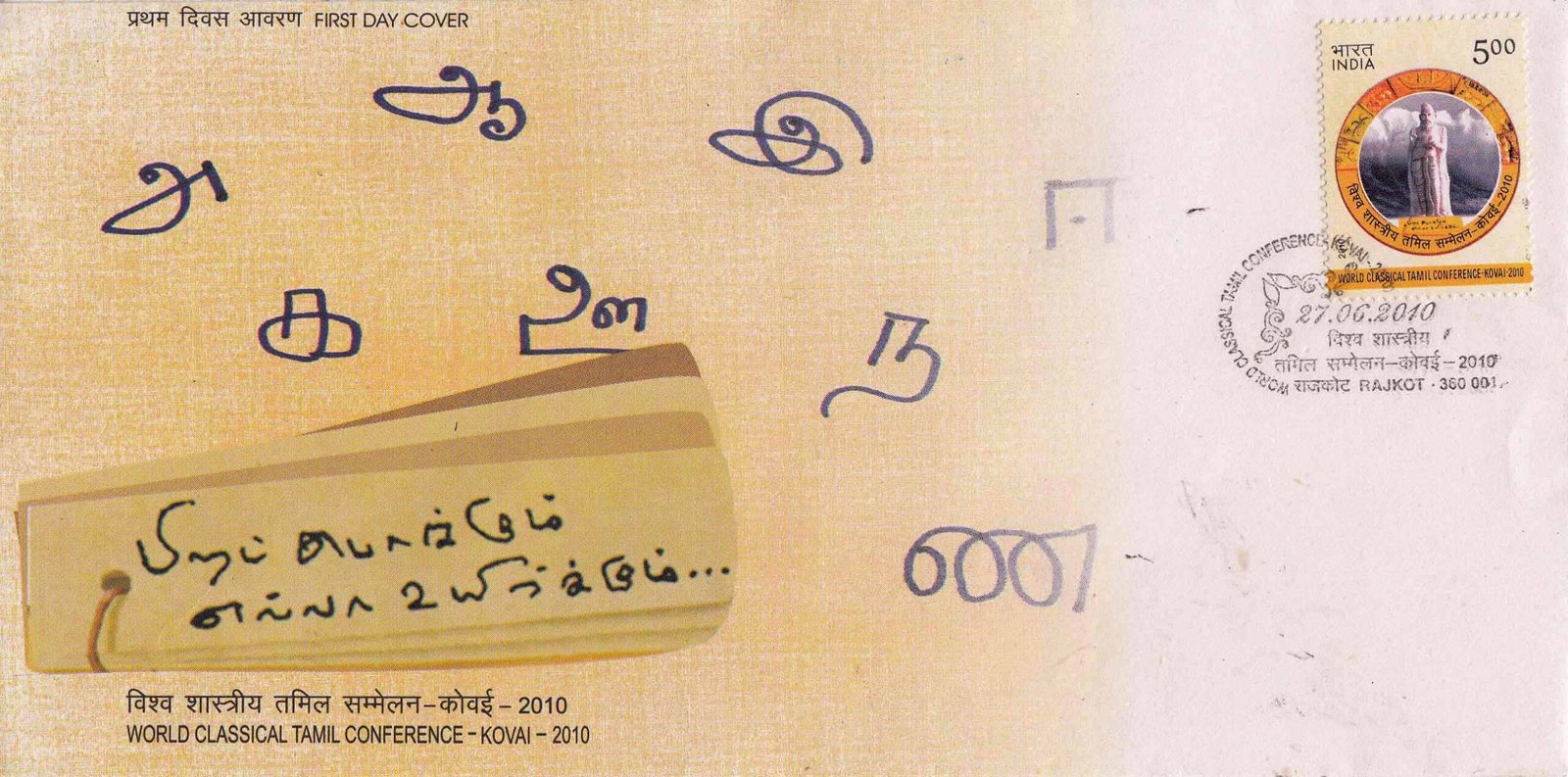
First Day Cover
Leave a Comment
You must be logged in to post a comment.