
Somnath Temple: 1000 Years of India’s Unwavering Faith and Devotion

Technical Data
| Date of Issue | May 11, 2026 |
|---|---|
| Denomination | Rs. 5 |
| Quantity | 202,800 |
| Printer | Security Printing Press, Hyderabad |
| Printing Process | Wet Offset |
| Watermark | Multicolor |
| Credit (Designed By) | Ms. Nenu Gupta |
| Themes | Buildings | Flags | Universities |
The Somnath Temple commemorative stamp marks a millennium of “unbroken faith” and resilience. Located on the western coast of Gujarat, the temple is historically significant not just as a religious site, but as a symbol of India’s ability to regenerate and rebuild.
Spiritual and Historical Significance
Somnath is revered as the first among the twelve Jyotirlinga shrines of Lord Shiva. Its position on the coast made it a historical crossroads for maritime trade and cultural exchange, integrating the temple into vast networks of learning and community life.
The text highlights several key historical milestones:
- The 1026 CE Turning Point: The temple was famously attacked and destroyed by Mahmud of Ghazni, an event that began a centuries-long cycle of destruction and reconstruction.
- Resilience through the Ages: Despite repeated damage, worship at the site never truly ceased. In the 1890s, Swami Vivekananda described Somnath as a symbol of India’s resilience and embodying a history of regeneration.
The Modern Reconstruction
Following India’s Independence, the reconstruction of the temple became a national initiative to preserve cultural heritage.
- Key Figures: Sardar Vallabhbhai Patel played a pivotal role in initiating the restoration effort, supported by leaders like K. M. Munshi.
- Inauguration: The current restored temple was inaugurated on 11 May 1951 by India’s first President, Dr. Rajendra Prasad.
This Department of Posts issuance honors the 1,000-year legacy of the site, celebrating it as a timeless emblem of architectural excellence and national identity.
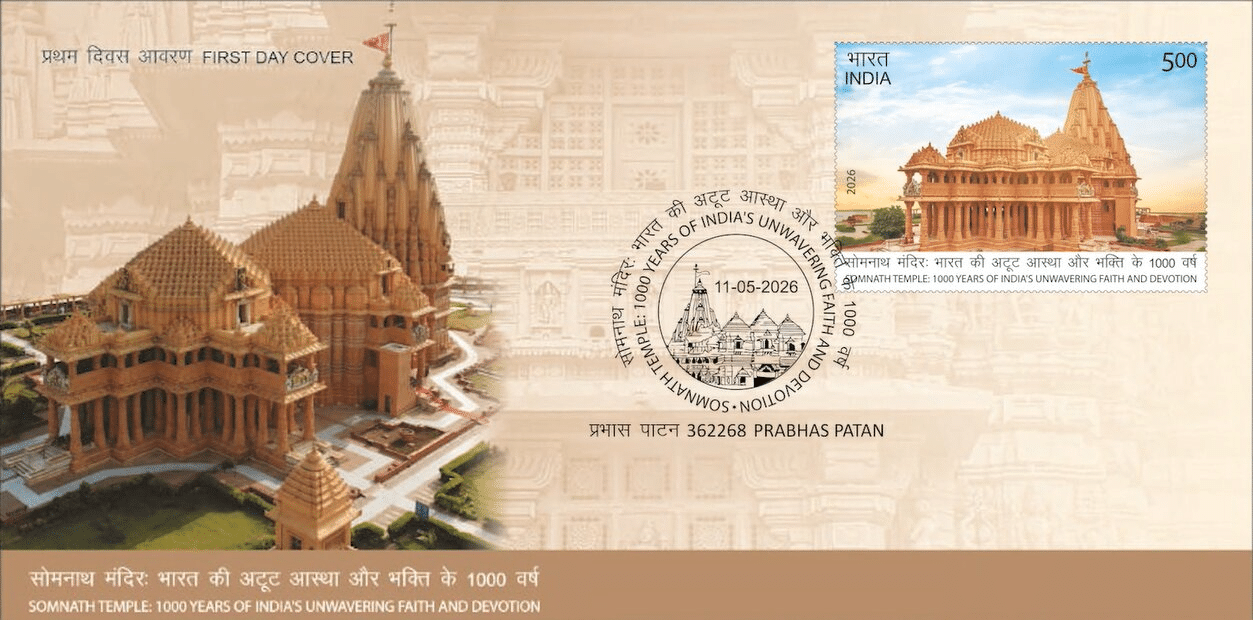
First Day Cover
Leave a Comment
You must be logged in to post a comment.