
Postal Unity in Indore, 1908: the State Offices, the Agreement and the 68 Places
The State post’s 80 offices in 1902, the decision to unite with the Imperial post, the agreement in force from 1 March 1908, its official-mail rules, and the 68 places listed at amalgamation.
Updated November 1, 2026
In this article
The State post at its height
The Indore report for 1901–02, published in 1903, records eight new State offices, and gives one head office, 42 branch offices and 37 sub-offices, 80 in all. It names four new lines: Talen–Zirapur, Manasa–Nandwai, Manasa–Neemuch and Dhavala–Khargon. It records that a Postal Guide had been compiled and put on sale, and that postal notes to serve as money orders were being printed in England, to be issued when they arrived. Harkawat places the guide and the postal notes in 1901–1902; the report itself shows only that the notes were planned.[57][4]
The report for 1902–03 shows the change of currency: 3,52,90,850 Hali rupees and 4 annas were tendered for conversion and 2,98,86,014 British rupees given in exchange. Which coin paid a particular postal charge needs a dated schedule or receipt.[59]
Towards one post, 1903–1907
In 1903–04 the administration asked the Postal and Telegraph Departments for terms for combined British offices at district headquarters and the main trading towns, while improving its own network.[60]
The Imperial report for 1905–06 records that the Indore City post office moved into tents during a plague outbreak, and that the delivery work of the Indore City sub-office passed to Indore Head Office during the year; it gives no dates and does not link the two.[66]
In his review of the State report for 1906, dated 1 September 1907, the Resident, O. V. Bosanquet, reported that the Council had decided after deliberation to apply for the unification of its post with the Imperial post.[65]
The Indian Postal Guide of October 1907 separates Indore head office from its City and Railway Station sub-offices, and Mhow head office from its Barracks, Bazar and Railway Station sub-offices; H and S mark head and sub-offices, and T beside Indore and Mhow a government telegraph station, unlike Tc for a combined post and telegraph office. It marks Indore City with an asterisk meaning “No delivery”, and lists Sanawad as a sub-office with Tc. The postal report for 1907–08 records that Sanawad’s combined office moved from the Central Provinces into the Rajputana and Central India postal circle, without a date.[67][68]
The agreement of 1 March 1908
Appendix G of the official Gazetteer of 1931 reproduces the agreement for postal unity, in force from 1 March 1908. The Agency’s postal report for 1907–08 also gives 1 March, although its introduction says 1 January 1908; both readings are in the original volume, and the March date is kept.[20][68]
Imperial offices were to be kept wherever State offices had been, although an office that did not pay its way could be moved unless it was at a tahsil headquarters. Registered and insured articles, value-payable parcels and money orders were to be accepted at and for every tahsil-headquarters office. The Imperial post’s report for 1907–08 records that amalgamation meant opening 53 post offices and 571 miles of mail lines.[20][42]
Official mail after 1908
State official letters posted and delivered within the State could bear Holkar State service stamps. If addressed or readdressed outside the State, they needed British India service stamps, or paid the British Indian service rate as unpaid. So Holkar service stamps lived on under postal unity as part of a regulated official-mail arrangement, not as a continuing public State post.[20]
Clauses 4 and 6 gave an annual free allowance of service stamps worth 25,000 rupees, divided between Holkar and British India stamps as the Darbar chose; stamps beyond it were paid for at face value. A Gazetteer footnote records an increase to 35,000 rupees after the Government’s representation in 1923, without an effective date. Clause 7 made the Darbar pay all the costs of making and supplying Holkar service stamps, and arrangements for keeping and issuing reserve stock needed Imperial approval. “Gratis” did not mean the stamps cost the Darbar nothing.[20]
The postmark wording
Clause 3 required the seals and stamps of every office in the State to carry the rim words “Holkar State”. Harkawat gives a fuller version separating HOLKAR STATE or H.S. from INDORE STATE or INDORE, which is not in the official wording, and adds a rule about mutual use of stamps at half face value that is not among the Gazetteer’s nine clauses. Record the actual legend, office and date, and do not read HOLKAR STATE after 1908 as a separate post.[20][4]
The 68 places at amalgamation
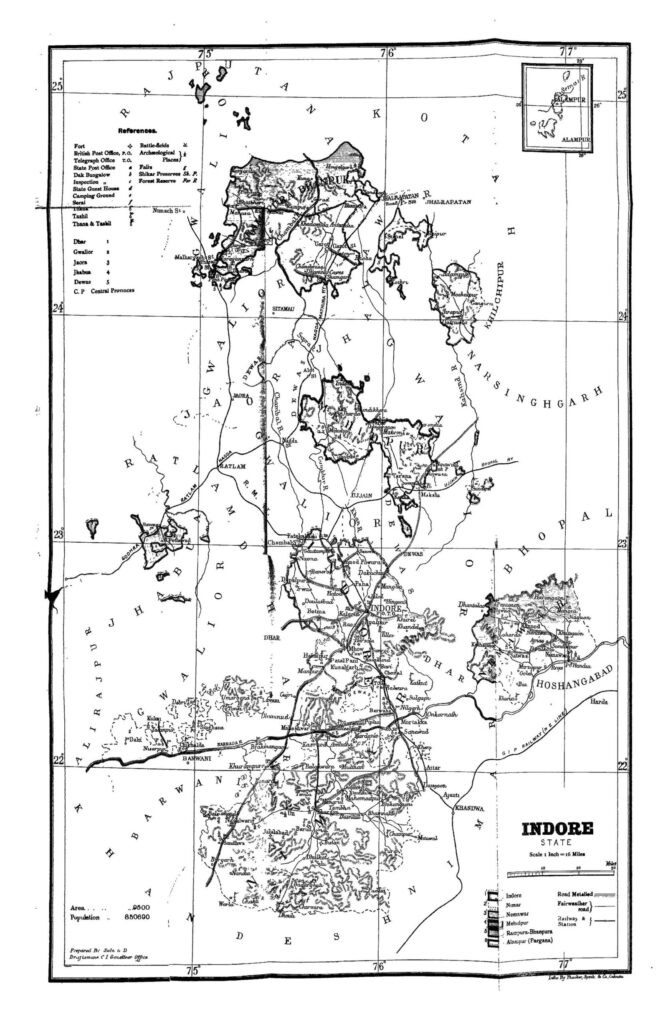
After the agreement, the Gazetteer lists 68 offices said to have existed at amalgamation, grouped by district. The list includes Imperial offices that were already there, so it is not a census of State offices, and its 68 cannot be matched one for one with the 53 openings. Its note says that 36 entries were tahsil or pargana headquarters and eleven were existing Imperial offices, but daggers appear beside twelve entries.[20][42]
| District | Places |
|---|---|
| Indore | Indore (HQ †), Sawer (HQ), Petlawad (HQ †), Gautampura, Depalpur (HQ), Hatod, Betma (HQ), Mhow (HQ †), Hasalpur (HQ), Khudel (HQ) |
| Mahidpur | Mahidpur (HQ †), Jharda (HQ), Jagoti, Tarana (HQ), Kyatha, Makrone (HQ) |
| Rampura | Narayangarh (HQ), Antri, Chandwasa (HQ), Kharaoda, Rampura (HQ), Kukreshwar, Manasa (HQ), Parda, Kanjarda, Nandwai (HQ) |
| Bhanpura | Bhanpura (HQ), Sandhara, Sunel (HQ †), Raipur, Machalpur, Jirapur (HQ), Kothari, Bolia, Garoth (HQ), Shamgarh, Melkhora |
| Bundelkhand | Alampur (HQ †) |
| Nemawar | Nemawar, Sandalpur, Khategaon (HQ), Haranagaon, Kannod (HQ), Satwas, Ajnas, Kantaphor (HQ), Panigaon (Bijawara) |
| Nimar | Balwara, Barwaha (HQ †), Dhargaon, Mandleshwar (HQ †), Maheshwar (HQ), Tonki (HQ), Singhana (†), Nisarpur (HQ †), Susari, Chikhalda (†), Brahamangaon (HQ), Sendhwa (HQ), Warla, Un, Barud, Khargone (HQ), Gogaon, Mahomedpur, Bhikangaon (HQ), Sanawad (HQ †), Kasrawad (HQ) |
After unity: schoolmasters and stamp shortages
The Holkar report for 1924, printed in 1925, records schoolmasters doing postal work at 32 places; the report for 1925, published in 1926, records 33. The 1924 report also records a rise of Rs 10,524 in Post Office receipts in 1923–24, put down to more spending on stamps after postal and telegraph rates were revised; its separate Stamps heading concerned court fees. The 1925 report explains lower receipts in 1924–25 by a shortage of higher-value service stamps at the Huzur Khajana, after which ordinary stamps were ordered to be bought instead. None of these passages names places, values or quantities.[51][43]
Sources
- [4] N. J. Harkawat, The Indore State Hand Book: The Postal History of Indore State from 1829–1950, undated.
- [20] L. C. Dhariwal, compiler, The Indore State Gazetteer (Revised and Enlarged), vol. III, Appendices & Statistical Tables, compiled under the authority of the Government of His Highness the Maharaja Holkar (Indore: Superintendent, Holkar Government Press, 1931), Appendix G, pp. 36–38.
- [42] Annual Report on the Post Office of India for the Year 1907–1908 (Calcutta: Superintendent Government Printing, India, 1908), printed 1–2, paragraph 3. Official year 1907–08.
- [43] Report on the Administration of the Holkar State for 1925 A.C., Indore: Holkar State Printing Press, 1926, pp. 73–74 (§420) and 90 (§518).
- [51] Report on the Administration of the Holkar State for 1924 A.C., Indore: Holkar State Printing Press, 1925, pp. 65–66 (§§358–363) and 84 (§486).
- [57] Report on the Political Administration of the Territories within the Central India Agency for 1901–1902, by C. S. Bayley (Calcutta: Office of the Superintendent of Government Printing, India, 1903), No. CCCXCVIII, Foreign Department Serial No. 134, chapter II, Indore State, §12, printed p. 6.
- [59] Report on the Political Administration of the Territories within the Central India Agency for 1902–1903, by C. S. Bayley, Calcutta, 1903, Indore State, Conversion of Currency, p. 6.
- [60] Report on the Political Administration of the Territories within the Central India Agency for 1903–1904, by C. S. Bayley, Calcutta, 1904, Indore State, Post Office, p. 7.
- [65] H. Daly, Report on the Political Administration of the Territories within the Central India Agency for 1906–07 (Calcutta: Superintendent Government Printing, India, 1908), Part II, (2), O. V. Bosanquet’s review of the Indore State administration report for 1906, printed pp. 21 and 23. Review dated 1 September 1907 on p. 23.
- [66] H. Daly, Report on the Political Administration of the Territories within the Central India Agency for 1905–06 (Calcutta: Office of the Superintendent of Government Printing, India, 1907), Part III, (4), Report on the Working of the Postal Department during the year 1905–06, §17, printed p. 97; departmental heading p. 95.
- [67] Indian Postal Guide, October 1907, 39th year, no. 4, published by order of the Director-General of the Post Office of India (Calcutta: Office of the Superintendent of Government Printing, India, 1907). List of Indian Post Offices: key, printed p. 217; Indore, p. 260; Mhow, p. 288; Sanawad, p. 313.
- [68] H. Daly, Report on the Political Administration of the Territories within the Central India Agency for 1907–08 (Calcutta: Superintendent Government Printing, India, 1909), departmental report (7), C. Currie, officiating Deputy Postmaster-General, Rajputana and Central India, printed pp. 82–83, §§4–5 and 11.
Notes 0
Add what you know: a cover or stamp in your collection, a date or source, a correction or a question.
No notes yet.
Sign in to add a note.
Notes show straight away. Keep them kind and about the article; anyone can report one that isn't. House rules
