
Indore’s Portrait Stamps, 1886–1904: Tukoji Rao II, Shivaji Rao and Tukoji Rao III
Waterlow’s lithographed half anna of 1886, the recess-printed Shivaji Rao stamps, the circular provisional, and the Perkins Bacon stamps of 1904 inscribed HOLKAR and INDORE.
Updated June 24, 2026
In this article
Three rulers appear on the stamps of these years, and each portrait came with a change of printer, inscription or process. Those changes give a firmer structure to a collection than shade names.[3][4]
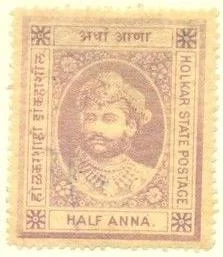
The first half anna, 1886
The first stamp, a half anna, shows Tukoji Rao II. Its date is disputed. Luard’s Gazetteer and Harkawat place it in 1885; Parton and the public catalogue use 1886; and Löwenhielm reproduces P. V. Pandharkar’s translation of a Durbar circular dated 4 January 1886 announcing issue on 6 January. The translated notice is the most specific, but the original circular has not been seen, and Luard’s different year is recorded.[21][23][4]
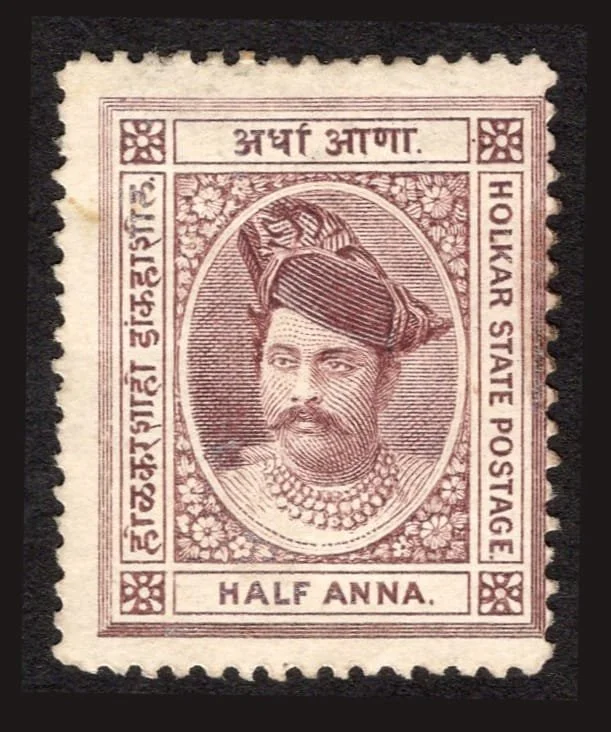
Evans’s account of 1900 describes the portrait as nearly full-face, in an oval framed by floral corners, with English and Devanagari inscriptions. He suggested that an engraved original die was transferred to a lithographic stone; Feldman attributes the lithography to Waterlow & Sons. Evans measured perforation about 15 horizontally and 14¾ vertically on his copies, and warned that thick gum and age could change the apparent paper and colour.[8][13]
The sheets held 64 stamps, eight by eight. Thick and thin papers, shades and transfer flaws divide the issue, but a faded mauve stamp should not be given a printing by its colour alone.[4]
The Waterlow watermark was a sheet mark
F. M. Douie explains the watermark of the thin paper: WATERLOW & SONS LIMITED with LONDON below, usually once in a sheet. The repeats were spaced more widely than a sheet of stamps, so some complete sheets show none of it. Its absence from a stamp, or even a sheet, does not rule out the thin paper. Douie put his thin mauve stamps in Stone B and described Stones C and D as on the same paper; his thick-paper Stone A was provisionally a single setting, without watermark.[26]
Seven transfers behind one stone
Following Douie’s four stones, Löwenhielm identifies Stone C as a setting built from seven intermediate transfers of the original die, each with its own features. His matrix places these types in the 64-stamp sheet, and his multiples filled seven positions left uncertain by Douie. A block or part sheet tells far more than a single shade. He also suggests that the portrait came from a well-known photograph of Tukoji Rao II seated in ceremonial dress, but writes only “probably”.[23]
The corners are not all the same. In 1905 C. A. Howes noticed five-petalled flowers at upper right and lower left and eight-petalled flowers at the other two corners, and suggested rose or cotton and lotus or a daisy-like flower.[24]
The circular provisional
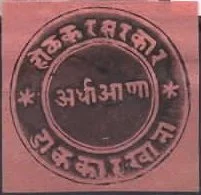
A circular half-anna provisional, black on red paper, has its own design. Harkawat explains that these local impressions were used as adhesives while new portrait stamps were awaited, and links them with an earlier handstruck format. He distinguishes two dies by the form of a Devanagari character in Holkar, the size and spacing of the upper inscription, and the length of the central value inscription, about 14½ mm in one and 15 mm in the other.[4][3]
Evans describes irregular handstruck impressions on pink wove paper, and regards a later, sharper form in oil ink as a reprint. Köhler catalogues a Type I half anna on a folded letter and a Type II on a combination cover to Cannanore with an arrival of 15 April 1890.[8][12]
Shivaji Rao, 1889–1892
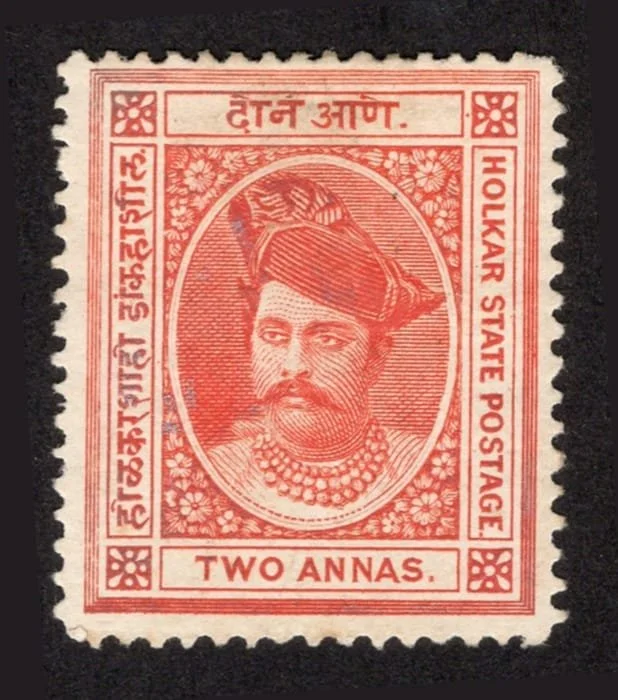
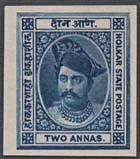
Shivaji Rao succeeded in 1886, and his portrait appears on the family of 1889, recess-printed by Waterlow. Evans separates the smaller Shivaji Rao half anna, reported in 1889, from the quarter, one and two annas added in 1892; Harkawat heads the group 1890–92. Visiting an office in February 1892, Major Adam Smith reported that one- and two-anna supplies had just arrived from the Treasury, and he later received the quarter anna at Mhow; his letter is dated 18 February 1892, and does not settle the catalogue’s 2 January.[15][8][10][4]
StampWorld’s row 4 drops the fraction from its value, but its photograph reads QUARTER ANNA and shows the orange Shivaji Rao portrait with HOLKAR STATE POSTAGE.[11]
Tukoji Rao III and Perkins Bacon, 1904
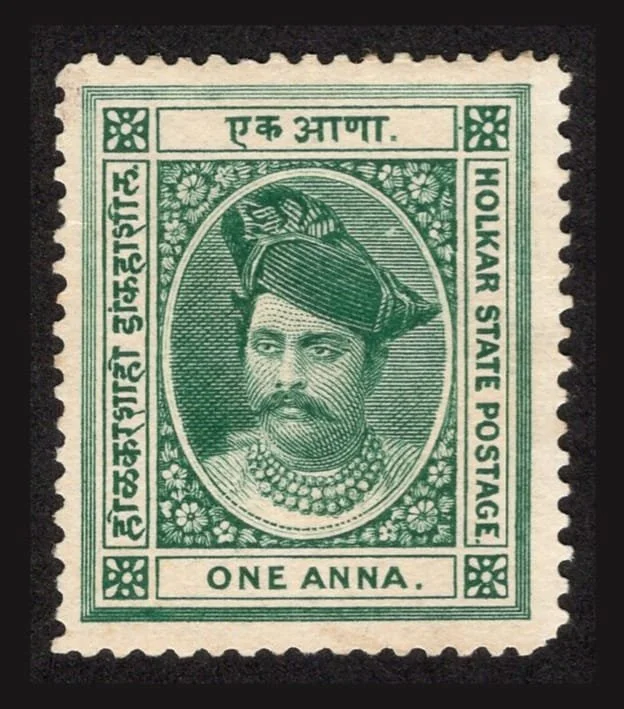
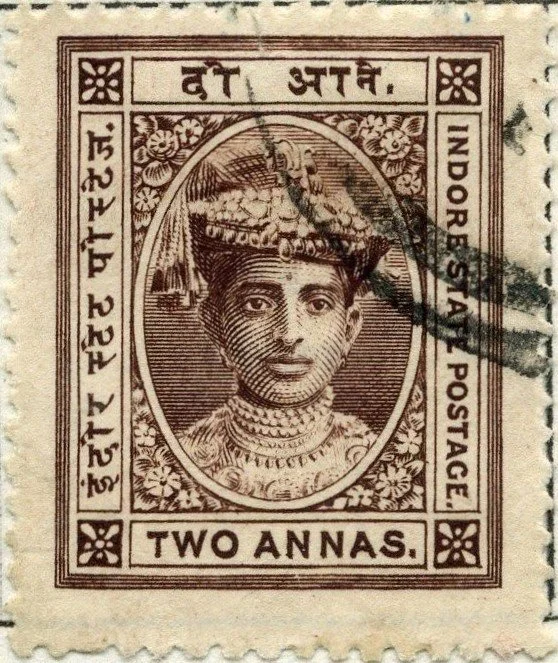
Shivaji Rao abdicated in January 1903, and Tukoji Rao III succeeded as a minor under a Council of Regency. The stamps for his reign were ordered through John Dickinson & Co. John Easton’s extracts from the Perkins Bacon records show Dickinson asking for a quotation on 7 September 1901 and receiving an estimate on 9 December. The pattern sent was Waterlow’s green one anna of 1892. Perkins Bacon quoted for printing direct from steel plates, on unwatermarked paper, in sheets of 80, gummed and perforated.[15][22]
The first order, received on 6 May 1903, was for 200,000 quarter annas. The die was entered in the Engraving Book on 24 June, hardened on 30 June and transferred to the roller on 6 July; the original engraving and hardening books confirm these stages. An order received on 3 October 1903 changed HOLKAR to INDORE after the quarter-anna design was already made, which is why the quarter anna reads HOLKAR and the other values INDORE; the October engraving entry names Dickinson & Co. as the customer for two Indore postage dies. The three- and four-anna colour proofs followed on 30 October. These are manufacturing dates, not dates of issue, and the portrait engraver is not named.[22][36][37][3]
Combs and a paper mark
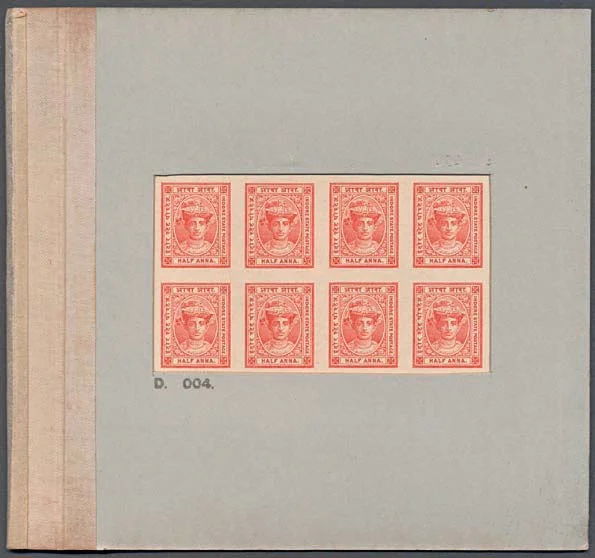
In October 1904 the Gibbons journal described an 80-subject quarter-anna sheet in ten rows of eight with the paper mark Jas. Wrigley & Son L-219. Its comb had teeth almost in line with the long row of holes, while the three- and four-anna stamps showed teeth opposite the gaps: the same nominal gauge can hide different combs.[9]
Writing in 1910 after examining sheets from Whitfield King & Co., Poole reported “Jas. WRIGLEY & SONS LD.—219” on the quarter-anna sheets, in two lines of large double-lined letters and figures across about ten stamps, repeated about 82 mm apart and reading up or down the sheet. Among the other values he found it only on the three annas. His claim that perforation always began on the right was corrected by the editor, who noted more than one machine. Keep this mark apart from Waterlow’s watermark of the first issue.[27]
A quarter anna on half anna provisional surcharge also belongs to this family.[3]
Sources
- [3] Evert Klaseboer, online catalogue, “Indian States, Indore”, portrait, provisional and official listings.
- [4] N. J. Harkawat, The Indore State Hand Book: The Postal History of Indore State from 1829–1950, undated.
- [8] E. B. Evans, “The Stamps of Some of the Native States of India: Holkar,” Stanley Gibbons Monthly Journal, 29 September 1900.
- [9] Stanley Gibbons Monthly Journal, “Holkar” notices, 31 October 1904 and 31 January 1905.
- [10] Major Adam Smith, “A Visit to a Native Indian Post Office,” The London Philatelist, 1892.
- [11] StampWorld, Indore/Holkar postage catalogue, 1890–1899, rows 4–6.
- [12] Heinrich Köhler, auction 377, Gems of Indian States, Indore. Lots 10738–10740, descriptions and illustration comparison.
- [13] David Feldman, Indian Princely States, December 2017, Indore introduction. Indore catalogue introduction.
- [15] C. U. Aitchison, A Collection of Treaties, Engagements and Sanads, Central India Agency, Indore. Indore narrative on succession, 1908 unification, full powers in 1911 and 1923 allowance; 1844 succession sanad.
- [21] Captain C. E. Luard, assisted by Major Ram Prasad Dube, Indore State Gazetteer, vol. II, Text and Tables, Central India State Gazetteer Series (Calcutta: Superintendent Government Printing, India, 1908), pp. 132–133.
- [22] John Easton (extractor), “The Perkins, Bacon Engraving Books 1900–1935”, IX, “Indian States”, Indore (Holkar) section, The London Philatelist, vol. 75 (1966), pp. 177–178.
- [23] Hasse Brockenhuus von Löwenhielm, “The Handsome Prince from Indore”, IND DAK, May 1995, pp.55–58.
- [24] C. A. Howes, “Some Stamp Designs: Indore”, American Journal of Philately, vol. XVIII (1905), pp. 431–434.
- [26] Lieut.-Colonel F. M. Douie, “The First Stamp of Indore”, The Philatelic Journal of India, vol. XLIII, no. 1 (January 1939), pp. 10–13, reprinted from The Philatelic Journal of Great Britain, April 1934.
- [27] Bertram W. H. Poole, “Countries of the World: Holkar—continued,” Gibbons Stamp Weekly, vol. XII (6 August 1910), pp. 131–132.
- [36] Perkins Bacon, Engraving Book, 1899–1905, Royal Philatelic Society London digitisation, flipbook pages 123, 131 and 146–149.
- [37] Perkins Bacon, Hardening Book, 1903–1911, Royal Philatelic Society London, PB-PRINT-136053.
- Christoph Gärtner, 17th auction, Indian States, 7 March 2011, lots 1054–1063, printed plate p.45 and lot descriptions.
Notes 0
Add what you know: a cover or stamp in your collection, a date or source, a correction or a question.
No notes yet.
Sign in to add a note.
Notes show straight away. Keep them kind and about the article; anyone can report one that isn't. House rules
