
Jasdan’s Two Posts: State Tapal and the Darbari Tapal of 1942–1948
The older State Tapal of runners and bullock carts, Gangaram’s plan of 1940, the Darbari Tapal opened on 15 March 1942, its twelve groups, its one-anna petition charge and its end in 1948.
Updated November 9, 2026
In this article
Jasdan’s one-anna stamp of 1942 did not create the state’s first means of carrying letters. It belonged to a new service for the public, set up beside an older post for official papers, and the orders that created it survive in English versions.
State Tapal before the adhesive
In his two-part study of 1985, P. M. Medhora separated the older State Tapal from the later Darbari Tapal. The State Tapal carried administrative papers and public petitions through village staff and a Khatara service, which he describes as bullock-cart transport. Watchmen could carry the post by day while keeping their night duties, an arrangement reported as a cause of delay and fatigue.[15]
The records quoted in that study name an organiser: Gangaram, Fozdar of Jasdan. His scheme of 30 September 1940 arranged eight circles in the Jasdan division. The route through Moti Aniyali linked cart transport with carriers from Kanesara, Kunani and Barwala on Tuesdays, Thursdays and Saturdays. This was an earlier administrative post, not an earlier issue of stamps.[15]
The orders that opened the Darbari Tapal
Medhora prints English versions of the orders introducing the new service. A draft submitted on 20 January 1942 was approved on 22 January. Its purpose was to let residents send letters and petitions to the ruler and the state’s officials without travelling to Jasdan in person. The detailed group instructions, Order No. 122, carry a separate footer date of 27 January 1942. Order No. 152, dated 6 March, directed that the stamps and cancelling devices come into use on 15 March 1942.[15][16][10]
A notice in The Philatelic Journal of India of April 1944, expressly based on information supplied by Jasdan’s Diwan Sahib, confirms the date. It says the Darbari postal system began on 15 March 1942, that offices worked at Jasdan, Vinchhia and ten villages, and that only letters were carried. It named L. V. Indap & Co. of Bombay as the printer, said the stamps were issued in booklets of 200, and gave 13,000 stamps printed to date. Medhora’s study of 1985 quotes a reply from the Dewan received on 25 February 1944 giving the same starting date and coverage. Neither source makes 1942 the beginning of the older State Tapal, and the notice and the reply may both draw on the same information from the Diwan.[15][16][10]
Twelve groups and two head offices
The scheme of 1942 names twelve groups: Jasdan, Vinchhia, Kamalapur, Pipardi, Lilapur, Hingolgadh, Kalasar, Shivrajpur, Madhuka, Jasapur, Motilakhavad and Kothi. Jasdan and Vinchhia were the head offices. Village collection relied on officers already in place: schoolmasters, a Kothari at Hingolgadh and the Patel at Motilakhavad. Medhora’s spellings vary, particularly for Madhuka and Jasapur.[15][16]
This administrative list is not the same as a collector’s list of office names seen in postmarks. A group, a village served by it and a surviving office mark are different things, and the twelve groups should be kept beside, not merged into, the six office marks recorded later (see below).[15][16]
| Group | Officer responsible | Onward dispatch | Note |
|---|---|---|---|
| Jasdan | Head post office; Jagaldar in the earlier order | Not stated in the group table | |
| Vinchhia | Jagaldar | Incoming group mail forwarded to Jasdan at the earliest opportunity | |
| Kamalapur | Headmaster of the Camp School | Daily Khatara service to Jasdan | |
| Pipardi | Schoolmaster | Daily to Vinchhia | |
| Lilapur | Schoolmaster | Combines its own mail with Kalasar’s daily mail and sends it to Jasdan | |
| Hingolgadh | Kothari | Daily to Jasdan | |
| Kalasar | Schoolmaster | Daily to Lilapur | |
| Shivrajpur | Schoolmaster | Daily to Jasdan | Also Shrivrajpur in the earlier order |
| Madhuka | Schoolmaster | Monday, Wednesday and Friday to Vinchhia | Printed as Methuda in the first order and Mothuka in a heading |
| Jasapur | Schoolmaster | Wednesday and Sunday to Jasdan | Jasapar in the first order; not to be confused with Jaspur elsewhere |
| Motilakhavad | Patel | Wednesday and Sunday, among the feeders to Vinchhia | Name printed in compact forms |
| Kothi | Schoolmaster | Monday, Wednesday and Friday to Jasdan |
How the letters moved
The order separates collection in the villages from onward dispatch. Villages generally sent their post to the group officer on Wednesdays and Sundays. Pipardi forwarded to Vinchhia daily, Madhuka on Mondays, Wednesdays and Fridays, and mail reaching Vinchhia went on to Jasdan at the earliest opportunity.[15]
Kamalapur had a daily Khatara service to Jasdan. Kalasar sent its mail daily through Lilapur, which added it to its own dispatch. Hingolgadh and Shivrajpur also forwarded daily to Jasdan; Kothi sent on Mondays, Wednesdays and Fridays, and Jasapur on Wednesdays and Sundays. These are the services the order prescribed, not timings worked out from surviving covers.[15]
A one-anna petition and a stamp for the reply
The January order required a one-anna Darbari stamp on a closed cover carrying a letter or petition to the authorities. A sender who wanted a written answer had to enclose another one-anna stamp for the reply. This is a documented charge for that service, not a general letter tariff guessed from the stamp’s face value.[15][16][10]
Medhora adds that two letters for different people could not be enclosed together and that currency notes were forbidden; breaking either rule cost double postage. The notice of 1944 and the Dewan’s reply both describe a service for letters only. No scale of weights, registration fee, parcel tariff or rate for mail leaving the state is known from these sources.[15][16][10]
Cancellation rules and actual practice
Each principal village was to receive a rubber stamp with the office name and a date stamp, with instructions to cancel the adhesive itself before sending the cover on. Group officers had to account every month for stamps sold and in stock, and for mail received, forwarded and delivered.[15][16][12]
Surviving covers did not always follow the rule. Medhora’s illustrations of 1985 from Pipardi and Shivrajpur show the large office marks struck away from the stamps, which he pointed out himself. His article of 1990 illustrates English circular marks on a cover described as sent from Vinchhiya on 24 June 1944 and received at Jasdan on 26 June; he thought these were apparently made by a metal die. That is an exception attributed by one writer, but enough to show that not every Jasdan cancellation is a large Gujarati rubber seal.[15][16][12]
A service with little demand
Medhora cites the Jasapur schoolmaster’s account for July 1942: no Darbari stamps had been sold that month, and stamps worth three rupees twelve annas were still in stock. Officials told him to explain the service to the villagers. It is one example of weak local demand, not a figure for every office.[16]
The study also records an enquiry from the Dewan of Porbandar on 12 October 1943 and Jasdan’s reply of 14 November. Another state was interested in the scheme; that does not show that Porbandar adopted Jasdan’s stamps or ran the same kind of service.[16]
Post offices and their marks
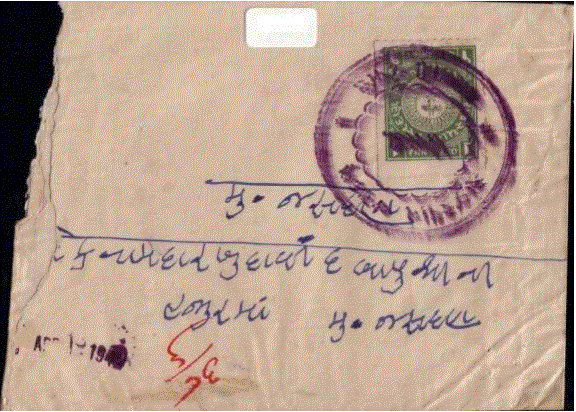
Medhora’s later account reports twelve state offices, but he had seen marks from only six: Jasdan, Jaspur, Pechhicha, Pipardi, Shivrajpur and Vinchhia. That is a list of the marks he had seen, not a register of twelve offices. The large double-circle devices carry Gujarati postal wording with the office name in the centre. Dates may be added by hand in English or Gujarati, and violet strikes also occur.[1]
Office seal, date mark and stamp are separate evidence
On both the Shivrajpur cover of 1944 and the Pipardi cover of September 1948, shown to Medhora by S. C. Sukhani, the large office postmark was not on the stamp. The stamps carried separate rubber-stamped dates, in violet ink. In neither case does a large office seal tie the stamp to the envelope.[1]
His Pechhicha single of 19 January 1948 is different: its date was written in by hand in Gujarati. His Jaspur block of six is described as cancelled to order, apparently part of a pane of eight. Office seal, date and kind of use are three separate things to record, and there was no single format for Jasdan mail. A cancelled-to-order block and a cover that travelled belong to different categories even when they show the same stamp and office. Where a day or month on these items is unclear, it is not supplied here.[1]
Why the closing date is still uncertain
Medhora’s study of 1985 says the Darbari Tapal ended on 15 February 1948, and records that a dealer’s order dated 17 February was refused. That is more specific than the date of the political merger, but it conflicts with the use at Pipardi in September 1948 reported in the later extract. The end of the service, later sales of stamps and possible later use have to be kept apart until the original dated evidence is reconciled.[16][1]
A cover from Vinchhia to Jasdan carrying sixteen stamps adds a further problem. Medhora’s caption of 1985 gives 5 September 1943; his description of 1990 gives 5 September 1946. The two illustrations appear to show the same cover, with the same arrangement of panes, the same damage at the left and the same cancellations. Feldman’s sale of 2010, lot 60044, gives 5 September 1948 while quoting the 1943 caption. The three years conflict and cannot be settled from the poor reproductions.[16][12][17]
Sources
- [1] P. M. Medhora, “The Stamps and Postmarks of Jasdan State”, undated revised three-page extract, pp. 1–3 (a later, different version of the 1972 article).
- [6] Indrajit Chatterjee, “Philately – Pre-SG 1 Jasdan”, Prinseps, online reproduction of an earlier study, with the Indap sample-sheet photograph.
- [10] “Jasdan State”, The Philatelic Journal of India, April 1944, p. 30 (unsigned report based on information supplied by the Diwan Sahib of Jasdan; the masthead prints vol. XLIX, no. 4).
- [12] P. M. Medhora, “Some Interesting Items of Jasdan”, India Post, vol. 24, no. 4 (no. 106), October–December 1990, pp. 118–120.
- [15] P. M. Medhora, “State Tapal and Darbari Tapal of Jasdan State”, part 1, India Post, vol. 19, no. 1 (no. 83), January–March 1985, pp. 6–10.
- [16] P. M. Medhora, “State Tapal and Darbari Tapal of Jasdan State”, part 2, India Post, vol. 19, no. 2 (no. 84), April–June 1985, pp. 48–51.
- [17] David Feldman, Rarities auction, 21 May 2010, lot 60044, India Feudatory States, Jasdan.
Notes 0
Add what you know: a cover or stamp in your collection, a date or source, a correction or a question.
No notes yet.
Sign in to add a note.
Notes show straight away. Keep them kind and about the article; anyone can report one that isn't. House rules
