About this stamp
The Man Who Made Biogas Practical
Dr Ram Bux Singh (1925–2016) spent his working life showing that cow dung and farm waste could give a village household clean cooking fuel and good fertiliser at the same time. His simple, low-cost gobar gas (biogas) plants were copied across India and in more than fifteen other countries.
Early Life
He was born on 13 August 1925 at Ramnagar in Sitapur district, Uttar Pradesh, and trained as a mechanical engineer. On 9 September 1957 he built his first gobar gas plant at Ramnagar, and soon afterwards the state government asked him to make biogas plants simpler and cheaper to build.
Gobar Gas Research Station, Ajitmal
For 16 years he was Officer-in-Charge of the Gobar Gas Research Station at Ajitmal (then in Etawah district, now in Auraiya), which India Post calls Asia’s first. It came under the Planning, Research and Action Division (PRAD) of Uttar Pradesh’s State Planning Institute in Lucknow. The station’s plant was in full working order by 1960. There he tested designs and materials, trained masons and farmers, and wrote practical manuals. His books include Can Cow Dung Fuel Your Home? (1972) and Bio-gas Plant: Generating Methane from Organic Wastes (1974), published by the research station and still read by people building small plants today. The Library of Congress in the United States holds Bio-gas Plant in its catalogue.
Work Around the World
In June 1972 he went to the United States and helped set up one of the first biogas plants there. An American magazine interview that year called him perhaps the father of methane development in the United States. He later advised the US Department of Agriculture and worked as a biogas consultant for United Nations programmes in Asia and Latin America. Altogether he worked on biogas and renewable energy in more than 15 countries, among them Denmark, the United Kingdom, Germany, Mexico, Costa Rica and Canada, and his work was cited in a 1975 United States Senate report.
He died in Lucknow on 18 September 2016. On 26 September 2023 the National Archives of India acquired his papers: his credentials, files, newspaper and journal cuttings, photographs and books in Hindi and English. They have been digitised and can be read on the Archives’ Abhilekh Patal portal. His work on biogas is also included in NCERT school textbooks.
The Commemorative Stamp
Design
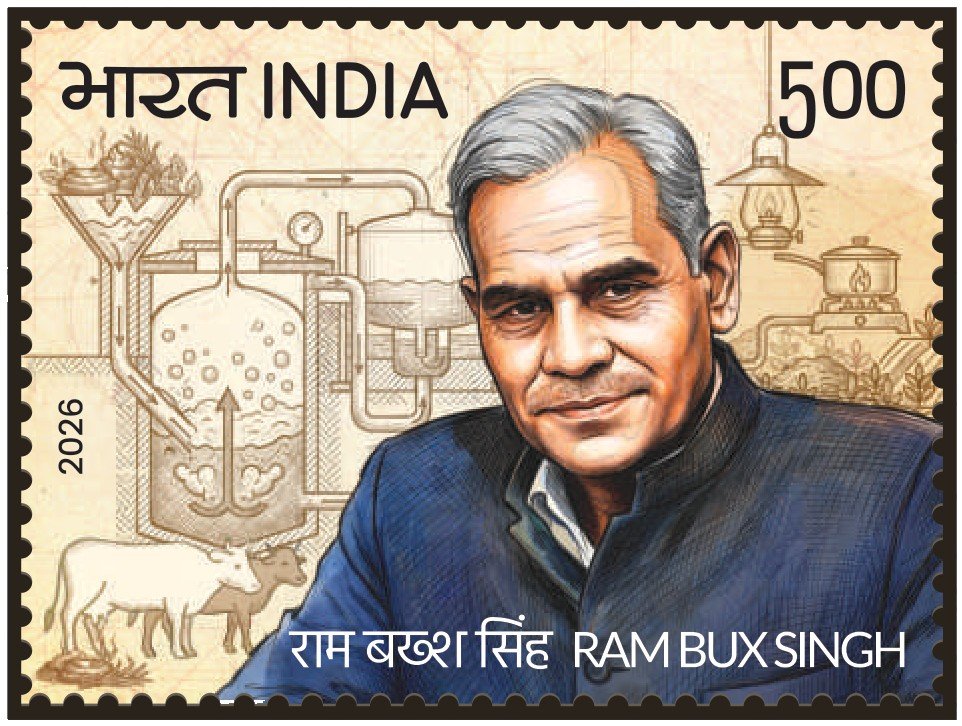
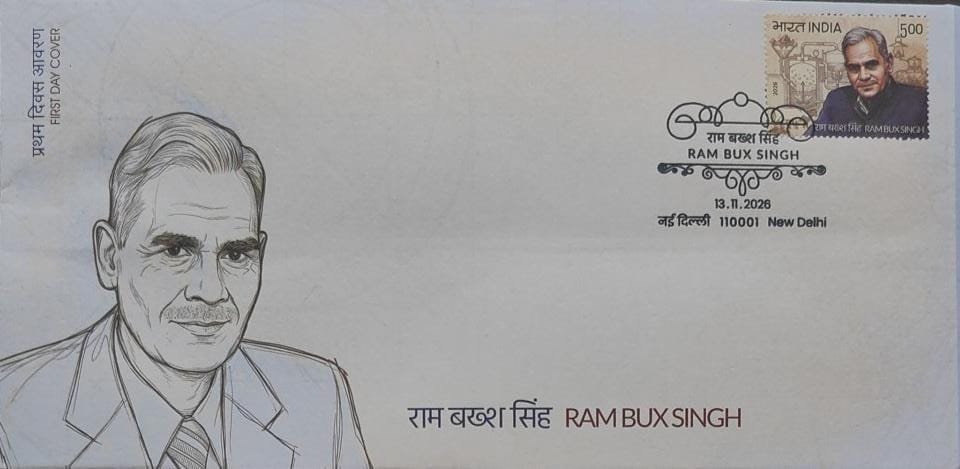
The Rs. 5 stamp shows Dr Ram Bux Singh’s portrait in front of a drawing of a biogas plant: waste going in at the inlet, gas bubbling up in the digester and pipes carrying it away. Cattle, a lamp and a cooking stove at the edges show where the dung comes from and what the gas is used for. His name is printed in Hindi and English. The first day cover carries a pencil portrait of him, and the first day cancellation is from New Delhi 110001. Shri Kamleshwar Singh designed the stamp, the first day cover, the brochure and the cancellation cachet.
Release
India Post’s Philatelic Advisory Committee approved the stamp in November 2024 for his birth centenary. It was released on 13 November 2026 at the Minister’s residence in New Delhi by Ramdas Athawale, Union Minister of State for Social Justice and Empowerment, together with Col. Akhilesh Kumar Pandey, Chief Postmaster General, Delhi Circle.
Security Printing Press, Hyderabad printed 303,425 stamps by wet offset.
For More Information
Read more here:
- India Post: stamp brochure (PDF)
- PIB: India Post releases commemorative postage stamp honouring Ram Bux Singh
- UNI: Postage stamp issued in honour of biogas pioneer Dr Ram Bux Singh
- PIB: National Archives of India acquires Dr Ram Bux Singh’s collection
- Mother Earth News (1972): interview with Ram Bux Singh
- Wikipedia: Ram Bux Singh