About this stamp
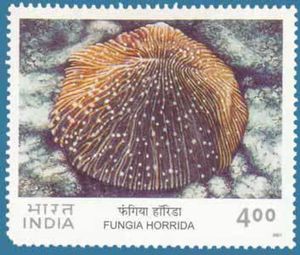
The Mushroom Coral (Fungia horrida) is a fascinating species of free-living stony coral belonging to the family Fungiidae. Unlike many corals that are attached to the reef substrate, Fungia horrida can move independently on the sea floor, which is one of its distinctive traits.
Key Characteristics of Fungia horrida:
- Shape: Fungia horrida is known for its solitary, disc-like shape that resembles a mushroom, hence its common name. The coral is typically flat or slightly dome-shaped, with a central depression or mouth at its center.
- Size: It can grow up to 20 to 30 centimeters in diameter, with thin, radially arranged septa (ridges or plates) extending from the center to the outer edge.
- Surface Texture: The surface of the coral is covered with numerous spines or tentacles, giving it a slightly rough or “horrid” appearance, which is the basis for its species name, horrida.
- Color: The color of Fungia horrida varies and can include shades of brown, green, purple, or even pink, often with a metallic or glossy sheen.
Habitat and Distribution:
- Fungia horrida is primarily found in tropical reef environments and is typically located in shallow waters, although it can survive at depths of up to 40 meters.
- This species is widespread in the Indo-Pacific region, including the Red Sea, Indian Ocean, and the waters around Southeast Asia and Australia.
Unique Features:
- Free-Living Coral: Unlike most corals that are permanently attached to a hard surface, Fungia horrida is a free-living coral that rests on the substrate. It can move slightly by inflating or deflating its tissue, allowing it to adjust its position in response to environmental changes such as light or sedimentation.
- Feeding: Fungia horrida is both a photosynthetic coral and a carnivore. It houses zooxanthellae, the symbiotic algae that provide nutrients through photosynthesis. Additionally, it captures plankton and small particles from the water using its tentacles.
Ecological Role:
- Reef Structure: Though free-living, Fungia horrida contributes to the complexity of the reef structure by providing habitat and shelter for small fish, invertebrates, and other marine life.
- Resilience: This coral is known for its resilience, as it can recover from physical damage by regenerating tissue. Its free-living nature allows it to avoid burial by sediment, as it can move to more favorable conditions.
Conservation Concerns:
- Fungia horrida, like other coral species, faces threats from ocean warming, coral bleaching, pollution, and habitat destruction. These factors, exacerbated by climate change, can lead to declines in coral health and biodiversity.
Protecting species like Mushroom Coral is crucial for maintaining the ecological balance and biodiversity of coral reefs.
For More Information
Read more here: