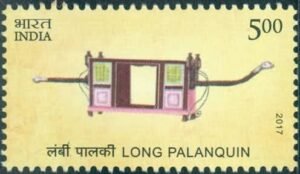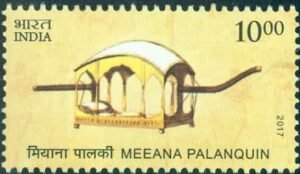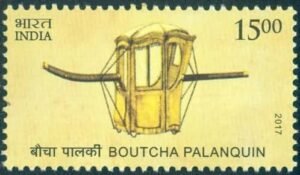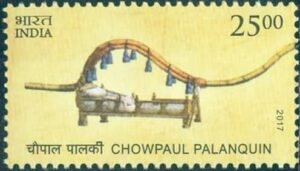

About this stamp
Commemorative Postage Stamp Series
From ancient times, mobility has played a vital role in the growth of civilization. Among the earliest and most distinguished means of transport in India was the Palanquin, popularly known as the Palki. As part of the Commemorative Postage Stamp Series on Indian Transport, the Department of Posts beautifully depicts various traditional models of palanquins, highlighting their cultural and historical importance.
Origin and Design
The word Palanquin is derived from the Sanskrit term “Palanki,” meaning a bed or couch. True to its name, a palki resembled a covered wooden cabin designed for comfortable travel.
A typical palanquin featured:
- A sturdy wooden structure
- Doors or curtains on both sides
- Decorative carvings and ornamental designs
- A long cylindrical pole attached lengthwise
It was usually carried by four or six bearers, who transported the passenger on their shoulders.
Historical and Cultural Significance
Palanquins were widely used in ancient and medieval India. References to their use can be found in early Indian literature, including the Ramayana. Over time, the palki became a symbol of prestige and dignity.
During medieval India, palanquins served as:
- The primary mode of travel for royal families and noblewomen
- A common conveyance for landlords and wealthy citizens
- An essential part of traditional wedding ceremonies
Beyond transportation, the palki reflected social customs, craftsmanship, and the hierarchical structure of society.
Decline and Legacy
With the introduction of rickshaws in the late 19th century and the expansion of modern road transport systems, the use of palanquins gradually declined. By the early 20th century, they had largely disappeared from daily life and remained only for ceremonial purposes, especially in weddings and religious events.
Philatelic Tribute
The set of four commemorative postage stamps on Palanquins forms part of the larger 20-stamp Indian Transport series. These stamps artistically showcase different models of palkis used across regions and periods, preserving an important chapter of India’s transport heritage.
For philatelists and history enthusiasts, this issue serves as a tribute to one of India’s earliest organized modes of human transport — a symbol of tradition, craftsmanship, and the beginnings of structured mobility in the country.
For More Information
Read more here: