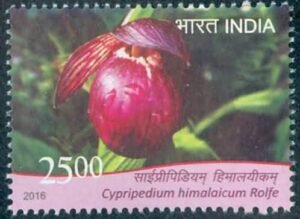

About this stamp
The Jewel Orchid of the Eastern Himalayas
The Emeralda cathcartii is one of India’s most exquisite and rare orchid species, celebrated for its delicate beauty, vivid colouring, and ecological significance. Endemic to the Eastern Himalayas, this orchid graces the moist, misty slopes of Arunachal Pradesh, Sikkim, and parts of Assam, thriving amidst the dense canopies of evergreen forests. Known for its refined elegance and adaptability to high-altitude environments, Emeralda cathcartii represents the fragile balance of India’s montane ecosystems and the splendour of its floral diversity.
Habitat and Distribution
Emeralda cathcartii grows naturally in cool, humid montane forests at elevations ranging from 1,200 to 2,400 metres. It is primarily epiphytic, often seen clinging gracefully to moss-laden branches of oak and rhododendron trees, or occasionally terrestrial on leaf-littered forest floors. The orchid’s habitat is characterised by filtered sunlight, high humidity, and steady moisture, conditions essential for its growth and blooming. Its presence in the Eastern Himalayas makes it a biological indicator of pristine forest health and ecological stability.
Botanical Description
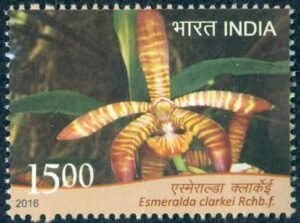
This beautiful orchid is recognised by its graceful arching stems and clustered blossoms, which range in colour from soft yellow-green to golden hues with a distinct white lip and purple markings. The sepals and petals are often translucent with fine veining, giving the flowers a luminous, ethereal appearance.
The plant’s leaves are smooth, lanceolate, and bright green, adding to its visual charm. Flowering typically occurs from April to June, when the cool Himalayan air and mist support abundant blooms. Each flower, though delicate, endures for several weeks, showcasing nature’s fine craftsmanship and resilience.
Ecological Importance
Emeralda cathcartii plays a significant role in the biodiversity of the Himalayan ecosystem. As an epiphytic orchid, it supports and benefits from its host trees without harming them, contributing to nutrient cycling and microhabitat formation for other organisms. Its intricate flower structure attracts specialized pollinators, such as bees and small flies, illustrating the remarkable interdependence between plant and pollinator species in mountain ecosystems.
Conservation and Threats
Over the years, Emeralda cathcartii has become increasingly vulnerable due to habitat loss, deforestation, climate change, and unsustainable collection for ornamental trade. The species is now regarded as threatened, with conservationists emphasizing the importance of in-situ preservation in protected forest areas and ex-situ propagation in botanical gardens. Community-based orchid conservation initiatives and eco-tourism awareness programmes have been key to protecting this delicate Himalayan treasure.
Commemorative Postage Stamp
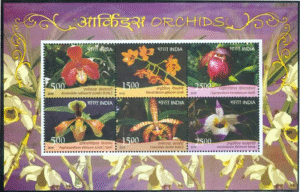
In recognition of India’s rich orchid heritage, the Department of Posts proudly releases a commemorative postage stamp on Emeralda cathcartii as part of its “Orchids of India” series. The stamp artistically portrays the orchid’s vibrant petals and graceful form, symbolising the harmony between nature and human admiration. It stands as a tribute to the nation’s commitment to biodiversity conservation, celebrating both scientific significance and natural beauty.
A Symbol of Himalayan Grace
The Emeralda cathcartii stands as a living jewel of the Eastern Himalayas, representing purity, resilience, and ecological harmony. Its rare elegance and enduring grace remind us of the delicate balance of mountain ecosystems and the need for sustained conservation efforts. Protecting such species ensures the survival of the Himalayan floral legacy, preserving India’s natural splendour for future generations to cherish.