
British India Postal Rates, Services and Regulations
The letter scale of 1854 in tolas, the changing weight a half anna bought, parcels by distance, the Postal Guide of 1875, registration, redirection and the 1935 schedule.
Updated May 30, 2026
In this article
The inland letter scale of 1854
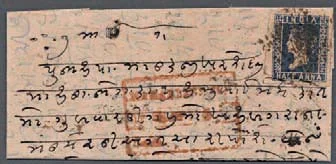
Clarke reproduces the letter scale of 1854, the starting point that tables beginning in 1866 leave out. Half an anna paid up to a quarter tola; one anna, over a quarter and up to half a tola; two annas, over half and up to one tola. The next half-tola steps cost three annas up to 1½ tolas and four annas up to two tolas, and above two tolas two more annas were charged for each further tola.[1]
The upper limit belongs to the cheaper step: a letter of exactly half a tola paid one anna, not two. Keep those limits exact when you reconstruct a franking. Elsewhere in his account Clarke gives the tola as about two-fifths of an ounce; keep the tola rather than quietly treating it as an ounce.[1]
| Weight | Postage | In pies |
|---|---|---|
| Not over ¼ tola | ½ anna | 6 |
| Over ¼, not over ½ tola | 1 anna | 12 |
| Over ½, not over 1 tola | 2 annas | 24 |
| Over 1, not over 1½ tolas | 3 annas | 36 |
| Over 1½, not over 2 tolas | 4 annas | 48 |
The same half anna paid for different weights
Clarke’s chapter IV (pp. 38–47) gives a sequence of inland letter rates that shows the danger of talking about “the half-anna rate” without a date. In 1866 six pies paid for a letter of up to a quarter tola; in 1869, up to half a tola; in 1905, up to three-quarters of a tola; in 1907, up to one tola. Six pies and half an anna are the same money, but what they bought changed.[1]
The one-anna step changed even more in 1907: up to ten tolas could then go for one anna, where, Clarke reckons, a ten-tola letter had needed seven annas before. In 1918 the one-anna limit came down again to 2½ tolas. A heavy-looking envelope with one anna on it may fit the rules of 1907 and fail those of 1918.[1]
| Scale | Most weight for ½ anna | Most weight for 1 anna |
|---|---|---|
| 1866 | ¼ tola | ½ tola |
| 1869 | ½ tola | 1 tola |
| 1905 | ¾ tola | 1½ tolas |
| 1907 | 1 tola | 10 tolas |
| 1918 | 1 tola | 2½ tolas |
A worked comparison
Take an ordinary inland letter weighing two tolas. Under the scale of 1905 it is over 1½ and not over three tolas, so it needs two annas. Under the scale of 1907 it is over one and not over ten tolas, so it needs one anna. Under the scale of 1918 it still needs one anna, but now the next step begins just above 2½ tolas.[1]
That is a sum worked from the published scales, not a description of a cover. Most surviving envelopes have lost their contents and so their weight. If an explanation depends on a higher weight step, give it as a likely reconstruction, unless a note of the weight or a surviving enclosure makes the case stronger.[1]
Letters, newspapers and parcels have different tables
In Clarke’s account the newspaper scale of 1898 begins at a quarter anna for up to four tolas; it is not the letter scale. Parcels kept their distance bands after letter postage had become uniform: only in 1871 did inland parcel charges stop depending on distance. A total of stamps alone cannot tell you the class.[1]
Registration, insurance, express handling and conveyance overseas could add fees or bring different conditions. The tables above give only some of the inland letter steps that Clarke quotes, not a day-by-day tariff to 1947. Exact dates of change, foreign destinations and special services need the Postal Guide or notification of the time for the item in question.[1]
Parcels kept distance after letters were made uniform
Clarke’s parcel table of 1866 charges a parcel of up to twenty tolas four annas for up to 300 miles, eight annas up to 600, twelve up to 900 and one rupee up to 1,200. A parcel of the same weight could therefore need different postage according to its route, and its amount cannot be checked against a letter table.[1]
His chapter on parcels dates the reform that removed distance to 1871, at three annas for every ten tolas, and separates the weight limits on foot lines from those on the railways. A service name is not enough: the class, the weight, the route and that year’s permitted maximum all belong to the explanation. These figures are examples from history, not every later parcel scale.[1]
The parcel increase of 1918 and the change of 1919
The scale of 1918 quoted by Clarke begins at two annas for twenty tolas, then four annas for forty, and four annas for each further forty tolas or part. He describes complaints that the increase hurt the fruit trade and other local business. From 1 June 1919 the forty-tola step was cut to three annas, up to 440 tolas, while the minimum of two annas for twenty tolas stayed.[1]
For an imagined parcel of thirty tolas, that changes the charge from four annas under the scale of 1918 to three under the revision of 1919. The sum shows why an exact date matters near a change of tariff: a cover dated only to a reign cannot show which of two neighbouring scales applied.[1]
A dated reference: the Postal Guide of 1 June 1875
The Indian Postal Guide of 1 June 1875 gives the instructions of its own day. Its inland table charges six pies, or half an anna, for a letter of up to half a tola; one anna over half a tola and up to one tola; two annas over one and up to two tolas; and then one anna for every further tola. These are the letter columns of a table that also gives newspaper, parcel and packet charges, and reading across the wrong column can give a plausible but wrong explanation.[2]
“Inland” was an administrative category, not just travel over land. A footnote includes certain Indian contract-steamer services to British Burma and the Indian post offices in the Persian Gulf, while separating other sea services. Identify the offices and the conveyance before applying the inland scale to a letter that went by sea. The edition’s date gives a reliable snapshot, but not the first or last day on which each of its rules applied.[2]
What the addressee owed in 1875
Clause 3 (p. 3) separates an unpaid letter from a partly prepaid one. An unpaid letter was charged twice the prepaid postage; a letter with too little prepaid was charged twice the deficiency — twice what was missing, not twice the whole proper postage. A mark of an amount due cannot be read simply by adding it to the stamps and calling the total the ordinary rate.[2]
Take an imagined ordinary inland letter of three-quarters of a tola under this edition. The right prepaid postage is one anna. With a half-anna stamp, the deficiency is half an anna and one anna is collected; with no stamp, two annas are collected. These are worked examples of the rule; on a real cover, missing contents, lost stamps and later redirection can all complicate the sum.[2]
| Already paid | Proper prepaid postage | Charged on delivery |
|---|---|---|
| 1 anna | 1 anna | Nothing |
| ½ anna | 1 anna | 1 anna: twice the deficiency of ½ anna |
| Nothing | 1 anna | 2 annas: twice the unpaid postage |
Four annas for registration bought a separate service
Section V (pp. 58–59) requires four annas for inland registration on top of the postage, both fully prepaid in stamps. The article had to be handed in at the counter: writing “registered” on a cover and putting it in the letter box did not buy the service, and the letter was normally treated as unregistered unless the rule of compulsory registration applied. Registration also closed earlier for each mail, so a cover handed in less than half an hour before closing could get a too-late mark and wait for the next dispatch.[2]
Under these rules a properly registered inland letter of up to half a tola needed 4½ annas, and one of over half and up to one tola five annas: two charges added together, not new letter steps. The Guide describes signed receipts as the article passed between postal officers, and a receipt for the sender, but expressly denies government responsibility for loss or damage under the Act. Registration was not insurance.[2]
Compulsory registration could lead to a different charge. Clause 8 covers letters containing coin or currency notes, including parts of notes, and certain other valuables when their presence was obvious or known. If a letter that should have been registered was found unregistered on the way, a double registration fee was collected on delivery, on top of any other postage due — eight annas for that part alone. That rule does not mean every business letter, cheque enclosure or unexplained eight-anna mark was treated so.[2]
Redirection could add postage to a fully paid letter
Section IV (pp. 57–58) charges forward postage when a letter is redirected from its original destination, on top of any postage paid or due, and each further redirection could add another charge. The footnote sets this at the prepaid rate for a fresh posting from the redirecting office, so a fully paid half-tola letter could pick up an extra half anna when sent on — a quite different operation from doubling a deficiency.[2]
The exceptions matter. Forwarding between a head office and its branch or district offices, or between offices under the same head office, was free, and the Guide also exempts certain soldiers’ letters and says which ranks and circumstances qualify. A changed address is not enough to show either a charge that had to be made or a clerk’s omission: record the redirecting office, the new destination, any military entitlement and the order of the marks before deciding what should have been collected.[2]
Two meanings of “registered”
In the newspaper rules (p. 3), registration means that the authority of the postal circle had recognised a periodical for a postal concession — not payment for registered handling of a single letter. The rules of June 1875 require, among other conditions, publication at intervals of no more than 31 days, full prepayment, an open wrapper or none, the printed registration designation and number just above the address, and posting at the place of publication.[2]
That changes what a wrapper can show. A printed newspaper registration number does not prove payment of the four-anna fee for registering a letter, and the rule for unpaid letters does not apply automatically either: the Guide sends an unpaid or underpaid registered newspaper that otherwise qualifies for its class to the Dead Letter Office. Decide the class and whether it complied before doing the arithmetic.[2]
A law may leave the detail to rules
Clarke calls the Post Office Act of 1898 largely an enabling measure, leaving many practical questions to rules. Finding the year of the Act does not mean finding the rate: an office instruction, a Gazette notice or an edition of the Postal Guide may hold the conditions that explain a particular posting.[1]
He also notes that official postal marks were treated in law as prima facie evidence of refusal, of an addressee not found or of an amount due. Those marks record administrative outcomes, but their exact effect has to be read in the regulation that applied. Postal history is clearer when the mark, the tariff and the legal rule are kept together.[1]
Official scales and Imperial Penny Postage
The same history records a separate official scale of 1873: half an anna up to half a tola, one anna up to ten tolas, then five annas up to twenty and ten annas up to thirty, with five annas for each further ten tolas. It also says government offices were to prepay official covers with service stamps. This generous one-anna limit comes before the ten-tola step for ordinary letters in 1907, and the official category stops it looking like an early use of the later public rate.[1]
For mail abroad Clarke dates India’s Imperial Penny Postage to 1899, with one anna at first paying for half an ounce to the United Kingdom and certain British possessions, and records the weight raised to one ounce in 1907. Those are particular destinations and conditions, not a one-anna rate for everywhere overseas.[1]
The 1935 schedule: a legal ceiling, not a tariff history
The Indian Finance Act of 1935 shows another trap. Its preamble speaks of maximum postal rates, and section 4 inserts a schedule for the year beginning 1 April 1935. The letter entries are one anna up to half a tola; one anna three pies over half a tola and up to 2½ tolas; and one anna three pies for each further 2½ tolas or part. A single postcard is nine pies.[3]
These figures give what the schedule contains, not every charge actually made or the day it began. Neither the Act’s date of 22 April nor the start of the financial year proves when a particular rate came into use; that needs the Postal Guide and the notification of the time. The Act carries the story beyond Clarke’s period, without pretending to give an unbroken tariff up to 1947.[3]
Sources
- [1] Geoffrey Clarke, The Post Office of India and Its Story, John Lane/The Bodley Head, London, 1921, chapters III–V.
- [2] Indian Postal Guide, No. IX, 1 June 1875, Calcutta: Office of the Superintendent of Government Printing, 1875, pp. 2–3 and 57–59.
- [3] Indian Finance Act, 1935, 22 April 1935: preamble, section 4 and First Schedule.
Notes 0
Add what you know: a cover or stamp in your collection, a date or source, a correction or a question.
No notes yet.
Sign in to add a note.
Notes show straight away. Keep them kind and about the article; anyone can report one that isn't. House rules
