
Chamba Stationery and Covers: the Sun on the Cards, a London Letter and Air Mail
Chamba’s overprinted cards with a brown or black sun, used cards of 1889 and 1901, a 1903 cover to the Royal Geographical Society and two air-mail covers of 1933–34, and how to read a Chamba cover.
Updated August 11, 2026
In this article
A sun on the stationery
The convention supplied overprinted cards and embossed envelopes as well as stamps. Colonel Jayanta Dutta and Dr Anjali Dutta illustrate a quarter-anna card classed as 1886 with a brown sun, an official quarter-anna card of 1888 with a black sun and SERVICE, and a reply card of 1888 with a black sun. These are their classifications, separate from the red trial for the stamp overprint, and who designed or cut the sun is not known.[15][9]
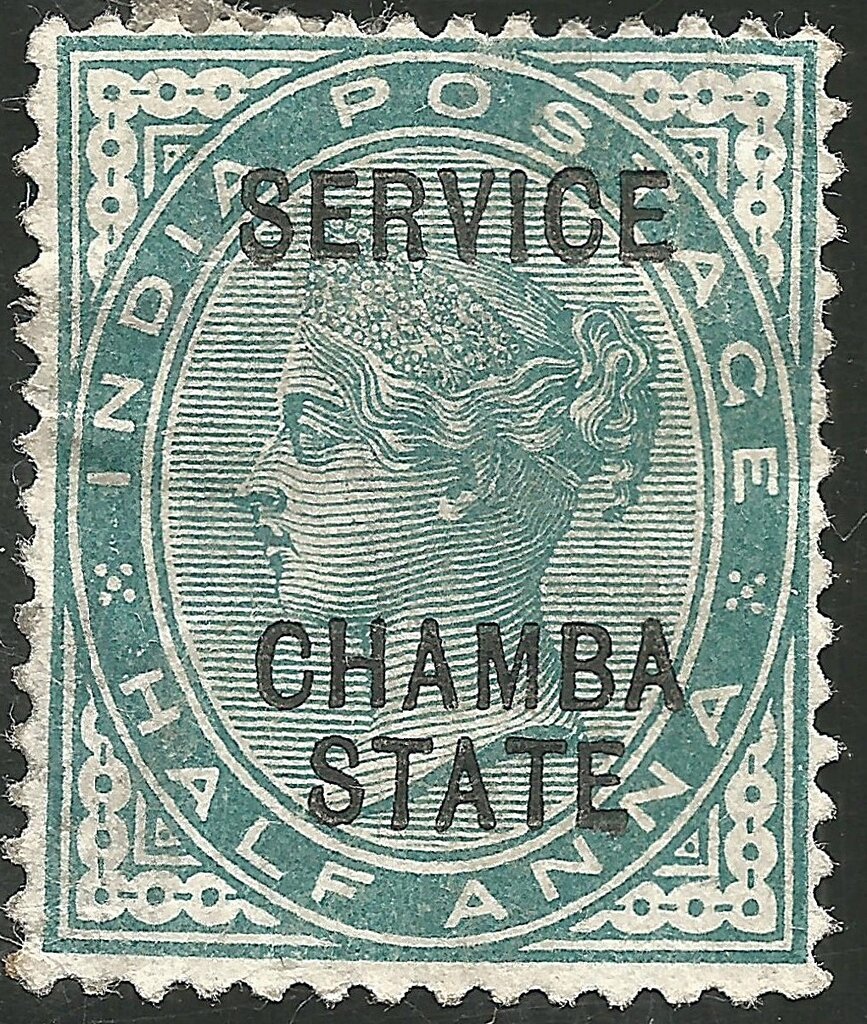
The Smithsonian holds a five-rupee Chamba stamp with the Indian design and the State name; the sun is a feature of the stationery only. Record the base stamp, the State name, any official status and the card or envelope format separately.[29][15]
A Cavendish sale describes two used quarter-anna Chamba cards dated 1889 and 1901, from John Lea’s collection. The listing does not give their offices, addresses, markings or charges; compare both sides and the Postal Guide before reconstructing a journey.[32]
Reading a Chamba cover
The origin, date, destination, full franking and service decide how a Chamba cover is read. Dalhousie and Chamba were the exchange offices named in the convention, and registered, insured, parcel and money-order traffic created accounting evidence beyond a cancellation. For a foreign letter the convention required unoverprinted Imperial postage. A clear CHAMBA strike records a handling event; it does not by itself prove the rate or the whole route.[2][6]
A letter to the Royal Geographical Society
Gärtner’s catalogue of 2009 illustrates a cover addressed to the Secretary of the Royal Geographical Society, 1 Savile Row, London. Its front has four green stamps in two pairs and a separate violet stamp, with circular cancellations; lot 11417 dates it to 1903 and describes a 2-annas violet and two pairs of half-anna green overprinted stamps with a CHAMBA-STATE cancellation. The small photograph does not confirm the date, every overprint or the charge, and the back, weight, service and tariff are unexamined. It is not proof of a rate or an earliest use.[41]
Air mail in two directions
The same catalogue’s lot 11430 includes a Chamba cover described as a Karachi–Lahore first-flight cover of 5 December 1934, with two Chamba stamps; an air-mail label and two stamps are visible, but the partial image does not confirm the cancellations or the flight.[41]
Argyll Etkin’s lot 745 of 2024 describes Chamba and Jhind covers handled differently in July 1933 and December 1934: a Chamba cover of July 1933 went by surface with its air label crossed out, and one of December 1934, Lahore to Karachi on 4 December, was flown. The seller reports special permission for 62 Chamba covers. Until the postal instruction and the covers are examined, this is a report, not a general air-mail rule; the convention of 1896 cannot decide air-mail eligibility in the 1930s.[42]
Traps for the collector
Inland validity of the State overprint does not extend to foreign letters, which needed unoverprinted Imperial stamps. Red ink means a proof, not a postal setting. Read the numeral, not the aircraft, to separate the twelve-annas and fourteen-annas aeroplanes. The SERVICE values of 1890 and 1900, the twelve-annas totals and the one-anna quantity of 1902 all have conflicting figures that should be shown, not corrected by guesswork. And an error’s catalogue number, such as O7a for CHMABA, does not belong to the normal stamp.[2][31][10][1][7][43][40]
What is still open
The first dated use of a Chamba stamp, the people who designed, composed and printed the overprints, a register of cancellations by office and every overprint setting are still to be established, as are the original notices of 1950 on replacement and validity.
Sources
- [1] C. Stewart-Wilson, British Indian Adhesive Stamps Surcharged for Native States, Part I: Chamba, Faridkot, Gwalior, Philatelic Society of India, Calcutta, 1897.
- [2] Government of India and Chamba State, Postal Convention, 1896, arts.1–27, printed pp.337–341.
- [6] William E. Steiner, India—Convention States, StampAlbums.com, album pages 2–13.
- [7] E.W.Aggleton, “Chamba”, The Stamp Lover, vol.5, May 1913, pp.262–263, with “Chamba: A Correction”, vol.6, June 1913, p.32.
- [9] C. U. Aitchison, A Collection of Treaties, Engagements and Sanads Relating to India and Neighbouring Countries, vol. I: Punjab, Punjab States and Delhi, Government of India, Calcutta, 1931, Chamba postal convention.
- [10] Burda Auction, Public Auction 74, Chamba objects 239563, 251296, 241808 and 249119.
- [15] Col Jayanta Dutta and Dr Anjali Dutta, convention stationery, Postal Stationery Society Journal 26(2), May 2018.
- [29] Smithsonian National Postal Museum, Chamba five-rupee overprint, object 2011.2005.340.
- [31] Heinrich Köhler sale 380, lot 1474, red Chamba official proof.
- [32] Cavendish Philatelic Auctions, sale 876, lot 559, ex John Lea.
- [40] David Feldman, Autumn Auction Series, 16 December 2021, lot 51290: Chamba three-annas official CHMABA error.
- [41] Christoph Gärtner, India Special Auction, 21 February 2009, lots 11417 and 11430.
- [42] Argyll Etkin, auction 54, 25–26 April 2024, lot 745, Air Mails.
- [43] Philatelic Journal of India, vol. VIII, no. 6, June 1904, pp. 200–201.
Notes 0
Add what you know: a cover or stamp in your collection, a date or source, a correction or a question.
No notes yet.
Sign in to add a note.
Notes show straight away. Keep them kind and about the article; anyone can report one that isn't. House rules
