
Faridkot’s Local Handstamps, 1879–1886: the Folus, the Paisa and the Red Half Anna
Faridkot’s own handstruck stamps: the oblong one folus and upright one paisa, their inscriptions and papers, the disputed larger paisa die, the red half anna that was never issued, and two letters of 1884–85.
Updated May 30, 2026
In this article
Faridkot has two postal collections in one state. The first post used stamps made locally and struck by hand; the convention post that followed used Indian stamps overprinted FARIDKOT STATE. H. D. S. Haverbeck dates the first local stamps to 1879 and the convention to 1 January 1887. A third group, labels made after the local stamps had been replaced, has to be kept apart from both.[1]
What the earliest printed reports establish
The Philatelic Record of November 1882 announced two blue designs, a small oblong and a larger upright rectangle. They had reached collectors, and the report of their use was second-hand; it is not an issue order. E. B. Evans estimated 1879 or 1880 for the folus, Haverbeck adopted 1879, and the later government Gazetteer says 1881. These dates are competing evidence; the first day is unknown.[14][5][1][21]
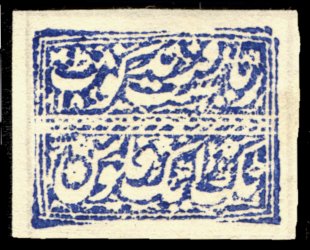
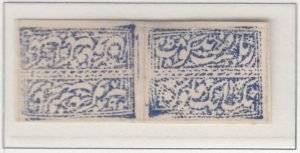
In Evans’s transcription of Rodet’s reading, the small oblong reads as the principality of Faridkot and a ticket, or stamp, of one folus. Evans distinguished native laid, European laid and wove papers, including ruled sheets. He saw the ruling as a sign of handling for growing collector demand, but did not treat every impression on ruled paper as a reprint made after the post closed.[5]
Evans also explained two ways a tête-bêche pair could arise: one impression struck upside down among upright ones, or a sheet turned round part way through the repeated striking. His view on whether this was done by hand or with a small press is an interpretation of the arrangement. The postal issue was imperforate; later fancy colours have to be judged against when they first appeared, after the local post had ended.[5]
The one folus and one paisa designs
The one folus has an oblong inscription in two rows. Haverbeck equates one folus with one paisa, a quarter anna. Ultramarine impressions occur on native and European laid papers and on wove paper. A single die was struck again and again by hand, so irregular arrangements and tête-bêche impressions are to be expected; they do not mean a lithographed sheet.[1]
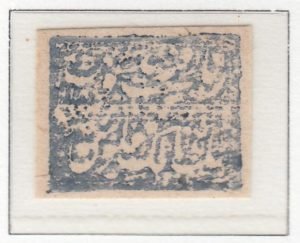
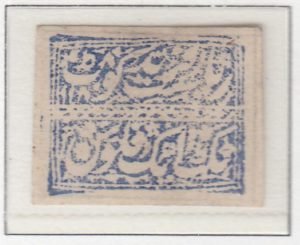
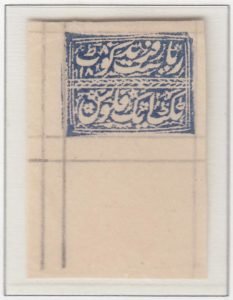
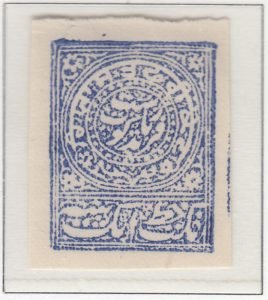
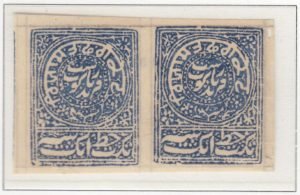
The upright paisa design is not one settled postal category. Haverbeck distinguished a smaller die, about 19½ × 24½ mm, and a larger one of 20 × 26 mm, and listed both among the original ultramarine stamps. Evans came to a different conclusion in 1900: he regarded the larger single die as a collector production, because it was first chronicled in November 1887, after the local post had ended, and he had found no evidence of earlier use.[5][1][16]
The Philatelic Record of November 1887 confirms the arrival of a modified design with a circular inscription, in blue and in black; the December illustration makes clear that its value is one pice, a quarter anna, not one pie. These notices show what collectors were seeing, not that the post authorised it. Both die descriptions stand, and the larger die’s postal status stays disputed. Haverbeck himself knew no cover with the larger die.[5][1][16]
Haverbeck’s descriptions, the smaller die on laid and wove paper and the larger on European wove, are his own classification. Evans had not seen a laid paisa when he wrote in 1900, but a notice of February 1904 accepted ordinary laid paper from Masson’s specimens. That notice’s “Type 2” is not necessarily Haverbeck’s Die II: each numbering scheme needs its own mapping.[1][5][19]
What the inscriptions and paper can tell us
The two local designs express the same quarter anna in two ways, one folus and one paisa. On the oblong stamp the upper Perso-Arabic line names the principality and the lower gives the value. On the upright paisa the central wording is repeated round the circular band in a second script, and Haverbeck notes a missing D in the outer rendering of Faridkot. That is a feature of the original design, not by itself a sign of forgery. Rodet’s reading reached The Philatelic Record through G. Campbell as an incomplete translation, because the journal lacked the type to print it; it is a historical interpretation, not proof of any religious or dynastic symbolism.[15][1]
Paper needs its own record. Haverbeck’s checklist puts the folus on native laid, European laid and European wove papers; the European laid paper can show part of a papermaker’s watermark, a feature of the sheet, not a stamp watermark found on every single. His paisa Die I occurs on laid and wove paper, Die II on European wove. Gum was not applied consistently to the early sheets. A watermark fragment, a different thickness or missing gum has to be read with the design, not turned into a new issue.[5][1]
Why the half anna is not another issued stamp
A blue square design was illustrated in April 1883, at first wrongly read as a quarter anna and shown upside down; The Philatelic Record corrected both points in July 1884. Its account of October 1884 says the State Postmaster described the red half anna impressions as models made that year from a die prepared earlier, and never issued for use. The red half anna therefore stays out of the list of issued stamps.[15][12][2]
The editor also rejected a letter, said to be from the Finance Minister, claiming that the red impressions were long obsolete, because its handwriting looked like the supplier’s. That was a published suspicion, not an examination of the letter. It should not be confused with the genuine Finance Minister’s letter of 16 July 1886 about convention supplies, quoted by C. Stewart-Wilson.[15][12][2]
The design’s date, Samvat 1934 (1877), is not the date the stamp was made or first used. Neither an early report of blue impressions nor guesses about accidental use give us a reliably documented cover. C. Stewart-Wilson tentatively included a half anna among the last supplies of the native design, but the postmaster’s own account of 1884, that the red models were never issued, is followed here.[12][5][2]
Two journeys before the convention
An Indian quarter anna postcard marked REPLY, Gärtner’s Park collection lot 985, also carries a blue Faridkot local stamp. Its markings include Faridkot, Ferozepore and Amritsar; the last two show 25 and 26 October 1885, and the catalogue reads the Faridkot despatch as 24 October. The sequence records the offices the card passed, not who carried it or how. The REPLY heading identifies this half of the card; it does not show that both halves or a return journey survive.[29]
A second object, lot 984, combines a green Indian half anna envelope with a Faridkot local stamp. The address shows Lahore, and the two prepaid elements have different cancellations. The catalogue gives a route through Ferozepore on 29–30 March 1884 and cites an ISES certificate. Together the two show the local and Imperial posts working before the convention; their combined face values are not a table of rates.[29]
Local postmarks and outside offices
The local cancelling device best known to Haverbeck has three elliptical rings round FARIDKOT, about 30 × 19 mm overall. Through L. E. Dawson he also reports a device of four concentric circles about 22 mm across, a heart-shaped seal and a large circular seal. These are reported devices, not a proven sequence with known dates of introduction.[1]
Ferozepore and Kharar cancellations also occur on the local stamps. Note them when they are visible, but a loose stamp cannot show why it reached that office, or by what route and at what rate. The same caution applies to collector labels with later State cancellations: a genuine postal device may have been applied as a favour to something that was never valid postage.[1]
Sources
- [1] H. D. S. Haverbeck, “India: The Stamps of the Feudatory States—Faridkot”, The Collectors Club Philatelist, vol. XXXV, no. IV (July 1956), pp. 239–242 and 256.
- [2] C. Stewart-Wilson, British Indian Adhesive Stamps Surcharged for Native States, Part I (Calcutta: Philatelic Society of India, 1897).
- [5] E. B. Evans (article byline: The Editor), “The Stamps of Some of the Native States of India: Faridkot”, Stanley Gibbons Monthly Journal, vol. X, 30 June 1900, pp. 268–271.
- [12] The Philatelic Record, vol. VI, no. 66, July 1884, “Faridkot”, p. 107.
- [14] The Philatelic Record, vol. IV, no. 46, November 1882, “Faridkote”, p. 175.
- [15] The Philatelic Record, vol. V, no. 49, February 1883, “Faridkot”, p. 6.
- [16] The Philatelic Record, vol. IX, no. 106, November 1887, “Faridkot”, p. 165.
- [19] “Indian Native States—Faridkot”, Stanley Gibbons Monthly Journal, vol. XIV, 29 February 1904, p. 160.
- [21] Punjab States Gazetteers, vol. XVI A, Faridkot State, 1907, Lahore: Civil and Military Gazette Press, 1909.
- [29] Christoph Gärtner, Park Collection, 7 March 2011, lots 984–985.
- Wikimedia Commons, “Faridkot 1 folus.jpg”.
Notes 0
Add what you know: a cover or stamp in your collection, a date or source, a correction or a question.
No notes yet.
Sign in to add a note.
Notes show straight away. Keep them kind and about the article; anyone can report one that isn't. House rules
