
Gwalior’s Queen Victoria Overprints, 1885–1904: Hindi and English, Long and Short
How the bilingual name was chosen in 1884, overprinted in Calcutta, set in long and short Hindi, printed in red and black; the first supplies and quantities, the Hindi officials of 1895, GWALICR, the reprints and the last Queen-head values.
Updated June 21, 2026
In this article
A design settled before the convention opened
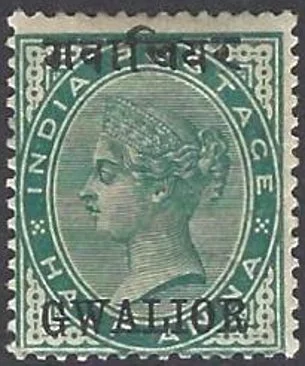
Gwalior’s overprint does not follow the simple English name used by Chamba or Faridkot: it gives GWALIOR in English with its Hindi form. Stewart-Wilson traces it to a request in April 1884 for the state’s name and its sun-and-serpents arms. Proofs were printed, but the arms were too small; in September 1884 the Maharaja chose bold English and Hindi names for the adhesives instead, keeping the arms for postcards and embossed envelopes. No original proof or artist is known.[1]
Who printed what
In the early convention years the Gwalior name was added at the Government of India Central Printing Press in Calcutta. The Superintendent of Stamps and Stationery supplied the Indian stamps and required an equal number back after overprinting. That identifies the overprinter, not the printer of the Indian stamp. By December 1897 surcharge proofs, revised at the Press, also had to be passed in the Director-General’s office, a reform Stewart-Wilson links to representations by the former Bengal Philatelic Society; it should not be backdated to 1885.[1]
An ordinary star-watermarked sheet normally needed 240 separately set impressions; printing a pane at a time was unusual. Elephant’s-head sheets had four panes of 80 and were overprinted in two operations, with errors repeated accordingly. The type was set 240 times, and broken or wrong-fount letters followed.[1]
How the overprints developed
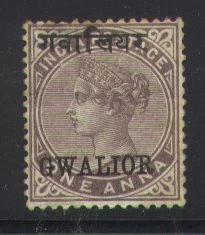
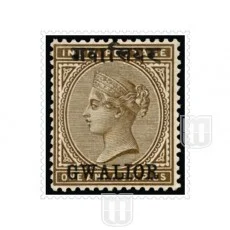
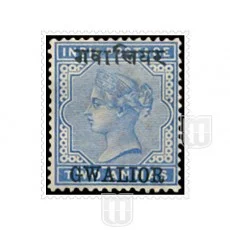
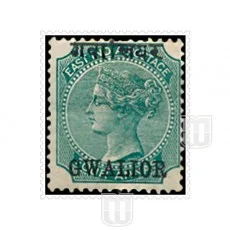
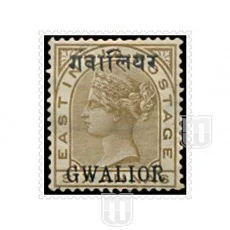
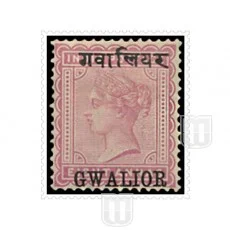
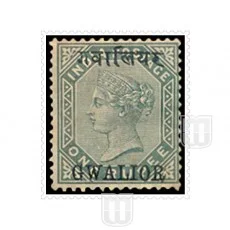
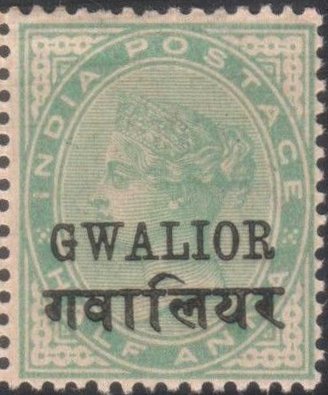
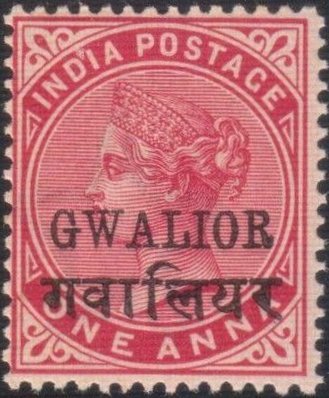
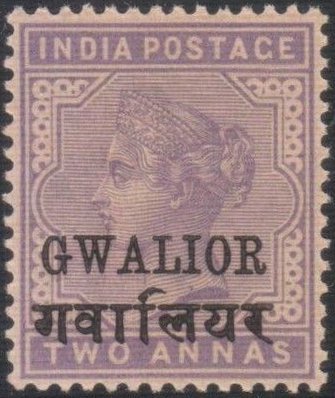
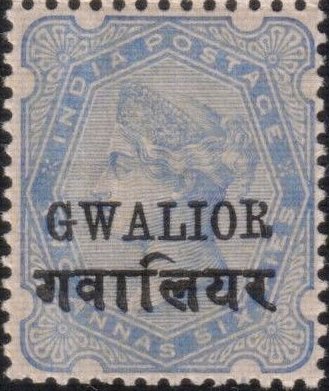
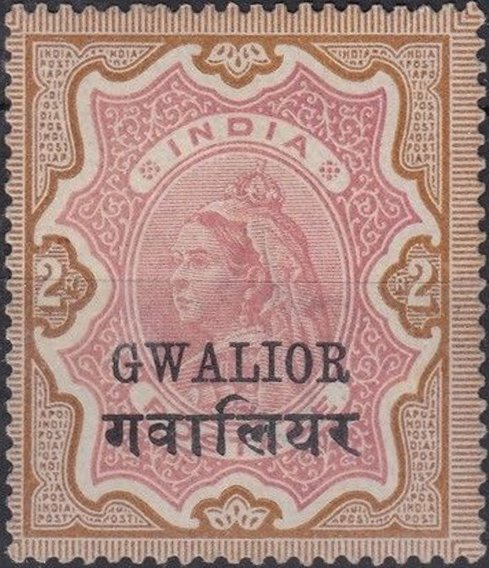
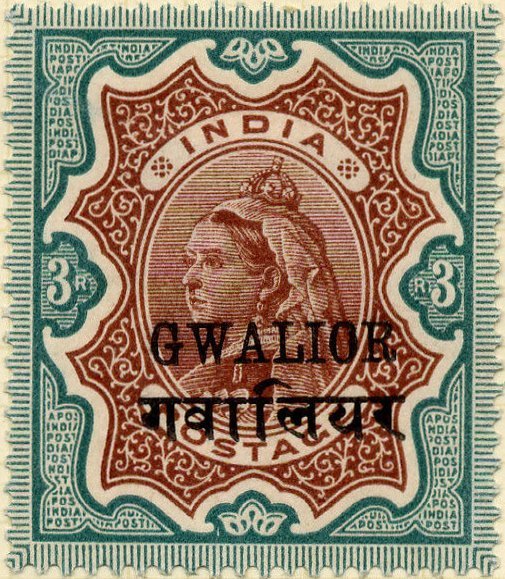
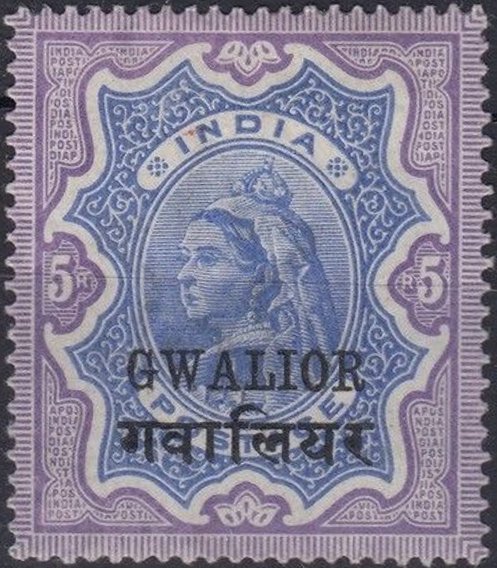
In the first arrangement Hindi stands above the portrait and English below. Later arrangements put English above Hindi near the foot, about 2 mm apart, in red and in black groups, and then an all-long Hindi setting in black. Early sheets had long and short Hindi together; the later regular form used the long Hindi. These are settings, not new values.[1]
Stewart-Wilson measures the short Hindi at about 13½–14 × 2 mm, the long at 15–15½ × 2½ mm, and English GWALIOR at about 14 × 2 mm. The separated lines stand 16–17 mm apart on star paper and 15 mm on the elephant’s-head four and six annas. A pair joining short and long Hindi shows that one sheet held both, not two issues. The handbook’s ratios of short to long are inconsistent, and Wetherell in 1905 stressed that the two lengths coexisted on a sheet and were not separate issues.[1][29]
The first supplies
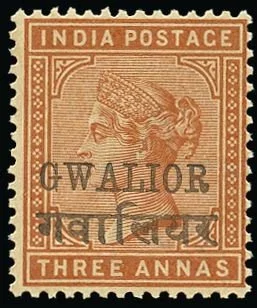
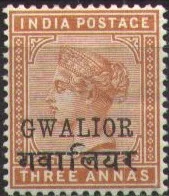
Stewart-Wilson’s list records the May 1885 printing as half anna 24,000, one anna 6,500 and two annas 12,500. June 1885 added half anna 74,100, one and a half annas 2,420, three annas 2,100, four annas 1,940, and six annas, eight annas and the grey one rupee 1,780 each, both groups labelled the first variety. These are printing months, not first days of sale. The three annas orange is in this list, though missing from a public album page and from Poole’s short summary of 1909.[1][6][15]
The first black separated group is perforated 14. Its May half, one and two annas are on star-watermarked Indian stamps; the June four and six annas use the elephant’s-head watermark. Those are properties of the Indian stamp beneath, not of the Gwalior name, and the gauge belongs to this group, not every Gwalior issue. StampWorld’s May and June 1885 groups also give perforation 14.[1][49]
In September 1885 red overprints are listed for the half, two and four annas and the grey one rupee, and black for the one, one and a half, three, six and eight annas; December 1885 lists the one and two annas in black, and every later printing in this account is black. Not every value exists in both colours. Poole’s page 130 says September 1885 in its text but June 1885 in its table, and gives 2,100 to the two annas where Stewart-Wilson gives it to the three annas; the detailed contemporary list is followed here.[1][15]
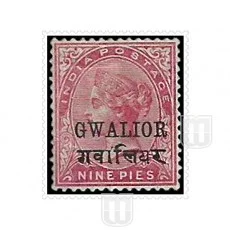
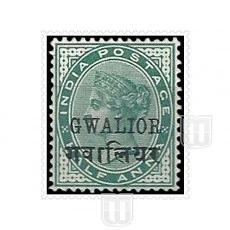
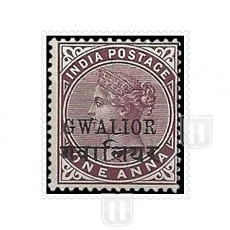
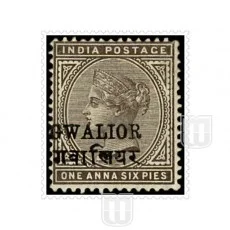
The adjacent black group includes the nine pies carmine and the twelve annas brown on red paper, listed under 1891; the April 1891 printing was the half anna, nine pies, one anna and twelve annas. After it the handbook marks the change to long-Hindi-only supplies, the next printing being November 1891; nine pies did not continue into every later setting.[1]
A 15 mm name and a doubtful letter
Stewart-Wilson places a 15 mm English-name variety between the 17th printing (April 1893) and the 18th (April 1894); a one-anna copy would support the latter. A three-anna Hindi-letter variety shown to him by Major Maxwell stayed doubtful, because he never found it in a sheet.[1]
GWALICR and the transposed official
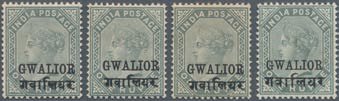
The 23rd printing, May 1896, produced GWALICR once on each small ordinary sheet and, on the officials, the last two Hindi letters transposed once per sheet; his quantities imply only twelve one-rupee official errors. Those are reconstructed printing figures, not counts of survivors. Poole in 1909 prints 1906 for the transposition, almost certainly a misprint for 1896.[1][28]
The first official stamps, 1895
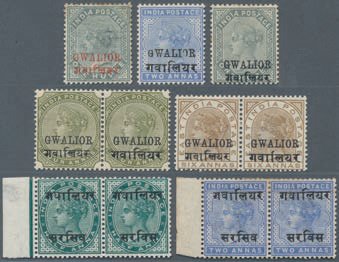
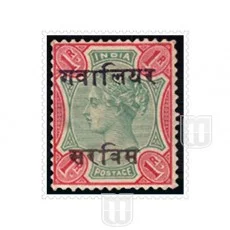
Before Service stamps, official mail had been carried free in the state. The first official supply came in April 1895: half, one, two, four and eight annas, overprinted with Hindi “Sarvis” and the state’s name, a purely Hindi overprint, because, Stewart-Wilson says, the officials using it generally did not read English. The bicoloured one rupee followed in May 1896. Gwalior is expressly excepted from his general description of an English SERVICE added to ordinary convention stamps, so searching for the English word will miss these. Three-pies officials and later bases belong to later supplies. A notice of 30 April 1903 reports King’s Head officials in three pies grey, half anna green and one anna carmine.[1][26][27]
The last Queen-head values
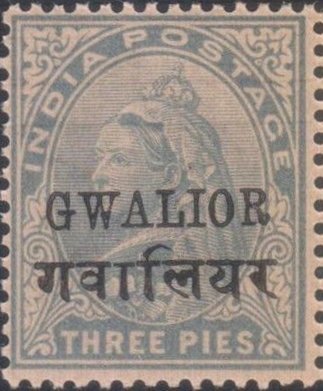
Queen Victoria stamps went on being overprinted after 1902. Poole’s continuation of 1909 gives three pies carmine in 1899; half, one and two annas in new colours in 1901; two and a half annas blue in 1903; and three pies grey in February 1904, the last Queen-head overprint, all in the large Hindi type. He places a tall R at the tenth stamp of the first row of the lower pane and a 2½ mm line spacing at stamp 185, against the usual 1¾ to nearly 2¼ mm, in his discussion of the 1907 POSTAGE & REVENUE stamps. Wetherell’s simplified list of 46 Queen stamps, against 101 catalogue entries, uses broad headings of 1885–1902 that do not date each stamp.[28][29]
Reprints
Stewart-Wilson believed that half and one anna stamps with a 13 mm separation and a heavy SPECIMEN were reprints of about 300 each; Poole separates an initial 13 mm setting from a 9¾ mm probable proof, so spacing alone does not decide. Poole also reports about 500 reprints of each of four early red-overprint values, all short Hindi, most marked REPRINT. An unmarked copy cannot be authenticated by its look or its Hindi length, and the quantities are not counts of surviving originals.[1][15]
Sources
- [1] C. Stewart-Wilson, British Indian Adhesive Stamps Surcharged for Native States, Part I, Calcutta: Philatelic Society of India, 1897, Gwalior chapter and reference lists, pp. 45–68.
- [6] William E. Steiner, India—Convention States, album pages, pp. 16–25.
- [15] Bertram W. H. Poole, “Countries of the World: Gwalior”, Gibbons Stamp Weekly, vol. 10, 7 August 1909, pp. 128–131.
- [18] Christoph Gärtner, 46th auction, Asia, 25 February 2020, lots 6542–6543, pp. 26 and 95.
- [26] Stanley Gibbons Monthly Journal, 30 April 1903, p. 212, Gwalior paragraph.
- [27] StampWorld, Gwalior Service stamps: Queen Victoria and Edward VII.
- [28] Bertram W. H. Poole, “Countries of the World: Gwalior—continued”, Gibbons Stamp Weekly, 21 August 1909, pp. 178–180.
- [29] E. W. Wetherell, “News from Mysore: The Stamps of Gwalior”, Gibbons Stamp Weekly, vol. 2, p. 61, letter from Bangalore of 16 June 1905.
- [49] StampWorld, Gwalior ordinary stamps: the May and June 1885 groups.
Notes 0
Add what you know: a cover or stamp in your collection, a date or source, a correction or a question.
No notes yet.
Sign in to add a note.
Notes show straight away. Keep them kind and about the article; anyone can report one that isn't. House rules
