
Indore Stationery, Covers and Proofs: How to Read the Evidence
Waterlow’s postcards and envelopes of 1893, combination covers, registered covers from Khargone, a TOO LATE envelope, a Court Fee stamp on a cover, and proofs beside the issued stamps.
Updated May 7, 2026
In this article
Postcards and envelopes
Harkawat dates the first portrait postcards to 1893. Reply cards were joined with wide pin perforations, and the half-anna envelopes carry a colourless Waterlow & Sons imprint on a back flap; removing the flap destroys the evidence of manufacture. Evans describes the first half-anna envelope as typographed on thin white wove paper, with the embossed imprint Waterlow & Sons, Limited, London Wall on the right-hand flap, and an indicium adapted from the engraved Shivaji Rao portrait. He received the envelope and card in January 1894 and thought they had been issued by the end of 1893. Later postcards with Tukoji Rao III kept much of the earlier wording and stayed in use through the later postal period.[4][8]
Combination covers
For a mixed-franked letter, transcribe every address, origin and transit date before assigning a route, and record which service cancelled each stamp and whether a due mark was added. The rules of 1878 explain why local and Imperial postage can appear together, but not that every mixed franking was correct.[1]
Köhler sale 376, lot 5008, is a British India half-anna envelope to Bombay with an extra British Indian half anna and an early Indore half-anna portrait. The back has INDORE, R.M.S. HOWRAH / NOV 21 and a partly overlapping Bombay / NOV 23; no year is shown.[46]
Registered covers from Khargone
Philaindia’s sale of 30 May 2026, lot 91, is described as a registered cover from Khargone of 1910. Its back has three INDORE STATE POSTAGE stamps, a green one anna and two blue two annas, five annas in all, and a KHARGONE strike of 22 APR whose year is not clear. The picture linked to lot 92, under the same description, shows a different envelope with a Kotah Minister-in-Waiting imprint and two 1½-anna INDIA POSTAGE stamps; it is not an Indore cover.[52][53]
Philaindia’s auction 8 of 10 October 2026, lot 103, is a registered envelope from Khargone shown on both sides, with the label R / KHARGONE / 141 and ten HALF ANNA stamps, five annas in all. The back carries “Addressee Not Found”, and a KHARGONE mark shows JUN and 40, so June 1940, with the day hidden by handwriting. The weight, charges and return journey are not known.[61]
TOO LATE
Lot 102 in the same sale is a British India Queen Victoria half-anna envelope, not an Indore issue. Its back has a Garot mark in Devanagari, a boxed TOO LATE and BIKANER / MA.11 / 91; the catalogue gives Neemuch as its origin. Which office applied TOO LATE, and whether a late fee was paid, are not known.[62]
Economy envelopes and a Court Fee stamp
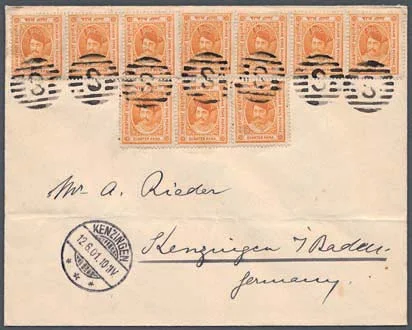
Köhler sale 376, lot 5034, has an official economy reuse slip, eight-anna and two-anna stamps, a written “Over weight” and a postage-due mark, with no readable year. Lot 5033 has a Mhow mark of January 1949 and belongs after independence. Lot 5042 is a green two-anna Court Fee stamp on the back of a British India envelope to Agra; the marks seem to read INDORE CITY / 15 FE 93 and AGRA / 16 FE 93, while the catalogue says 15 February 1889. A fiscal stamp on a cover is not proof of authorised fiscal postage.[49][50][45]
Proofs beside the issued stamps
Proofs and colour trials need their own place. The Prussian-blue two-anna proof and the mounted red half-anna block are production material, unperforated and presented on card. Neither is an issued colour, and an undated proof does not show the emergency postal use reported for saved plate impressions. Keep proofs, emergency proof use and normal imperforate-between varieties apart until a complete cover supports them.
What to record
Record the printer and process: Waterlow lithography, Waterlow and Perkins Bacon recess printing, Times of India typography. A Waterlow sheet watermark may miss a single stamp, and Douie’s WATERLOW & SONS mark and Poole’s Wrigley mark belong to different issues. Keep quotation, order, die entry, hardening, roller transfer, proof and issue dates apart. On covers, read the origin, exchange, onward cancellation and delivery separately, and remember that Ujjain and Neemuch were Gwalior towns with Indore offices.[4][26][27][5]
What is still to be found
Still to be found: the designers and engravers of the Waterlow stamps and of the 1904 portrait, the engraver of the 1926 rupee frame, and the artist of the Times of India series; the sequence of the thick and thin SERVICE settings and whether the ICE omission recurred; the Holkar State Postal Guide and a continuous tariff; whether the postal notes were issued; the schedule of the 53 offices opened in 1908; the Agency report for 1904–05 (IOR/V/23/84, No. 424); and the orders that ended the State’s stamps in 1950.[69]
Sources
- [1] Leonard C. Parton, “Indore”, Collectors Club Philatelist, vol. 38, no. 4, July 1959, pp. 165 ff.
- [4] N. J. Harkawat, The Indore State Hand Book: The Postal History of Indore State from 1829–1950, undated.
- [5] Christopher J. Cleal, “Indore State P.Os in Gwalior State”, India Post, vol. 30 (1996), pp. 42–47.
- [8] E. B. Evans, “The Stamps of Some of the Native States of India: Holkar,” Stanley Gibbons Monthly Journal, 29 September 1900.
- [26] Lieut.-Colonel F. M. Douie, “The First Stamp of Indore”, The Philatelic Journal of India, vol. XLIII, no. 1 (January 1939), pp. 10–13, reprinted from The Philatelic Journal of Great Britain, April 1934.
- [27] Bertram W. H. Poole, “Countries of the World: Holkar—continued,” Gibbons Stamp Weekly, vol. XII (6 August 1910), pp. 131–132.
- [45] Heinrich Köhler, sale 376, Hasse Brockenhuus von Löwenhielm collection, 19 April 2021, lot 5038. SERVICE quarter-anna on 1907 Gazette. Linked original auction photographs.
- [46] Heinrich Köhler, sale 376, Hasse Brockenhuus von Löwenhielm collection, 19 April 2021, lot 5008. Combination envelope with three postal elements. Linked original auction photographs.
- [49] Heinrich Köhler, sale 376, Hasse Brockenhuus von Löwenhielm collection, 19 April 2021, lot 5034, official economy envelope with due marking.
- [50] Heinrich Köhler, sale 376, Hasse Brockenhuus von Löwenhielm collection, 19 April 2021, lot 5033, official economy envelope of 1949.
- [52] Philaindia auction, 30 May 2026, lot 91.
- [53] Philaindia auction, 30 May 2026, lot 92.
- [61] Philaindia, auction 8, 10 October 2026, lot 103 (publisher object 18702).
- [62] Philaindia, auction 8, 10 October 2026, lot 102 (publisher object 18701).
- [69] British Library, India Office Records, Report on the Political Administration of the Territories within the Central India Agency for 1904–05, IOR/V/23/84, No. 424, Foreign Department serial no. 159.
- Christoph Gärtner, 17th auction, Indian States, 7 March 2011, lots 1054–1063, printed plate p.45 and lot descriptions.
Notes 0
Add what you know: a cover or stamp in your collection, a date or source, a correction or a question.
No notes yet.
Sign in to add a note.
Notes show straight away. Keep them kind and about the article; anyone can report one that isn't. House rules
