
Nabha from Edward VII to George VI: the Later Overprints, Officials and Rupee Sheets
Nabha’s Edward VII supplies of 1903, the George V single- and multiple-star groups, the George VI transport set and rupee gutter sheets, NABHA without STATE, and the later officials.
Updated October 14, 2026
In this article
The succession of base stamps
The State overprint continued on the Indian stamps of each new monarch: Edward VII, George V and George VI, with official markings beside them. Establish the watermark, colour and value of the Indian stamp before classifying the overprint; the same State name can hide a different setting.[4][6]
Edward VII, 1903
A chronicle of 30 June 1903 reports that Nabha received King’s Head stamps about the end of April: 96,000 three pies grey, 48,000 half annas pea-green, 24,000 one anna carmine, 12,000 two annas purple and 6,000 three annas orange-brown. The writer did not know whether the figures included SERVICE stamps, so they are not separate totals for ordinary and official stamps.[30]
The same report mentions small A letters in the setting and irregular spacing of both words on the lower right stamp of the upper pane: a place to look in a multiple, not proof that every later setting kept the fault.[30]
In November 1903 the journal recorded higher values sent by Whitfield King & Co.: six annas olive-buff, eight annas magenta, twelve annas purple on red and one rupee green and carmine. The dealers supplied the stamps; they did not make them. The chronicle of 30 January 1904 reports the four annas, eight annas and one rupee with SERVICE, without saying whether the State name and SERVICE were applied together or separately. An undated clipping, citing Ph. Echo, reports a twelve-annas King’s Head purple on red with SERVICE.[31][32]
George V: De La Rue, then Nasik
A notice of December 1911 identifies a Bertram Mackennal model behind the portrait on India’s new one-anna George V stamp, and names De La Rue as printer of the one, two and three annas; the one anna was on white wove paper, star watermark, perforated 14. That credits the Indian base, not Nabha’s overprint.[27]
The official centenary album dates the move of Indian stamp printing from De La Rue to Nasik to 1926, with the same dies on new Multiple Star paper. The press’s own history dates the start of production to 1925 and credits the project report to Sir George H. Willis and D. Ascoli, planners rather than artists. A familiar portrait can therefore cross an important manufacturing boundary; identify the base before the overprint.[26][29]
A longer checklist than a portrait sequence
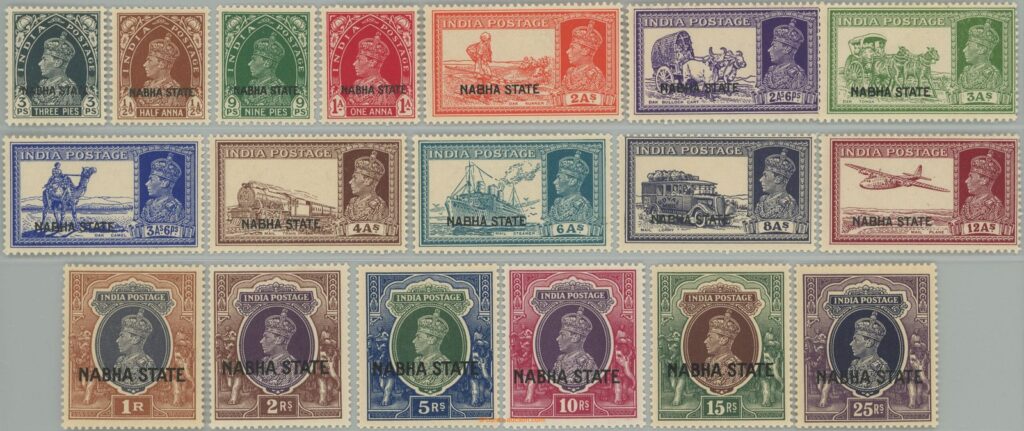
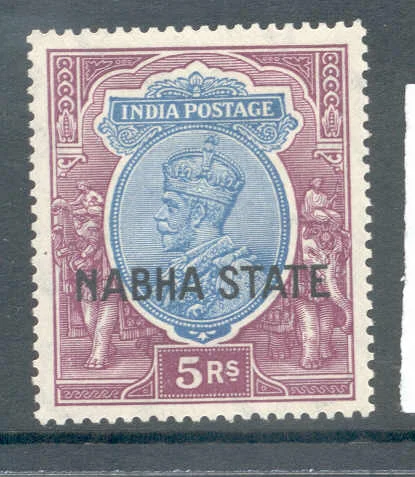
The later collection is not simply Edward VII, George V and George VI. George V’s single-star and multiple-star watermarks, changed colours and new low-value designs make successive groups. The George VI ordinary stamps of 1938–1939 run to eighteen values, up to twenty-five rupees, and the later low values on white backgrounds make another group.[6]
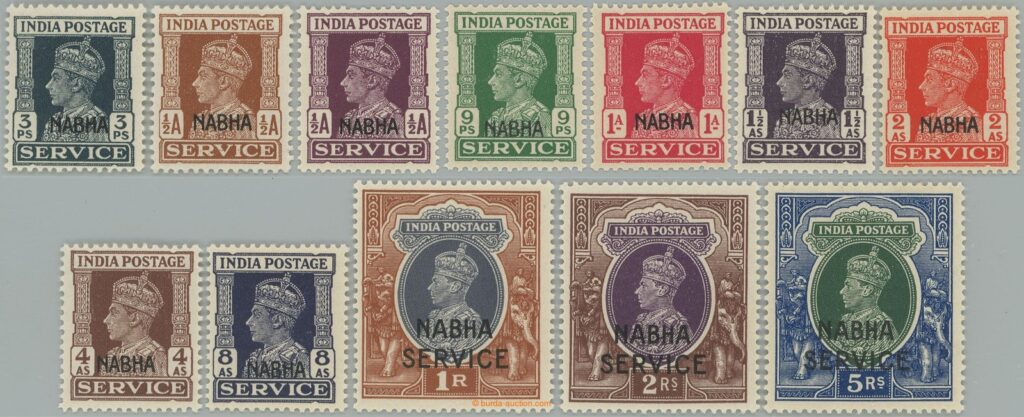
The officials run their own course. The album records the George V multiple-star officials as three pies and one, four and eight annas, not a match for every ordinary stamp; the later George VI officials include changed half-anna colours and rupees up to five. An official checklist has to be copied from the evidence, not generated from the ordinary one.[6]
A transport collection within the George VI set
The ordinary set shows a runner, a bullock cart, a tonga, a camel, a train, a steamer, a lorry and an aeroplane, each on its own value. The twelve-annas aeroplane on a loose stamp is not evidence of an airmail rate. The six rupee values (one, two, five, ten, fifteen and twenty-five rupees) have a larger portrait format.[26]
The official album presents the 1937 George VI designs as pictures of mail transport, and explains that the wartime shortage of paper stopped the large stamps being reprinted, so smaller replacements followed. Joseph Monteiro attributes the transport designs to Archer, preferring the initials T. I. to H. No designer of Nabha’s lettering is known.[26][28]
The bullock-cart stamp of 1938 is two annas six pies (2½ annas), attributed to SG 82 on Wikimedia Commons; StampWorld shows two annas three pies.
NABHA STATE becomes NABHA
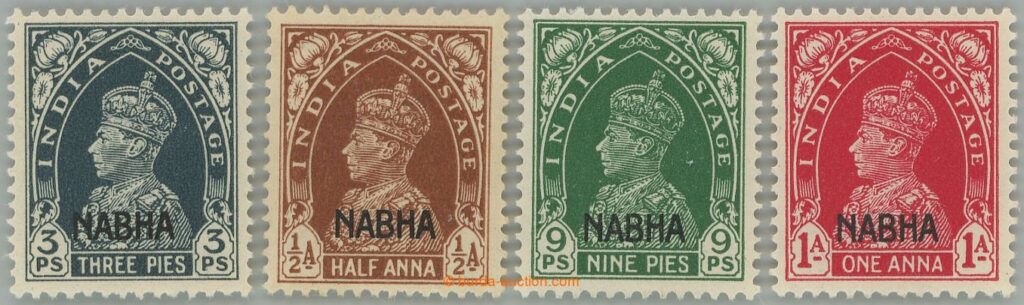
The four early low values can be compared directly in these photographs: NABHA STATE in the ordinary set, and NABHA alone in the four-stamp group. A change of State wording is separate from a later change of the Indian design; check both before assigning a stamp.[16]
The officials need another look. In the later group, SERVICE is part of the Indian low-value design, while the rupee stamps have NABHA and SERVICE added together. Two half-anna colours are shown; they are not two values.[16]
Rupee sheets and the gutters between panes
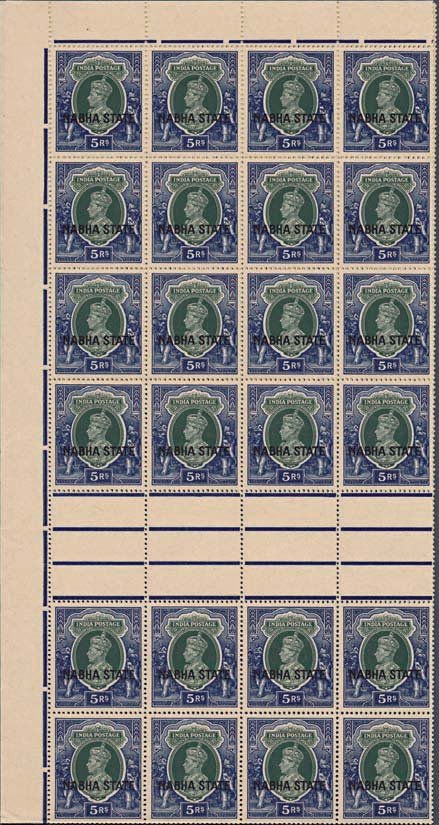
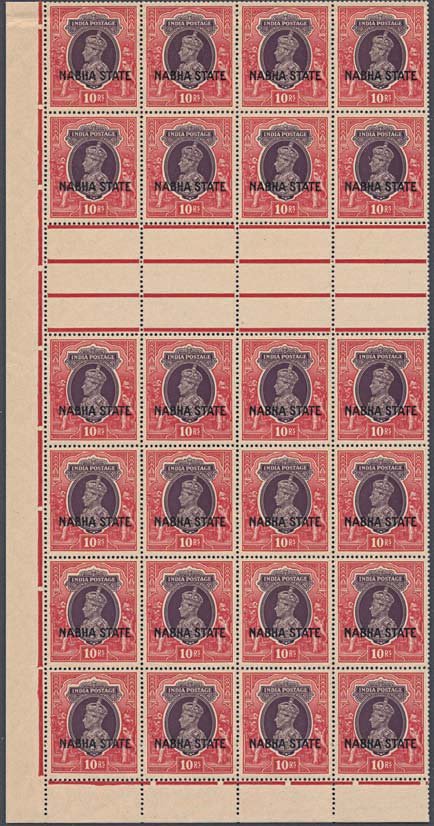
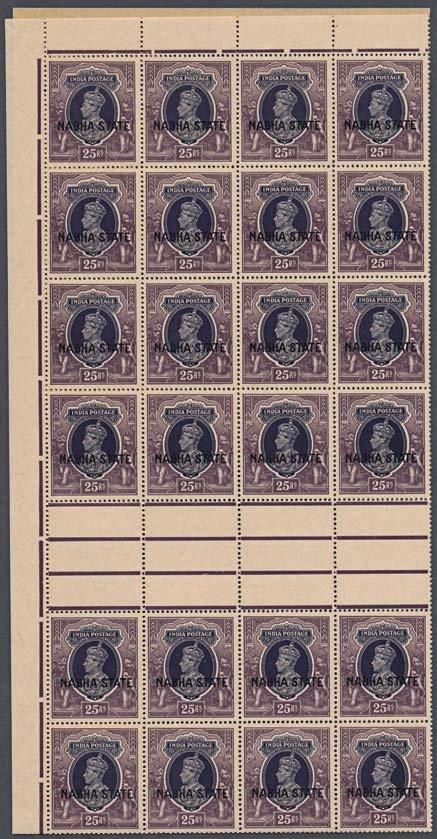
The later rupee stamps survive with margins and the gutters between panes. The auction describes partial gutter sheets of forty-eight; the photographs show parts of them. Their watermark and gum need the stamps themselves.[8]
A nine-pies official still to be matched
A dealer’s listing attributes a George VI nine-pies green official block to SG O58; StampWorld’s Service row 43, type H3, shows nine annas. Until the catalogue entry and the stamp itself are compared, the checklist keeps the nine pies without a number. SG O53 belongs to the separate officials of 1938.[22][23][24]
What a picture can and cannot show
A photograph shows the portrait, the value, the transport subject and the arrangement of the State name and SERVICE. Watermark and its direction, gum and exact perforation need the stamp or a specialist description. A mint stamp is not automatically a proof, and an imperforate or SPECIMEN stamp needs its own history.
Sources
- [4] StampWorld, Nabha, ordinary postage: Edward VII and George V.
- [6] William E. Steiner, India—Convention States, StampAlbums.com, undated public album PDF, digital pp. 38–46.
- [8] Christoph Gärtner, 17th auction, 7 March 2011, India and Indian States, Nabha lots 1412–1414, plate p. 79.
- [16] Burda Auction, Public Auction 74, Nabha lots 247435, 241789 and 251323.
- [22] 1st4stamps1840, HipStamp listing 75091991, Nabha GVI SG O58 nine-pies green official block.
- [23] StampWorld, Nabha Service stamps, row 43, type H3, group headed 1940.
- [24] Universal Philatelic Auctions, sale 67, lots 12236, 12242 and 12244–12246.
- [26] Indian Postage Stamp Centenary 1854–1954, Souvenir Album, pp. 1–3.
- [27] The Postage Stamp, 30 December 1911, p. 166.
- [28] Joseph Monteiro, “The Early Pictorials (1929–1949)”, The Canadian Philatelist, May–June 2015.
- [29] India Security Press, Nasik, About Us / History.
- [30] Stanley Gibbons Monthly Journal, 29 November 1902, p. 89, and 30 June 1903, p. 260.
- [31] Stanley Gibbons Monthly Journal, 30 September 1903, p. 45; 30 November 1903, p. 89; 30 January 1904, p. 136.
- [32] Undated clipping, p. 201, citing Ph. Echo.
Notes 0
Add what you know: a cover or stamp in your collection, a date or source, a correction or a question.
No notes yet.
Sign in to add a note.
Notes show straight away. Keep them kind and about the article; anyone can report one that isn't. House rules
