
Soruth’s Early Stamps, 1864–1891: Handstamps, Typeset Sheets and Engraved Plates
Junagadh’s first stamps: the black handstamp of 1864, the typeset stamps of the Niti Prakash press in changing settings, the two annas of 1869, the 1877 engraved plates and the government imitations of 1890–91.
Updated September 7, 2026
In this article
The handstamp of 1864
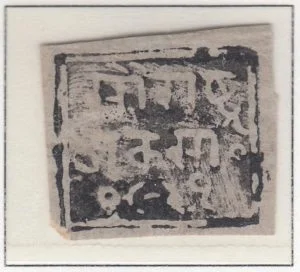
The first issue of 1864 was a one-anna black handstamp on coloured laid and wove papers, imperforate and without gum. These pieces need close attention to paper and impression; the later typeset and pictorial issues were made in quite different ways and cannot be judged by the same look.[2]
Dawson himself thought the conventional date of 1864 might be a year or two too early, while citing an example of 6 July 1868. A recorded use dates that piece; it does not prove when the issue first went on sale.[5]
The typeset stamps
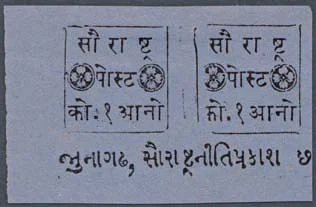
Dawson’s study separates the handstruck seal from the typeset issues, which he places in 1868. The typeset stamp has three lines of inscription and a rosette on either side, in sheets of twenty, five rows of four. A long Gujarati inscription runs above or below the stamps, while the stamps themselves mostly use Nagari: the two scripts belong to different parts of the same sheet.[5]
The normal one anna includes black on pink wove, black on azure laid and red on white laid; the four annas is on white laid paper. Values were changed by altering the value characters and the singular or plural wording. Value, script, accent position, paper and setting together describe a stamp far better than colour alone.[5]
The sheet keeps the history of the type
The typeset stamps were reset again and again, so the sheet inscriptions and mixed numerals are evidence of how they were made. In Dawson’s second setting of the one anna, positions 1–18 have Nagari numerals and 19–20 Gujarati; in his third, Gujarati numerals appear at 1, 3, 4 and 8 and Nagari elsewhere. Position 13 of the first setting lacks the first two characters of ANO, restored in the second; in the fifth setting position 17 lacks KO. Type could fall out of the forme, so a supposed new design has to be checked against a reconstructed sheet and its margin.[8][9]
The Gujarati margins name the Niti Prakash press and give the price of the sheet. A one-anna sheet cost one and a quarter korees, the price of twenty stamps in local money, not a postal rate; later shortened inscriptions leave the price out. Dawson also records genuine printing on both sides, and strong offsets on the back; a reversed offset is not a second printing.[8][9]
Two annas, 1869
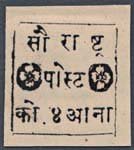
The early values are not only one and four annas. Dawson discusses a two annas black on yellow wove on a complete cover of July 1869 with an Indian half anna, and a damaged two annas black on pink wove on another cover with a red Joonaghur mark of 5 August 1869. His case rests on comparing settings and complete covers, not on accepting every reported coloured paper. His article of 1955 also brought back catalogue entries that had been dropped and reproduced warnings about forgeries; its talk of unique examples describes the collections known then.[5]
Government imitations are not the original sheets
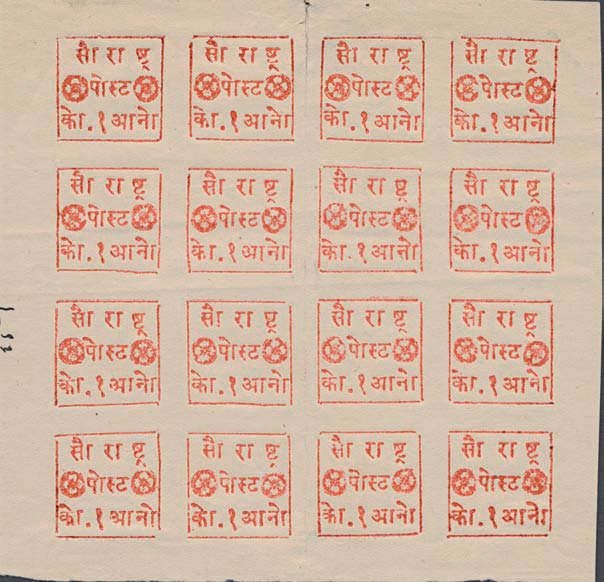
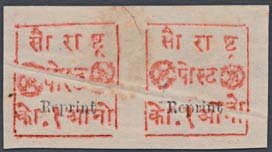
The so-called reprints were not simply new pulls from the twenty-stamp setting. Dawson describes the government imitations of 1890 as a new setting of sixteen, without the bottom inscription. The flattened rosette of position 12 reappears, but defective frame lines were replaced, and the original azure paper was not used. They exist in several inks and papers, imperforate and perforated 12; some are marked REPRINT in red, but not all, so the absence of the word proves nothing. A further reprint setting of four followed in 1891: the one anna in black on white laid or deep-blue wove, the four annas in red on white laid.[8][9]
An old envelope does not settle the question. Dawson warns of forged typeset stamps, including squat-lettered ones on azure laid paper, stuck onto covers. The stamp, its setting, the cancellation and its fit with the cover each need examining.[5][8]
The engraved plates of 1877
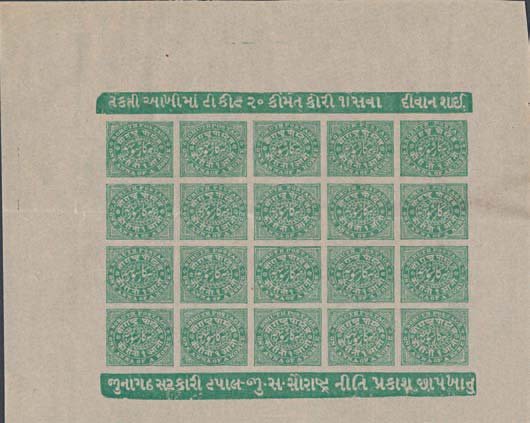
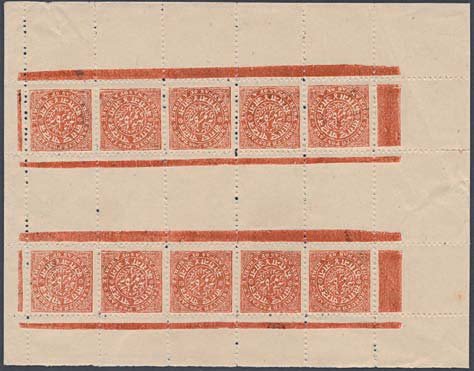
The one anna of 1877 began as fifteen separately engraved stamps in three rows of five. A fourth row was started, and Dawson describes an intermediate printing with that row unfinished; once completed the plate had twenty stamps, with long Gujarati inscriptions above and below. Separate engraving explains the differences that recur between positions. The four-annas plate began with a single row of five, with bars in the margin and no long inscriptions.[8][9]
Dawson reads the central Persian wording as Sarkar Soruth, with Nagari inscriptions above and below and a Gujarati numeral. Catalogues list the one anna green, SORUTH POSTAGE in an ellipse, and the four annas red, in a circle. Dawson places wove paper and perforation from 1886, while laid paper stayed in use, so perforation, paper and plate format have to be recorded separately.[8][9][7]
The Imperial office beside the state post
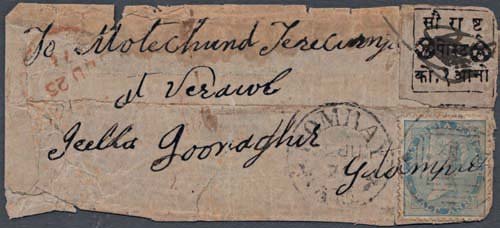
Dawson separates the state’s pen cancellations and circular dot obliterators from the numeral 304 of the Imperial Junagadh office in the Bombay circle. A mixed franking may therefore show two administrations at work. Joonaghur is a historical postal spelling and should stay as written in a transcription.[5]
Sources
- [2] The Philately Life, “Soruth—Junagadh”, original collection study of the first issue and Saurashtra transition.
- [5] L. E. Dawson, “Rediscoveries in Soruth”, Gibbons Stamp Monthly, February 1955, pp. 72–74.
- [7] William E. Steiner, India Feudatory States album pages, Soruth, p. 122.
- [8] L. E. Dawson, “Indian Feudatory States—VI: Soruth (i)”, The Philatelist, September 1965, pp. 272–277.
- [9] L. E. Dawson, “Indian Feudatory States—VI: Soruth (part ii)”, The Philatelist, October 1965, pp. 7–10.
Notes 0
Add what you know: a cover or stamp in your collection, a date or source, a correction or a question.
No notes yet.
Sign in to add a note.
Notes show straight away. Keep them kind and about the article; anyone can report one that isn't. House rules
