About this stamp
The Great Peshwa of the Maratha Empire
Baji Rao I was one of the greatest military commanders and statesmen in Indian history. During his active career from 1720 to 1740, he transformed the Maratha Empire into a powerful political force and significantly reshaped the balance of power across India.
Early Life and Appointment as Peshwa
Baji Rao was born in 1698 to Balaji Vishwanath, the distinguished Peshwa of the Maratha Empire. From an early age, he was trained in warfare and statecraft by his father. By the age of eleven, he had already gained his first experience on the battlefield.
Recognizing his remarkable abilities, Shahu I, the Maratha king, appointed him as Peshwa (Prime Minister) in 1720. This appointment was not simply hereditary; it was a recognition of his military brilliance and political insight, qualities that he later proved throughout his career.
Personal Life
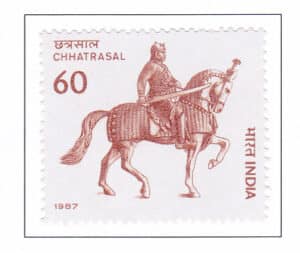
Baji Rao married Kashibai, but his life is also closely associated with Mastani, the daughter of Chhatrasal. Their relationship became legendary in Indian history. Mastani lived in a special wing built for her at Shaniwar Wada, the Peshwa’s palace in Pune.
Baji Rao died suddenly in 1740 after a brief illness. According to historical tradition, Mastani died soon after him, deeply devoted to his memory.
Military Achievements
Baji Rao I was known for his extraordinary courage, innovative strategies, and lightning-fast cavalry tactics. His leadership established Maratha supremacy in the Deccan and expanded their power into northern India.
One of his major achievements was defeating Nizam-ul-Mulk Asaf Jah I, who represented Mughal Empire authority in the Deccan. After this victory, the Marathas secured the right to collect the taxes known as Chauth and Sardeshmukhi from the Nizam’s territories.
With the help of his loyal army and his capable brother Chimaji Appa, Baji Rao also expanded Maratha influence along the western coast. He curbed the power of the Siddis of Janjira and weakened Portuguese Empire authority in Konkan.
Expansion of the Maratha Empire
Baji Rao had a deep understanding of the political conditions of his time. Taking advantage of factional conflicts within the Mughal court at Delhi, he extended Maratha influence beyond the Narmada River.
He secured control over important regions such as:
- Malwa
- Bundelkhand
Baji Rao maintained strong alliances with rulers such as:
- Chhatrasal
- Sawai Jai Singh II
Leadership and Administration
Baji Rao possessed a remarkable ability to identify talented commanders. Among the most notable were:
- Udaji Pawar
- Malhar Rao Holkar
- Ranoji Scindia
These commanders later established powerful states at Dhar, Indore, and Gwalior respectively, further strengthening Maratha influence.
Military Strategy
Baji Rao’s army relied primarily on fast-moving cavalry, capable of covering over 50 miles in a day. His troops lived disciplined and austere lives, avoiding heavy baggage and unnecessary camp followers.
His strategy focused on:
- Rapid movement and surprise attacks
- Cutting off enemy supply lines
- Harassing enemy forces to weaken them gradually
He also led by personal example, sharing the hardships of his soldiers and maintaining strict discipline while rewarding merit and loyalty.
Legacy
The political and military foundations laid by Baji Rao ensured that the Maratha Empire remained a dominant power in India for more than half a century after his death. His courage, determination, and visionary leadership made him one of the most celebrated generals in Indian history.
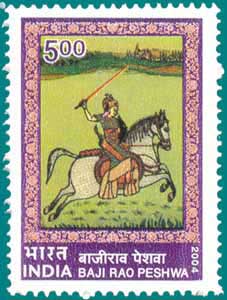
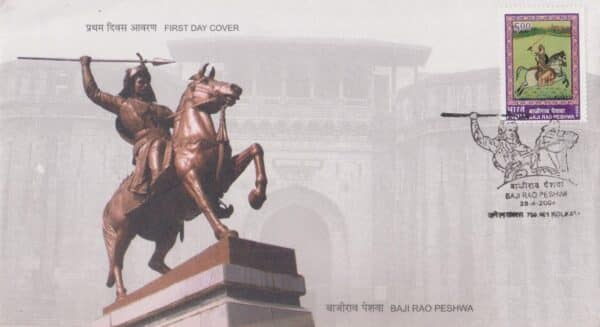
To honour this remarkable leader and statesman, India Post issued a commemorative postage stamp dedicated to Baji Rao I, paying tribute to his enduring legacy in shaping the history of India.
For More Information
Read more here: