About this stamp
Introduction
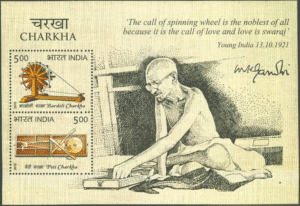
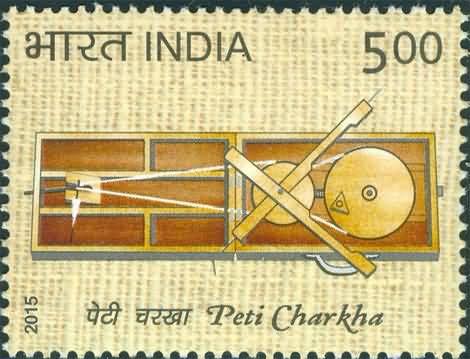
The Portable Charkha represents an ingenious evolution of India’s ancient spinning tradition. While the Traditional Charkha served generations of spinners, the Portable Charkha—compact, foldable, and easy to carry—enabled people to spin yarn anywhere, turning hand-spinning into a mobile, accessible, and democratic activity. It became a vital instrument during India’s freedom struggle, embodying the ideals of simplicity, self-reliance, and Swadeshi.
Origins and Evolution
Spinning cotton has been integral to Indian civilization for millennia, as evidenced by early remains found at Harappa and Mohenjo-Daro and references in sacred texts like the Rig Veda. Over centuries, the craft evolved into a highly skilled occupation.
However, it was during the national movement that a more practical, portable version of the Charkha became necessary. The need for mobility, mass participation, and ease of distribution inspired the creation of this innovative design.
Role in Household Spinning
Like its traditional counterpart, the Portable Charkha was primarily used by women and artisans who contributed substantially to household income through spinning. The new compact design allowed spinners to carry the device during travel, meetings, community gatherings, or fieldwork—ensuring that spinning could continue uninterrupted.
The rituals associated with respect for the craft—lighting incense, offering prayers, tying sacred threads—continued with the portable form as well, reflecting the enduring reverence for this livelihood tool.
Catalyst During Colonial Decline
The decline of handmade textiles during British rule severely impacted rural craftsmen. As mills in England and later in India began to dominate the cloth market, traditional spinning suffered a major setback. Amid this crisis, the Portable Charkha emerged as a practical solution for reviving domestic production of yarn and encouraging people to reclaim their economic independence.
Symbol of the Swadeshi Movement
The Portable Charkha became central to the Swadeshi philosophy, which urged Indians to abandon foreign goods and revive indigenous, handcrafted products. Its portability enabled thousands of Indians—including students, workers, and freedom fighters—to participate in spinning as an act of patriotism.
It was not merely a tool; it was a quiet but powerful form of resistance against colonial exploitation.
Gandhiji’s Vision and Encouragement
Mahatma Gandhi’s association elevated the Portable Charkha to a national symbol. To him, this simple device represented:
- Moral regeneration through labour
- Self-sufficiency and decentralised economy
- Nonviolent empowerment of India’s poorest
- A spiritual discipline connected to daily life
Gandhiji actively promoted its use, encouraging every able person—regardless of age, class, or profession .to spin yarn for at least some time each day. The Portable Charkha made his vision practical and widespread.
Innovation for the Masses
The Portable Charkha was designed to be:
- Lightweight
- Foldable
- Easy to transport
- Affordable to the common people
Its engineering allowed it to be carried in a small box, enabling mass distribution across villages, towns, and educational institutions. Demonstrators and volunteers used it as part of training programmes during the freedom movement.
Representation in the Commemorative Stamp
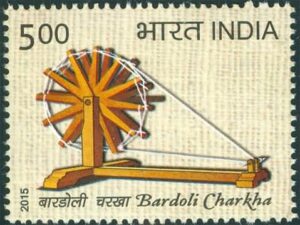
The commemorative stamp issued by the Department of Posts honourably depicts the Portable Charkha, symbolising India’s resilience, ingenuity, and unity.
It pays tribute to the millions who spun yarn not only for livelihood but also as a profound contribution to the nation’s march toward independence.
Conclusion
Compact yet powerful in its message, the Portable Charkha stands as a testament to India’s spirit of self-reliance and moral strength.
The Department of Posts proudly issued this commemorative stamp as part of preserving and celebrating the nation’s heritage of hand-spinning.