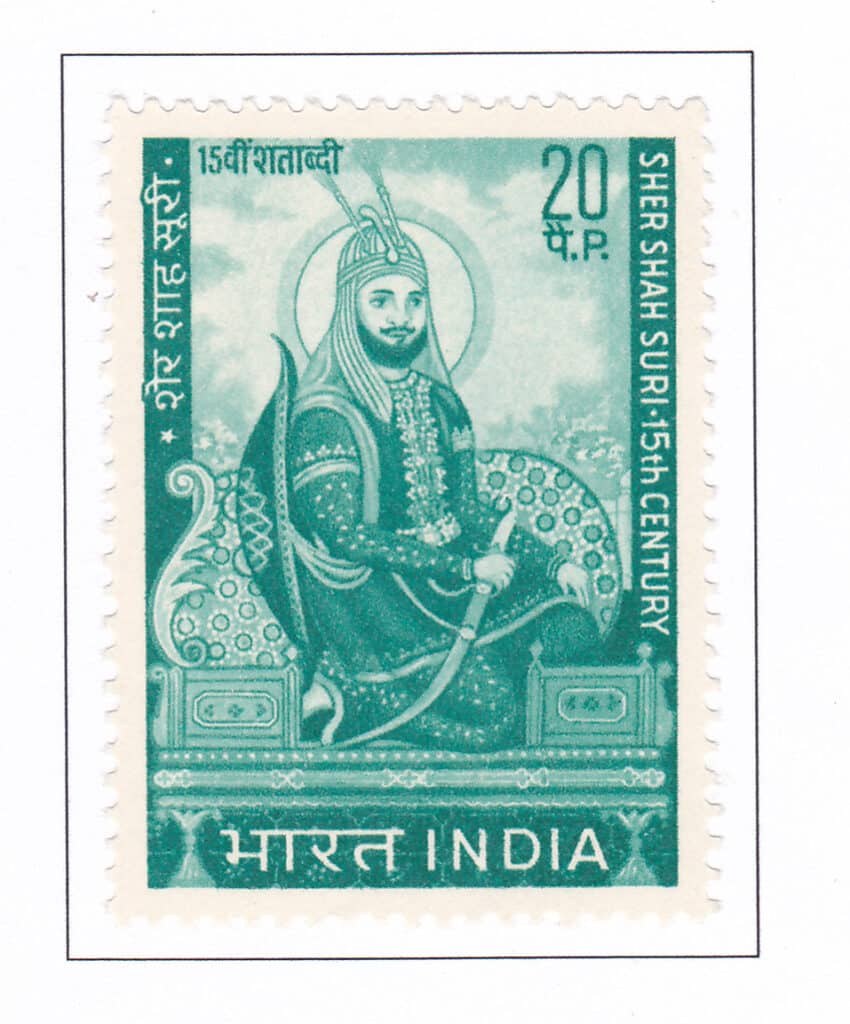
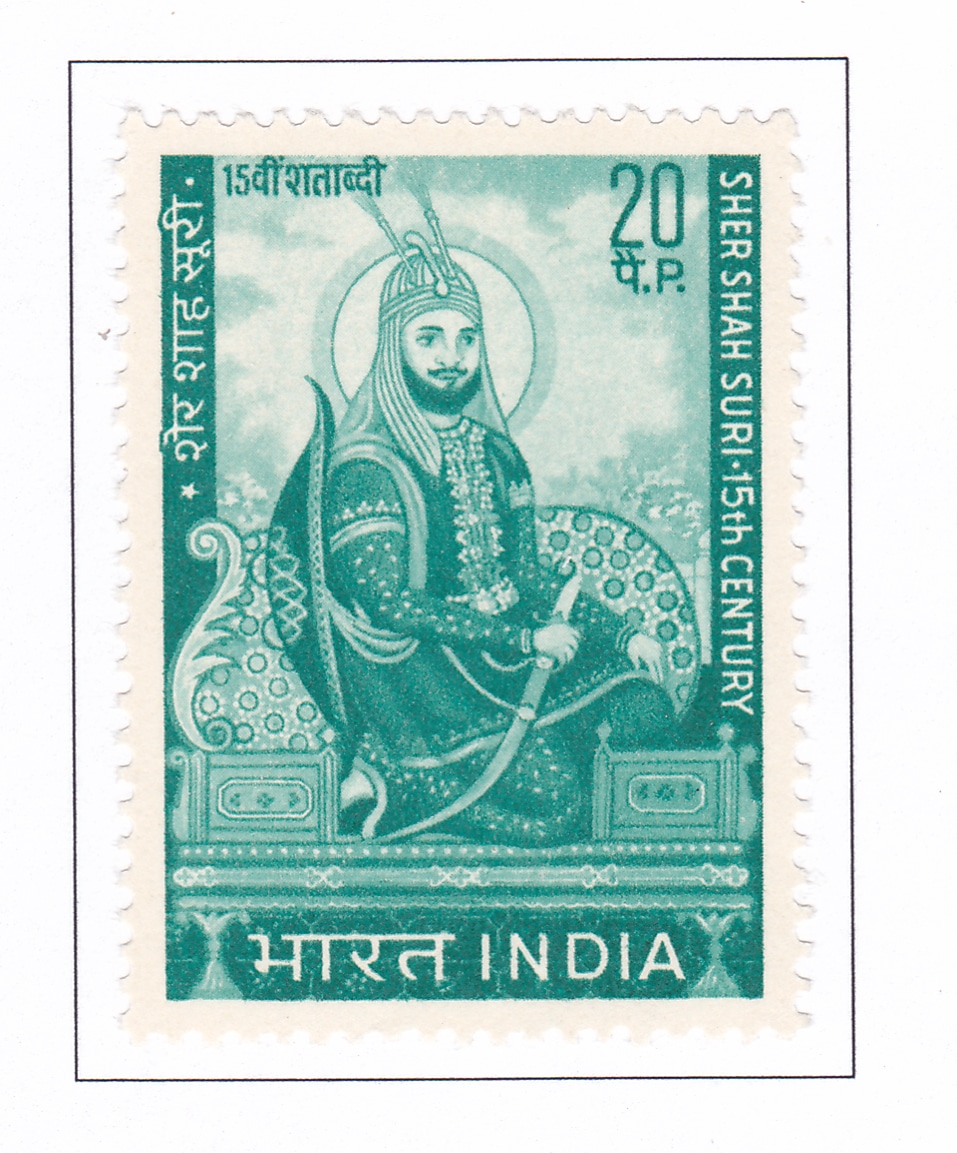
About this stamp
Sher Shah Suri stands as one of the remarkable and benevolent rulers in Indian history. His lineage traces back to Afghanistan, with his grandfather Ibrahim Khan Suri and father Hasan Khan Suri migrating to India during Sultan Bahlul Lodi’s reign. The exact details of Sher Shah Suri’s birth remain uncertain, with potential birthplaces including Parganah of Bajwarah, Narnaul, or Hissar Firoza.
Raised in Sahasram (modern Sasaram) in Bihar, Sher Shah Suri, initially known as Farid Khan Suri, received his education in Jaunpur. Gifted with natural intelligence and talent, he mastered Persian and Arabic languages and literature, memorizing works such as the Gulistan, Bostan, and Sikandaranamah.
Upon ascending to power, Sher Shah Suri celebrated his coronation in Gaur (Bengal) in 1538, pledging to expel the Mughals and reshape history. His adept politico-military leadership culminated in the conquest of Delhi, defeating the Mughal Emperor Humayun in the Battle of Kanauj in 1540.
Despite his brief tenure of around five years, Sher Shah Suri left an indelible mark as an exceptional administrator. He implemented several beneficial administrative reforms, including revenue, currency, and tariff reforms, central and provincial government reorganization, postal system strengthening, and army restructuring.
Sher Shah Suri displayed a deep concern for the welfare of the peasantry, ensuring a tolerant and liberal approach to revenue assessment by his revenue officers. He introduced the silver rupee coin, ‘Rupiya,’ and embarked on extensive road-building projects, including the iconic Grand Trunk Road (Shahrah-i-Azim), which connected Bengal to Punjab via Agra, Delhi, and Lahore.
Under his rule, Sher Shah Suri laid the foundation of a well-organized nationwide postal system, facilitated by improved communication means and a robust horse post system.
Tragically, Sher Shah Suri met his end on May 22, 1545, due to injuries from a gunpowder magazine explosion during his successful Kalinjar expedition. His magnificent mausoleum in Sasaram, Bihar, serves as a solemn tribute to his legacy.
At the time of his death, his territories extended from Bengal in the East to Punjab in the North-West, and from the Vindhya hills in the South to the Karakoram range in the North.
Sher Shah Suri’s reign revitalized the Indian postal system, leaving a lasting impact on its development. The Indian Posts and Telegraphs Department commemorates his memory by issuing a special postage stamp, honoring his legacy as a great ruler and early advocate of a nationwide postal service.
For More Information
Read more here: