
Nabha’s Postal Convention of 1885 and the State Post Office
How Nabha joined the Indian post: ratification on 23 March 1885, the convention in force from 1 July, three head offices tied to Ambala, Ferozepore and Delhi, and the end of the State post in 1949–51.
Updated October 21, 2026
In this article
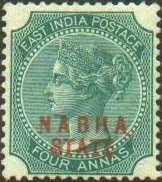
Nabha was a convention state: it used Indian stamps overprinted with its own name, supplied by the Government of India, and its post worked as part of the Indian post. The convention’s dates, its terms and the State’s own postal office are the frame for everything else.
A rural network within a wider post
C. Stewart-Wilson’s account of 1898 records fifteen State post offices and the mail lines that connected them, a snapshot of the early convention years rather than a fixed count. Nabha’s three separated territories had to exchange mail with the wider Indian post.[1]
Stewart-Wilson names Lalla Harnam Das as Nabha’s Head of Post Office, with the ruler, Hira Singh, listed separately. That places him in the postal administration in 1898; it does not make him a designer or printer of stamps, or prove that he held the post from 1885.[1]
Ratification, issue and commencement
Three dates need to be kept apart. C. U. Aitchison records the convention’s ratification by the Viceroy on 23 March 1885. A Postal Notice dated 22 June 1885 at Simla, signed by H. E. M. James as officiating Director-General of the Post Office of India and reproduced in Stewart-Wilson’s appendix, states that the conventions with Nabha and Jhind would come into force on 1 July 1885.[7][18]
Stewart-Wilson also reports that Nabha’s first curved overprints were made in February and issued in May 1885, separate from both. His chapter heading calls 1 July the date of execution, while the notice in his appendix calls it the date the convention came into force. Aitchison’s narrative says the original convention was executed in 1884, which does not fit his more specific ratification entry.[1][18][7]
What the 1885 notice allowed
The notice allowed the exchange of letters, insured and value-payable articles, parcels, money orders and India postal notes between Imperial offices and the offices of Nabha and Jhind. Inland postage and the conditions for registered, insured and value-payable articles applied in both directions; parcel postage had to be prepaid; money orders and postal notes followed the inland rates and conditions. It sets out the framework, not the full signed convention or a table of charges.[18]
Geoffrey Clarke’s account of the convention system describes Indian stationery and stamps overprinted for the State and supplied at cost for inland mail posted there. Foreign postage was to be paid with unoverprinted Indian stamps, and designated exchange offices handled insured and value-payable articles and money orders, under the rules of the Indian Postal Guide.[39]
The treaty collection records that Nabha signed a similar revised convention on 6 March 1900. That is the date of signing; its approval and commencement are not given, and the terms of the Patiala convention printed beside it should not be transferred wholesale to Nabha.[7]
Three head offices and their accounts
The Phulkian States Gazetteer, describing the year 1904 and published in 1909, places Nabha’s Postal Department under the Mir Munshi, with a Postmaster-General at Nabha; neither is named, and Harnam Das should not be given those titles. Overprinted stamps and stationery were supplied at cost for inland mail. State service labels paid official letters going outside the State, while official letters within it travelled without stamps; that was not an exemption for private local letters. Money-order commission was credited to the State, at a rate not stated.[19]
The Gazetteer pairs Nabha’s three head offices with Imperial offices for their accounts, and the Indian Postal Guide of October 1907 lists Umballa, Delhi and Ferozepore as Nabha’s exchange offices for money orders. These are accounting links, not the route of every letter.[19][20]
| Nabha head office | Imperial accounting office |
|---|---|
| Nabha | Ambala |
| Jaitu | Ferozepore |
| Bawal | Delhi |
How the stamps were supplied
B. Gordon Jones described the supply chain for the convention states in 1911. The State’s indent went to the Director-General of the Post Office, who requisitioned the Stamps and Stationery Office, and the sheets went to the Government of India Press. The printed sheets came back through the same offices to the State. Spoilt sheets were returned for replacement and were supposed to be destroyed. In these states, he says, SERVICE was applied separately. It is an account of the system, not a job sheet naming Nabha’s typesetters.[25]
A local press and fiscal paper, not postage
The Gazetteer mentions a Durga Press at Nabha, printing State papers in Gurmukhi and Urdu and Gurmukhi books, “but not books for sale”. It names no owner and says nothing of stamps, overprints or stationery.[19]
Nabha’s revenue paper had its own chain of control. Impressed non-judicial sheets of foolscap size were made in the Diwan’s office at Nabha, each signed by the Diwan, with its value in words and figures, an annual serial number at upper right and the Sambat year at upper left. They went to the Sadr treasury, where they were credited like cash, and the treasurer accounted monthly to the Diwan. Four vendors sold them, one at the capital and one at each nizamat; sales were registered and endorsed with the buyer’s details. Judicial stamps came in 1902, in colours by department: yellow for the Collectorate, green for Diwani (financial), red for criminal and black for murder cases. None of this concerns postage stamps.[19]
The later rulers
The Government’s memorandum of 1932 records Partap (Pratap) Singh’s succession in January 1928, with a Council of Regency during his minority; he was Ripudaman Singh’s eldest son, born 21 September 1919. The Supreme Court’s chronology dates his installation to 2 February 1928 and his full ruling powers to 5 March 1941. The London Gazette of 15 October 1946 names Pratap Singh Malvendra Bahadur as Maharaja of Nabha. The portraits on Nabha’s stamps are of course the British monarchs, not the Maharaja.[14][21][15]
The end of the State post
Political merger and postal integration were separate events. Nabha handed its administration to PEPSU on 20 August 1948. A postal-history study citing DGPO Circular 49 reports the takeover of Nabha’s postal administration on 16 September 1949, with Nabha stamps valid until 30 April 1950; the Smithsonian National Postal Museum describes their use alongside Indian stamps after 1 April 1950 and their replacement on 1 January 1951. The original circulars and dated covers are needed to reconcile these dates.
Sources
- [1] C. Stewart-Wilson, British Indian Adhesive Stamps Surcharged for Native States, Part II (Calcutta: Philatelic Society of India, 1898), Nabha chapter, pp. 33–46.
- [7] C. U. Aitchison, A Collection of Treaties, Engagements and Sanads, vol. I (Government of India, 1931): Nabha narrative; no. XI, p. 180 (ratification note); no. XX, p. 205 (revised convention); no. XXII, p. 215.
- [14] Government of India, Memoranda on the Indian States 1932 (corrected up to 1 January 1932), Calcutta: Central Publication Branch, 1933, “Nabha”, printed pp. 126–127, especially final paragraph p. 127.
- [15] The London Gazette, supplement to issue 37756, 15 October 1946, p. 5070, military memorandum: Pratap Singh Malvendra Bahadur named Maharaja of Nabha.
- [18] Postal Notice of H. E. M. James, officiating Director-General of the Post Office of India, Simla, 22 June 1885, reproduced in Stewart-Wilson (1898), appendix, document I, p. 123.
- [19] Punjab States Gazetteers, vol. XVII A, Phulkian States: Patiala, Jind and Nabha (descriptive year 1904, published 1909), Nabha, pp. 339–396, especially pp. 370–372, 376.
- [20] Indian Postal Guide, October 1907, pp. 172–173, clause 309.
- [21] Supreme Court of India, Maharaja Pratap Singh v. Maharani Sarojini Devi, 17 August 1993.
- [25] B. Gordon Jones, “The Puttilla Error”, letter dated London, 25 March 1911, The Philatelic Journal of Great Britain, 20 April 1911, pp. 64–65.
- [39] Geoffrey Clarke, The Post Office of India and Its Story (1921), chapter III and the account of the Tibet Field Force.
- Supreme Court of India, Talat Fatima Hasan v. Nawab Syed Murtaza Ali Khan, 31 July 1996 (Nabha’s transfer to PEPSU, 20 August 1948).
- Smithsonian National Postal Museum, Convention States: Nabha.
- “Merger of Postal System”, postal-history study citing DGPO Circular 49.
Notes 0
Add what you know: a cover or stamp in your collection, a date or source, a correction or a question.
No notes yet.
Sign in to add a note.
Notes show straight away. Keep them kind and about the article; anyone can report one that isn't. House rules
