
Kishangarh’s Portrait Stamps, 1904–1947: Engraved Sets, the Diamond Soap Works and ON K S D
Reading the portrait inscriptions, the engraved set received in 1905, the Perkins Bacon question, trials and tête-bêche multiples, the Diamond Soap Works sheets, later papers and the ON K S D handstamps.
Updated August 7, 2026
In this article
Read the inscription before the colour
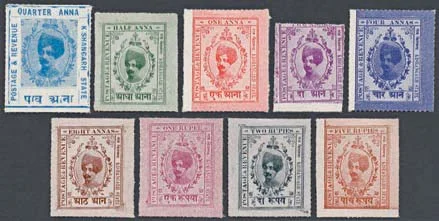
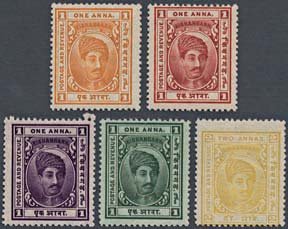
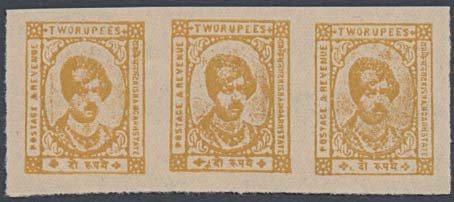
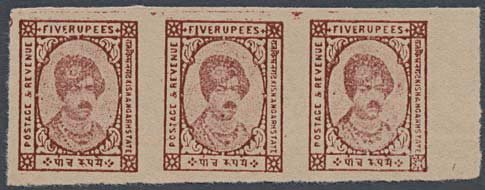
The portrait is only the start of identification. In the catalogue’s 1904 family, POSTAGE AND REVENUE runs down the left side; the 1913 family reads POSTAGE & REVENUE. Read the lettering before using colour, since different values and later types can look alike.[3]
The two-anna portraits need a second check. The catalogue separates a brown portrait in an ellipse, dated 1899, from a yellow portrait in a rectangular frame, dated 1904. Sharing a value does not mean two stamps belong to the same issue.[3]
What had been received by February 1905
The Monthly Journal of 28 February 1905 describes an engraved portrait set: an upright oval portrait in a rectangular frame, the value in English above and in Devanagari below, POSTAGE AND REVENUE at the left and KISHANGARH on the upper tablet. It reported white wove paper, perforation 12½–13, and sheets of eighty stamps in ten horizontal rows. That description belongs to this issue and does not replace every later perforation listing.[26]
Eight values were received in February: quarter, half, one, two and four annas, and one, two and five rupees. The eight annas violet was reported on 30 June from another periodical, explicitly not yet received by the editor. A later family of nine values does not show that all nine reached collectors, or came into use, at the same time.[26]
What the Perkins Bacon evidence does not name
The journal of 1905 thought the engraved stamps evidently the work of the same firm as Jaipur’s: an inference, not a reproduced order. Archive material catalogued by Grosvenor as Perkins Bacon revenue work includes a hand-painted two-anna design, a black die proof and green proofs on sunken card. The pictured design carries no artist’s signature, and a related revenue design does not identify the designer or engraver of the postage stamps or give the history of the commission; that needs the firm’s job records or a signed design.[26][31]
Whose portrait?
Howes said the early portrait was supposed to represent Sardul Singh, a deliberately less certain wording than a signed identification. He called the later engraved set of 1904 a nearly full-face portrait of his successor, Madan Singh. Both statements concern their own groups. His comparison with Jaipur’s taille-douce stamps describes a printing technique and does not show a shared printer, designer or engraver. The portrait of 1928 is a separate question that the name of the reigning ruler cannot settle.[32]
Abnormal printings, trials and multiples
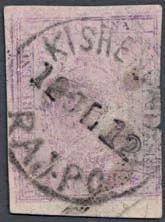
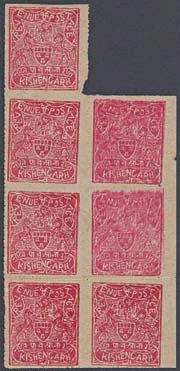
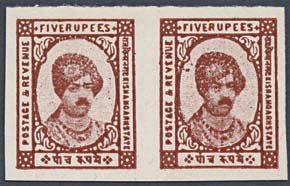
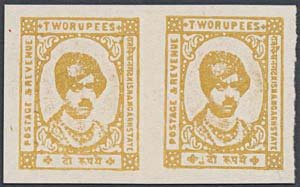
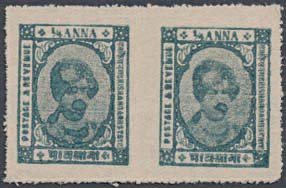
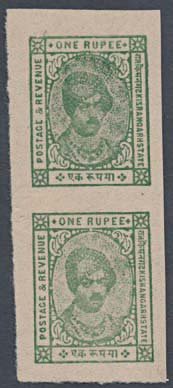
The pictures below separate a repeated printing, a missing part of an impression and a change of direction. A tête-bêche pair has neighbouring stamps facing opposite ways; a double impression repeats the printing on the paper. Neither is a colour trial, made to test or show a colour rather than for the ordinary issue.[8]
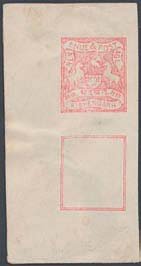
The two-anna colour trials are labelled as trials and kept out of the issued stamps; their colours should not be transferred to the ordinary issue. A frame-only lower position must be compared with the two empty frames deliberately left in the half-anna layout of 1903; without evidence to separate it from them, it is not treated as an accidental omission or a new value.[8][10]

The Diamond Soap Works on the sheet
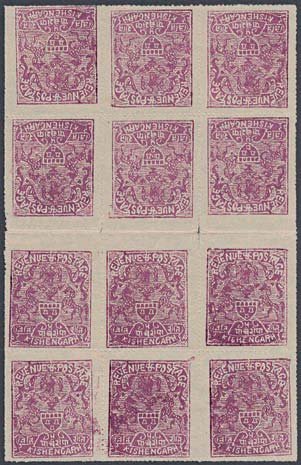
A complete sheet in Gärtner’s lot 1345 carries DIAMOND SOAP WORKS. K.S.G. at its foot. Its twenty stamps are in two vertical panes of ten, separated by a central gutter. An imprint on the sheet itself is better evidence of the maker than a catalogue label. The auction’s dates of 1913–16 and its claim of a first printing remain the catalogue’s; the sheet gives no date of production and does not show that the firm printed every other Kishangarh issue.[8]
A blue card from the Diamond Soap Works offers to prepare the State’s revenue stamped papers and tickets in different colours and asks His Highness to give an order. It closes K. L. Manager, The Diamond Soap Works, Kishangarh, and the other side carries four samples, in the order two annas, half anna, one anna and quarter anna. It is a commercial proposal from a manager known only by his initials: not a contract, an invoice, a signature, a printed quantity or evidence that K. L. designed or engraved the stamps. The card is undated and does not name the ruler addressed.[28][29]
A study of the small sheets
An undated two-page study signed R. F. S. examines sheets of twenty, in five rows of four, on thick surfaced paper, rouletted. It names three printings A, B and C, reports the letters D.S.W.K.C. below A and B and none below C, and suggests what the last initials stand for. The labels are the author’s, not dated printings.[27]
The study places KISHANGAHR at position 7 in both values, and O for Q at position 16 of the quarter anna. Repeated features of the portrait and of the vertical lettering led the author to suggest shared frames, and larger figures 2 at positions 2, 3 and 4 of the two annas give further points of comparison. These belong to that setting, not to all later sheets, and his old SG 59–60 numbers need checking against a dated catalogue.[27]
Later papers
The register separates the thick surfaced paper of the portrait group catalogued as 1928–36 from the thick, soft, unglazed paper of the 1940s. The album lists the soft paper up to one rupee; the auction also illustrates two- and five-rupee stamps on it. These keep their paper attributions and are not dated by the look of the portrait.[7][8]
Later sheets came in different sizes. Köhler’s descriptions record half anna in tens; one anna in tens and twenties; two annas in twenties; and eight annas in tens and fifteens. These describe particular sheets, not a printer’s standard.[3][30]
The official ON K S D handstamps
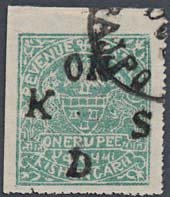
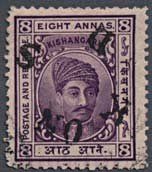
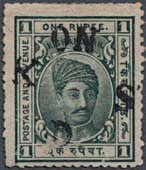
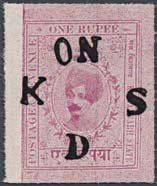
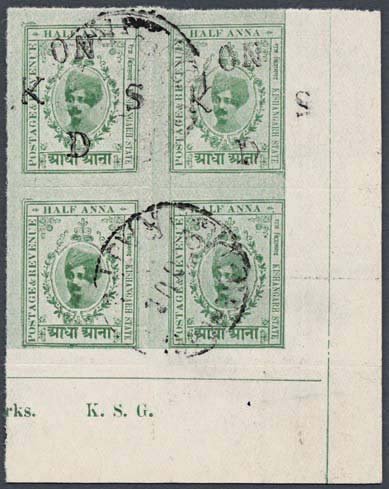
The official list separates the black and red ON K S D handstamps by the stamp underneath. The same face value does not make an arms stamp, an early portrait and a later redrawn portrait interchangeable. An unclear five-anna label in the album has been left out rather than turned into a value that did not exist.[7][8]
Applying the handstamp was a separate operation from printing the stamp. Keep each black or red application with its arms or portrait design; an old stamp handstamped later is not a new printing, and a transposed wording in an auction description is not a new type of overprint.[3][30]
Sources
- [3] Evert Klaseboer, online catalogue, “Indian States, Kishengarh”: issue families, official overprints and forged cancellations.
- [7] William E. Steiner, India—Feudatory States, album pages, StampAlbums.com, pp. 96–104.
- [8] Christoph Gärtner, 17th auction, India and Indian States, 7 March 2011, Kishangarh lots 1310–1382, plates pp. 69–76.
- [10] E. B. Evans, “The Stamps of Some of the Native States of India: Kishengarh”, Stanley Gibbons Monthly Journal, 30 June 1904, p.270.
- [26] Stanley Gibbons Monthly Journal, 28 February 1905, p. 161, and 30 June 1905, p. 245.
- [27] R. F. S., “Note on Kishengarh: Stanley Gibbons’ Nos. 59, 60”, two pages, undated.
- [28] Diamond Soap Works solicitation card, reverse: Heinrich Köhler, auction 377, lot 10882.
- [29] Diamond Soap Works sample card, front: Heinrich Köhler, auction 377, lot 10882.
- [30] Heinrich Köhler, auction 377, Kishengarh lots 10873–10895.
- [31] Grosvenor, auction 94, 11 March 2015, lot 2121.
- [32] C. A. Howes, “Some Stamp Designs”, Kishangarh section, The American Journal of Philately, pp. 4–5.
Notes 0
Add what you know: a cover or stamp in your collection, a date or source, a correction or a question.
No notes yet.
Sign in to add a note.
Notes show straight away. Keep them kind and about the article; anyone can report one that isn't. House rules
