
Kishangarh’s Darbar Post: Offices, Runners, Lorries, Money Orders and Postmarks
The State post beside the British offices, the 1902 report of absorption that did not come true, the State’s own office counts from 1906 to 1943, money orders, lorries, officials, presses and how to read a RAJ. P.O. mark.
Updated September 30, 2026
In this article
Two separate networks
Kishangarh’s stamps belonged to the Darbar’s own post, not to the British Indian post offices inside the state. The Imperial Gazetteer describes four British post offices, three of them with telegraphs, beside thirteen State offices, ten runners and a local network of 65 miles. These are separate counts, not one list of seventeen offices, and the Gazetteer gives no date for its postal paragraph: it is a picture of the early twentieth century, not a census for its year of publication.[5]
Spelling needs care. Kishengarh, with an e, is a familiar spelling of the time on stamps and in catalogues and should be kept when reading a cancellation. Evans warned that directories listed both Kishangarh and another Kishengarh farther north, while the State’s stamps used the second spelling; identify an office from the whole cancellation and its setting, not from one vowel.[1]
The 1902 report of absorption
In September 1902 The Philatelic Record reported that Alwur, Bundi and Kishengarh would issue no more stamps, their posts having been absorbed into the Imperial Post of India. It named its informant as Mr Stewart-Wilson. The Stanley Gibbons Monthly Journal repeated the news, crediting the Record, so the two notices are not independent.[25][1]
The report shows what collectors were being told in 1902. It gives no date or terms for a postal agreement, and its prediction failed: Evans pointed out in 1904 that new stamps had appeared, and the State’s own later reports go on recording its post offices. It stays a reported development, not a closing date.[25][1]
What collectors saw in 1899 and 1900
Evans separated what collectors had seen from what the State had established. He recalled a report of December 1899 naming only Arain and Kishengarh, then a list in The Philatelic Journal of India of March 1900 adding five offices whose postmarks had been seen: Arkeri, Bandersindri, Didwara, Kuchil and Salemabad (Arkeri is his spelling). These show what marks were known, not when each office opened, and the first two-office report was never a full census.[1]
The State’s own counts
The State’s administration reports give firmer dated counts. The report for Sambat 1963, covering 19 September 1906 to 7 October 1907, records eighteen post offices, one of them opened during the year. There were still eighteen in the report for 26 September 1908 to 14 October 1909, which proposed new offices at Fatehgarh and Gothiana. The report for 4 October 1910 to 23 September 1911 records twenty-one, without naming the three new ones or saying when the two proposals were carried out. The reporting periods differ from the years the reports were printed, 1908, 1910 and 1912.[13][14][15]
| Reporting period | State offices | What the count shows |
|---|---|---|
| 19 September 1906 – 7 October 1907 | 18 | One office opened during the period; its name is not given |
| 26 September 1908 – 14 October 1909 | 18 | Fatehgarh and Gothiana proposed, not proved opened |
| 4 October 1910 – 23 September 1911 | 21 | A total, not a list of openings |
| 1 November 1938 – 31 October 1939 | 29 | Against 23 the year before |
| 1 November 1940 – 31 October 1941 | 34 | Unchanged from the year before; postal arrangements in every tehsil except Satolao |
| Samvat 1998, in the report for 1941–43 | 34, reduced to 30 | Both figures printed against Samvat 1998; the cut followed fewer tehsils, with no office names or closing dates |
State money orders and local currency
The report for the year ending July 1904 refers to State postal money orders. Its Mint section says that Imperial rupees were now allowed in remittances paid to the public through them, as part of an effort to encourage Imperial rather than local currency. So the State had a money-order service by then, though its start and any exchange agreement with the Imperial Post Office are unknown.[12]
The difference of currency was real. The report for 1908–09 values the commonly used Choisania rupee at eleven British annas; that for 1910–11 gives nine and a half British annas for the Choisaniya rupee. These are exchange rates, not postage, and they do not allow stamp values to be converted or the currency of every charge to be guessed.[14][15]
Lorries and runners
In 1938–39 the State reported twenty-nine post offices, against twenty-three the year before, and fourteen runners. The interior Raj post offices worked through the tehsildars. Mail went by lorry to Sarwar, Rupnagar and Arain, and by runner elsewhere.[16]
The report for 1940–41 records thirty-four Raj post offices, unchanged from the year before, with postal arrangements in every tehsil except Satolao, thirteen runners, and Karkeri added to the places served by lorry. The report for Samvat 1998–1999 records the cut from thirty-four offices to thirty after tehsils were reduced, and again describes motor carriage to Sarwar, Rupnagar, Karkeri and Arain, with runners elsewhere. These describe transport at their dates; they are not a timetable, nor proof of the route of a particular cover.[17][18]
The people who ran the post
The report for 1938–39 places the State Post Offices under Mr. Nathoo Lal, Sarishtedar of the Revenue Department. The report for 1940–41 names Mr. Nathulal Mattar as in charge throughout the year; it gives him no title such as Postmaster-General. The names are printed differently and, without more evidence, should be kept as separate entries rather than one man’s continuous service. Neither is credited with designing or printing stamps.[16][17]
Local presses and State printing
The reports name printers working for the State, but never as postage-stamp printers. In 1906–07 the private Sardul Gyan Sagar Press did job work and vernacular printing for the State. The report for 1908–09 says that an unnamed press “did not do much work”, without saying why or which press. The report for 1910–11 describes a new press opened the year before by N. Parasar, which had done the State’s work satisfactorily. The Ajmer printers named on the reports’ title pages printed the reports, not stamps.[13][14][15]
Reading a State datestamp
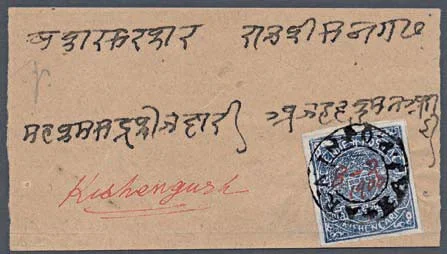
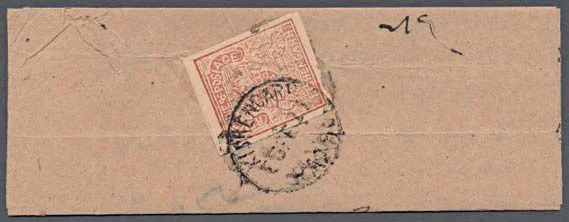
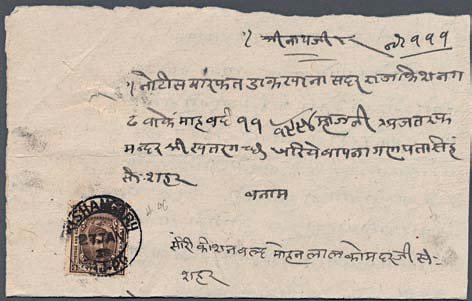
Evans describes circular State datestamps, usually with the office name above and RAJ. P.O. below. Early strikes have dates written by hand; movable type followed. His earliest legible movable-type date read KISHENGARH 7 JU 00, on a one-anna stamp on an entire envelope with an Arain backstamp written by hand. He said he had too few examples to date the change. Keep the reading JU as it is, and do not treat a handwritten date as non-postal.[1]
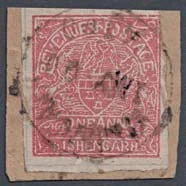
Transcribe both halves of the circle: RAJ. P. O., the office name and occasional different lower inscriptions can separate similar marks. Describe a faint red strike as partly illegible when it is; filling the gaps from a catalogue gives false precision.[1]
A dated cancellation can still be forged
Evert Klaseboer’s catalogue identifies a KISHENGARH / 23 AP 04 / RAJPO cancellation as a Fournier forgery and illustrates suspect stamps with a strike of that date. That is a specific warning, not a reason to doubt every Kishangarh cancellation. A readable date alone does not prove postal use: compare the whole strike, the stamp and, where possible, the cover.[3]
Sources
- [1] E. B. Evans, “The Stamps of Some of the Native States of India: Kishengarh”, Stanley Gibbons Monthly Journal, 30 June 1904, pp. 268–271.
- [3] Evert Klaseboer, online catalogue, “Indian States, Kishengarh”: issue families, official overprints and forged cancellations.
- [5] The Imperial Gazetteer of India, vol. XV, “Kishangarh”, pp. 312 and 315.
- [8] Christoph Gärtner, 17th auction, India and Indian States, 7 March 2011, Kishangarh lots 1310–1382, plates pp. 69–76.
- [12] Annual Report on the Administration of the Kishangarh State for the Sambat Year 1960 (ending July 1904), Ajmer: Rajputana Printing Works, 1904, section XIV, “Mint”, p. 24.
- [13] Annual Report on the Administration of the Kishangarh State for the Sambat Year 1963 (19 September 1906 – 7 October 1907), Ajmer: Rajputana Printing Works, 1908, “Post Office”, p. 14, and p. 17.
- [14] Report on the Administration of the Kishangarh State for the Sambat Year 1965 (26 September 1908 – 14 October 1909), Ajmer: Job Printing Press, 1910, “Post Offices” and “Mint”, pp. 20 and 24.
- [15] Report on the Administration of the Kishangarh State for the Sambat Year 1967 (4 October 1910 – 23 September 1911), Ajmer: Job Printing Press, 1912, “Post Offices” and “Mint”, pp. 14 and 18.
- [16] Report on the Administration of the Kishangarh State for the Sambat Year 1995 (1 November 1938 – 31 October 1939), submitted 25 June 1940, pp. 4–8 and “State Post Offices”, pp. 43–44.
- [17] Administration Report of the Kishangarh State for the Samvat Year 1997 (1 November 1940 – 31 October 1941), September 1943, chapter VIII, “Raj Post Office”, pp. 52–53.
- [18] Report on the Administration of the Kishangarh State for the Samvat Years 1998–1999 (1 November 1941 – 31 October 1943), Ajmer: Vedic Yantralaya, 1944, pp. 3–4, 69 and 81.
- [25] The Philatelic Record, September 1902, p. 195; repeated in the Stanley Gibbons Monthly Journal, p. 64.
Notes 0
Add what you know: a cover or stamp in your collection, a date or source, a correction or a question.
No notes yet.
Sign in to add a note.
Notes show straight away. Keep them kind and about the article; anyone can report one that isn't. House rules
