
Bundi’s Service Stamps: Handstamped Cows, Overprinted Arms and a Dispute
Bundi’s official mail was carried free until 1941; the native-script and English BUNDI SERVICE handstamps on the cows, the SERVICE arms, and the argument over how many were used for postage.
Updated May 20, 2026
In this article
An official overprint marks a category of use; it does not print a new value. Read it with the stamp underneath and its original value.
Reading the official inscription
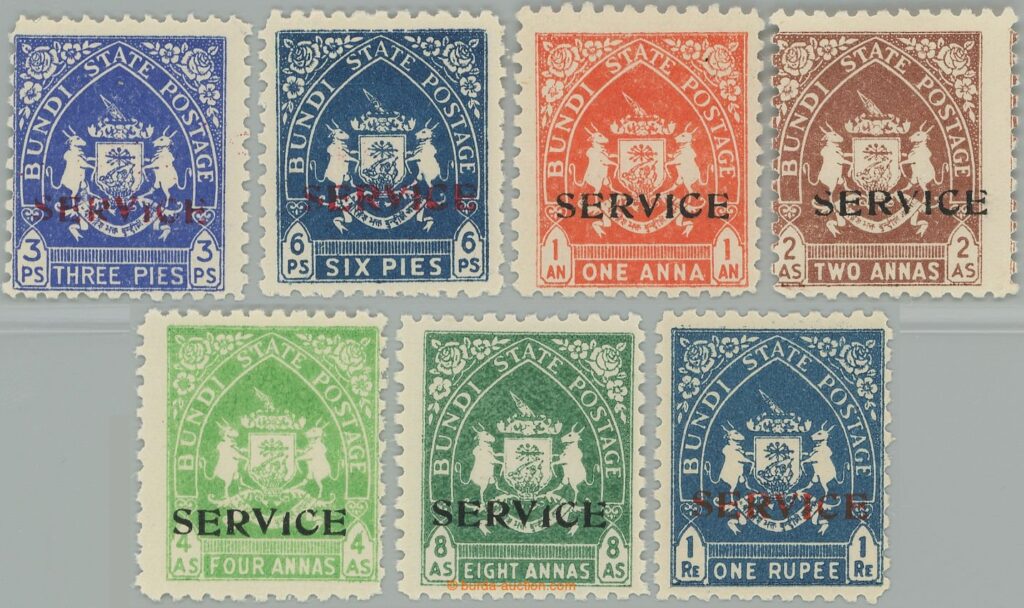
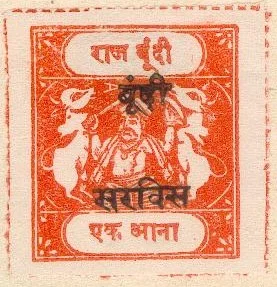
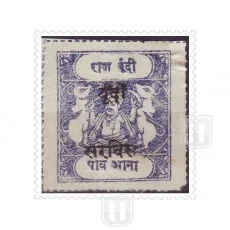
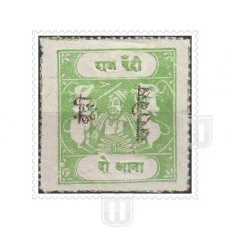
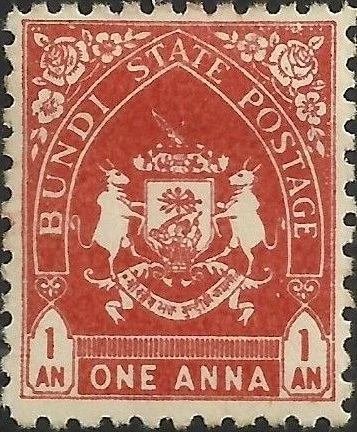
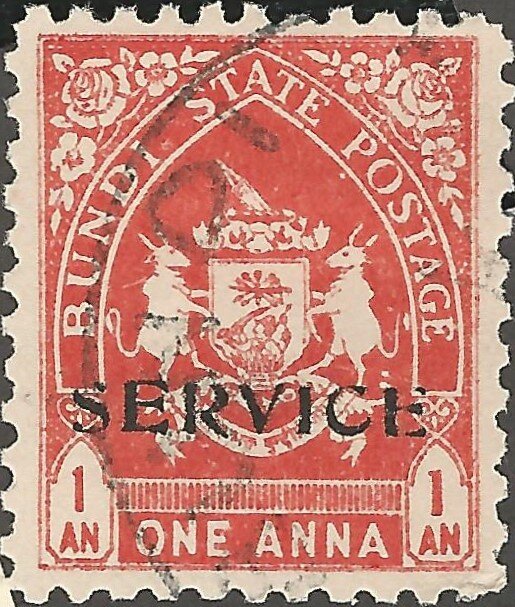
BUNDI SERVICE marks the intended official use. The catalogue separates native-script service markings from the English BUNDI SERVICE in different sizes, and records inverted and double applications; these distinctions need the right base stamp as well as the added text. The arms set also received an English SERVICE overprint. A surcharge, by contrast, gives a new value, and the Rajasthan overprints are another category again: the transition from the former state.[B14]
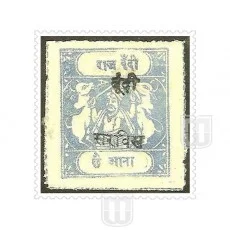
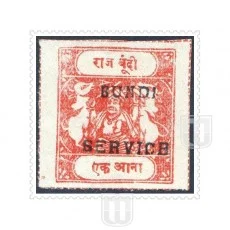
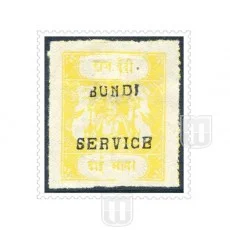
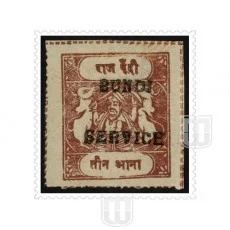
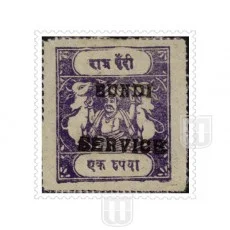
Three handstamps, not a new design for every strike
The Devanagari overprint and the small and large English overprints were applied as single handstamps, so their position varies from stamp to stamp in a block of four. Differences in spacing across a block are not the mark of a fixed four-subject forme.[B20]
Benns records red and black for all three, green in some Devanagari and small-English settings, and no green large-English example in his study, an observation of its date, not proof that a later report is impossible. Inverted, double, sideways and mixed handstamps need to be separated from postal status: a genuine impression may still have been made for a collector.[B20]
Why a Service overprint needs postal evidence
In 1974 Peter Rover examined Bundi’s administration reports. Those for 1939/40 and 1940/41 described state mail as free; the report for 1941/42 recorded the introduction of payment and Service stamps. He argued that the earlier overprinted cows had mainly served collectors, and reproduced a report of 1925 describing overprinting to a visitor’s requirements.[B18]
The editor did not accept that the earlier stamps were never used for postage. His note allowed that some had been, while agreeing that official mail was generally carried free until 1941. The disagreement stands: a catalogue listing, an inverted overprint or a loose cancelled stamp cannot settle how much was really used. Rover also recorded the two-anna arms Service stamp on public covers from early 1947, an observation that should not be extended to every official stamp.[B18]
Rover’s transcription connects charging for state mail with an effort to cut down correspondence: 5,000 official packets in 1939/40 and 1,503 in 1944/45. These are traffic totals, not printing quantities, and they show why a government might start accounting for postage even on a post it ran itself.[B18]
The arms with SERVICE
A cover described in the covers chapter, a registered official letter of 29 May 1938 marked KAR SARKARI (“on service”) with a three-annas cow stamp, shows a stamp on mail marked official; it is one cover, not evidence that every official letter paid.[B15]
Feldman’s 2025 reference lot describes cow forgeries of types F1 and F2 with genuine small native or English official overprints: a genuine overprint does not make the whole stamp genuine.
Sources
- [B14] Evert Klaseboer, Bundi, forgery and official overprint notes.
- [B15] Christoph Gärtner, 17th Auction: Indian States (Park Collection), 7 March 2011, Bundi pp. 113–115, lots 714–756, plate p. 19.
- [B18] Peter Rover, “The Sacred Cows of Bundi: What about the Service Overprints?”, Stamp Monthly, August 1974, pp. 44–45, with the editor’s comment.
- [B20] R. J. Benns, The Sacred Cow Issues of Bundi, Handbook of Indian Philately, India Study Circle, April 1986.
- [B23] Burda Auction, Public Auction 74, object 249183, Bundi SERVICE arms set, SG O53–O59 as attributed.
- David Feldman, Indian States: Bundi, December 2022, official Sacred Cow lots (SG O1–O52).
Notes 0
Add what you know: a cover or stamp in your collection, a date or source, a correction or a question.
No notes yet.
Sign in to add a note.
Notes show straight away. Keep them kind and about the article; anyone can report one that isn't. House rules
