
Bundi: the Dagger, the Sacred Cows and the State Post, 1894–1950
Bundi, the Hada Chauhan state of Hadoti, issued its own stamps from 1 May 1894 until the Indian Postal Department took over on 1 April 1950: its rulers, chronology and stamps.
Updated September 23, 2026
In this article
The state behind the stamp
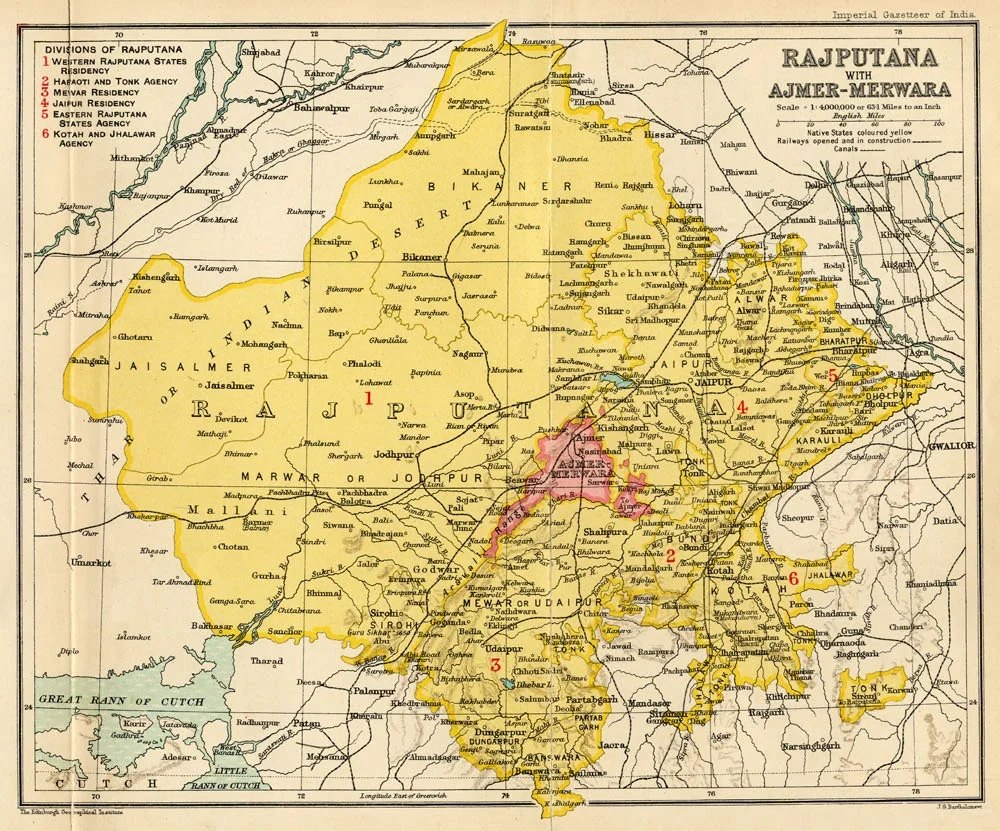
Bundi was a principality of the Hada Chauhan Rajputs in the Hadoti region of Rajputana, now south-eastern Rajasthan. Its capital, also called Bundi, lies in a narrow valley about 36 kilometres from Kota, with the palace and fort rising above the town, and its history is shared with neighbouring Kota. On the 1909 map Bundi lies south-east of Ajmer, just north-west of Kotah.
Its stamps show the state’s authority in different forms: the dagger, the sacred cows, the state arms and finally the portraits of Bahadur Singh and views of the town. Rajasthan overprints carried the last Bundi designs into a new administration. Bundi was incorporated into the United States of Rajasthan in March 1948, but its separate post ended only on 1 April 1950.
The rulers
A ruler’s reign and the dates a stamp was issued or valid are different kinds of evidence.
| Reign | Ruler | Note |
|---|---|---|
| 1821–1889 | Ram Singh | His long reign is the background to the later post; it ended before the first stamps |
| 1889–1927 | Raghubir Singh | Ruler when the first stamps appeared in 1894 and during the early Sacred Cow issues |
| 1927–1945 | Ishwari Singh | The later Sacred Cows and the 1941 arms set fall in his reign |
| from 1945 | Bahadur Singh | His portrait is on the 1947 set; the state joined Rajasthan in 1948 |
A state made visible in its post
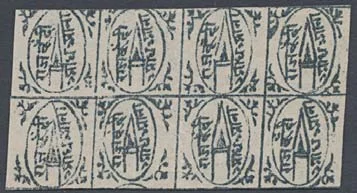
Adhesive stamps were introduced on 1 May 1894 in a State post that already existed. The first half annas were lithographed, every stamp drawn on the stone, so paper, drawing and sheet arrangement are what identify them.[1]
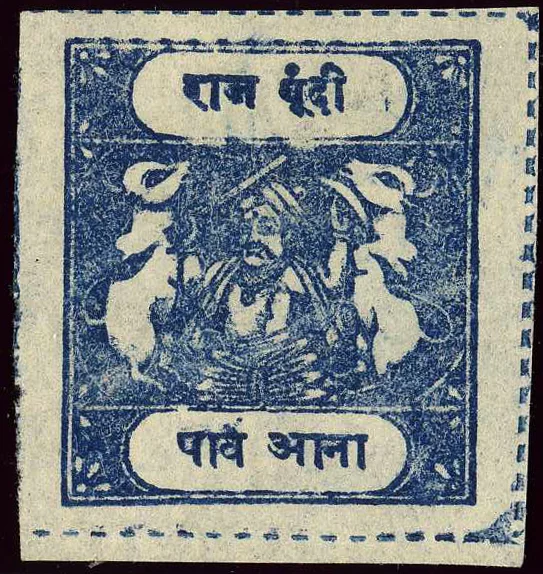
The Sacred Cow design brought another method: four typographic clichés with replaceable inscription tablets, used for decades in many values, papers and settings. The 1947 set put Bahadur Singh on the lower values and Bundi town on the two highest, and these stamps were overprinted for Rajasthan before the service passed to the Indian Postal Department.
In December 1903 the authorities told The Philatelic Journal of India, through Mr. Lovell Pigott, that the half anna was the only stamp then used for postage, and reported that the Bundi rupee was worth about 20% less than the British Indian rupee, an approximate comparison of that date.[B42][B31]
The chapters that follow take the dagger stamps of 1894–1899, the Sacred Cows, the arms and portrait sets with the Rajasthan overprints, the Service stamps, how the post worked (tariffs, currency and formula postcards), covers and postmarks, and forgeries and collecting.
Chronology
| Date | Event |
|---|---|
| 1 May 1894 | Adhesive stamps introduced in the existing State post; first half-anna printing reported as 3,000 |
| 7 December 1894 | Second half-anna printing, reported as 10,000, in an unequal sheet of 294 |
| 1 November 1896 | Third half-anna printing, 12,800, on laid commercial paper |
| Autumn 1897 | Stewart-Wilson’s enquiry; assurance that no more eight annas and one rupee would be printed |
| 1 July 1897 | Higher values introduced on papers with commercial watermarks |
| 14 January – 5 February 1898 | Four, two, one and half anna printings (Evans’s dates of manufacture) |
| 3 and 7 July 1898 | Eight annas (6,000) and one rupee (5,640) printed again |
| 9 November 1898 | Four annas with the dagger facing left, 2,000 |
| About mid-1899 | A fresh drawing of the one anna |
| 28 February 1901 | Evans publishes the complete sheet of 294 |
| 31 October 1902 | Stanley Gibbons Monthly Journal relays news of an Imperial takeover; not an abolition order |
| December 1903 | The half anna reported as the only stamp then used for postage |
| 1908 | The Imperial Gazetteer describes Bundi’s local post and its stamps |
| October 1914 | Half-anna Sacred Cow issued |
| February 1915 | Two and four annas Sacred Cows |
| 12 December 1917 | Our Day Red Cross label (Benns); postal use unproved |
| 25 March, 12 May and 25 August 1924 | Tariff and postcard instructions; formula cards sent for sale; earliest recorded use 5 September |
| 9 February 1929 | Shree Rangnath Press registration form, 800 printed |
| 1 and 11 October 1938 | Hali currency abolished; postal instructions to Nainwa in Kaldar |
| 1941–1944 | State arms set, in sheets of twelve |
| 1941/42 | Payment and Service stamps for official mail introduced (administration report) |
| 1947 | Portrait and town set, printed by the Times of India Press, Bombay |
| 25 March 1948 | Union of Rajasthan inaugurated, including Bundi |
| 1948–1949 | Rajasthan handstamps and machine-printed overprints on the 1947 stamps |
| 1 April 1950 | Bundi’s separate post ends; Indian stamps replace the State’s |
The stamps
The issues and their values, from the research checklist. Service stamps, the shades, papers, settings and inscription types are not listed; one anna was twelve pies.
| Period | Issue | Values |
|---|---|---|
| 1894; 1896 | Early katar dagger | ½ anna — May 1894, ½ anna — December 1894, ½ anna — November 1896 |
| 1897–1900 | Dagger; narrow and wider blades, including left-pointing variety | ½ anna, 1 anna, 2 annas, 4 annas, 8 annas, 1 rupee |
| 1914–41 | Maharao and sacred cows | ¼ anna, ½ anna, 1 anna, 2 annas, 2½ annas, 3 annas, 4 annas, 6 annas, 8 annas, 10 annas, 12 annas, 1 rupee, 2 rupees, 3 rupees, 4 rupees, 5 rupees |
| Catalogued 1941 | Redrawn cow design | ¼ anna, ½ anna, 1 anna, 2 annas |
| 1941–45 | State arms | 3 pies, 6 pies, 1 anna, 2 annas, 4 annas, 8 annas, 1 rupee |
| 1947 | Bahadur Singh portraits; Bundi town | ¼ anna, ½ anna, 1 anna, 2 annas, 4 annas, 8 annas, 1 rupee |
| 1948–49 | 1947 Bundi stamps handstamped RAJASTHAN (rajasthan overprint) | ¼ anna, ½ anna, 1 anna, 2 annas, 4 annas, 8 annas, 1 rupee |
| 1949 | 1947 Bundi stamps, machine overprint in black (rajasthan overprint) | 2 annas, 4 annas, 8 annas, 1 rupee |
Sources
- [1] “The Stamps of Bundi”, reprinted from The Philatelic Journal of India, The Philatelic Record, vol. 20, 1898, pp. 36–37.
- [B31] Stanley Gibbons Monthly Journal, vol. 14, 30 January 1904, p. 136.
- [B42] The Philatelic Journal of India, vol. VII, no. 12, December 1903, p. 344.
- Census of India 2011, District Census Handbook, Bundi, Part B, Brief history of the district, p. 10.
- Los Angeles County Museum of Art, object M.75.19: Ram Singh of Bundi, reigned 1821–1889.
- Smithsonian National Museum of Asian Art Archives, FSA.A1999.01_ref30: Raghubir, Ishwari and Bahadur Singh of Bundi.
Notes 0
Add what you know: a cover or stamp in your collection, a date or source, a correction or a question.
No notes yet.
Sign in to add a note.
Notes show straight away. Keep them kind and about the article; anyone can report one that isn't. House rules
