
Sirmoor’s Inscription Stamps, 1879–1893: the First Pice and the Printed Border
Sirmoor’s first stamps: the green and blue one-pice inscription stamps of 1879–80, their sheets and paper, and the redrawn issue of 1892 with a perforation border printed into the design.
Updated May 7, 2026
In this article
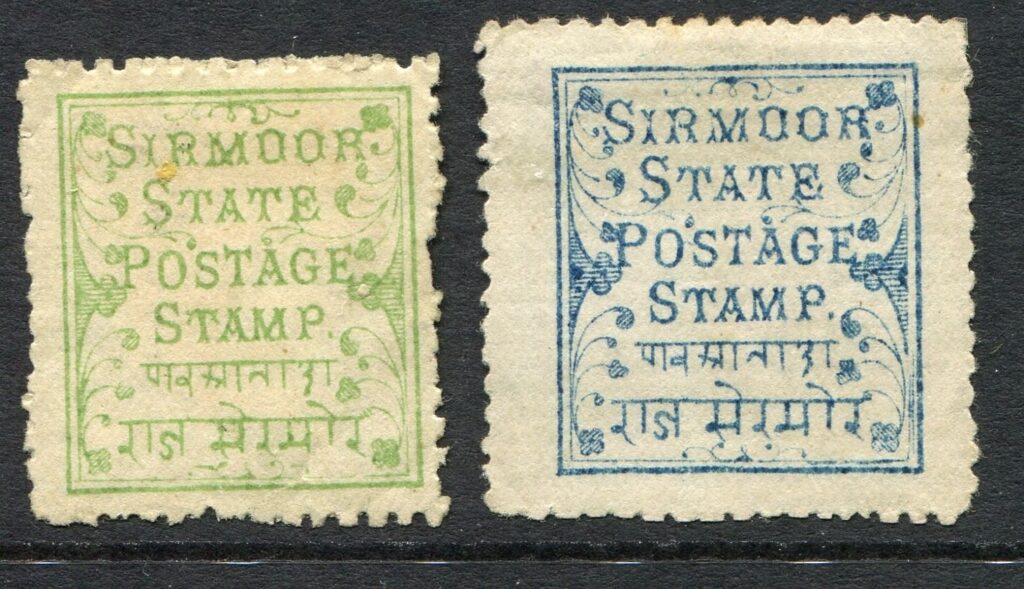
Sirmoor’s first stamps carry no picture at all: four lines of English and two of local script inside a frame of foliage. Behind that plain design lies a long argument about sheets, paper and perforation, and a later reprint ordered by a collector.
A post before the first stamp
Dawson lists a state network that was already working before the stamps of 1879, with offices at Nahan, Majra, Naina, Pachha, Palwi, Paonta, Rainka, Rajgarh, Shalai and Sangra (his spellings). The first adhesive was a new way of paying for a service that already existed, not the start of the service. Dawson dates the Imperial takeover of this network to 1 April 1902.[4]
The green stamp of 1879
Dawson attributes the first inscription stamps to lithography in Calcutta. The Philatelic Record of September 1879 describes the green stamp printed in sheets of 63, nine rows of seven, on paper watermarked A. C. & S. Superfine. Evans quotes the same layout in 1904, but Dawson turns it round to seven rows of nine. The total is the same; the orientation is still disputed.[15][4][25][26]
The Record’s first notice, in July 1879, already described a heavily cancelled green stamp. That shows the stamp had reached the journal by then; it does not give a first day of sale.[4][25]
The blue stamp of 1880
The blue was reported on laid paper in July 1880. Evans saw horizontal laid lines but never a complete sheet, and his suggestion that the blue used the same stone and sheet size as the green was, in his own words, a presumption. Dawson later describes a complete blue sheet of 70, ten rows of seven. Evans also wondered about a maker’s watermark on the blue sheets; that is a guess, not evidence of any particular watermark.[15][4][25][26]
Dawson records a blue pair cancelled with the octagonal mark of Palwi dated 21 December 1884, and another pair with a barred rectangle enclosing a large S. These are recorded examples, not a full list of the cancellations used.[4][25]
Paper, watermark and workshop
The sources do not agree on the paper. StampWorld lists the group without a watermark, while the Record of September 1879 positively reports the A. C. & S. Superfine mark on the green. A writing-paper watermark covers only part of a sheet, so many single stamps will show none of it. The initials A. C. & S. have not been traced to a particular mill, and the blue’s maker’s watermark remains conjecture. Nor is the printer settled: Dawson says Calcutta, Feldman’s sale describes the stamps as local.[25][15][4][16][17]
Perforation 12 or 11½
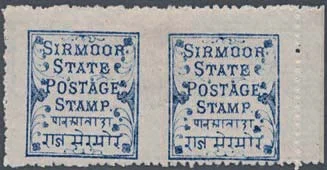
The September 1879 notice reports a rough perforation 12; Evans measured 11½ for both the early and the redrawn inscription stamps. He put the early blue perforations down to a single-line, or guillotine, machine and describes rows of holes left out and rows added. Each measurement belongs to its source: there is no need to invent a variety to reconcile them. An intact pair imperforate between is evidence that a trimmed single can never give.[25][15]
Why the 1892 stamps have a printed perforation border
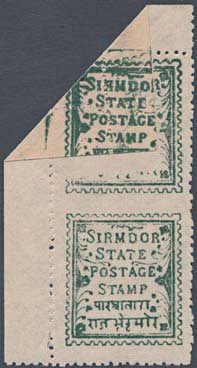
The redrawn inscription issue came from a collector’s order. Evans tells of a request in September 1891 and of a catalogue illustration being handed to the Calcutta printers as their model. The perforation border drawn in the illustration was copied into the design, while the sprigs at the bottom, missing from the illustration, were left out. A letter from the state postmaster of 28 January 1892 promised that the new supply would soon be available, with or without postmarks: an announced supply, not a first day of sale.[15][4]
A second letter from the postmaster, dated 12 February 1893, confirms that the State had the stamps printed in Calcutta, that they were bought from the State Treasury, and that further printing was stopped once the irregularity became known. Evans believed the remaining stock was later issued for postal use, but that is his own belief, not something the letter says, and he had seen no copy he could call certainly used in the ordinary way. Dawson repeats the later-use account. A cancellation alone cannot settle it, because cancelled supplies had been offered from the start.[15][4]
Sixty-three or seventy
The sheet size of the redrawn stamps is disputed too. Evans says the sheets he examined held 63, nine rows of seven; Dawson says 70, ten rows of seven. Both describe separate stones for the green and the blue, and wove paper. Only a complete sheet with a known history would settle the number.[15][4]
Reading an inscription stamp
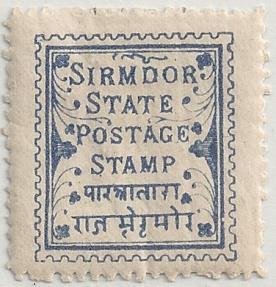
Look first for the printed border: without it the stamp belongs to the first group of 1879–80, with it to the redrawn group of the early 1890s. Then look at the real edges, the paper (wove or laid) and the perforation, and keep the printed teeth apart from the physical holes. A small picture cannot tell all three. Dawson also found apparently genuine cancellations on forged copies of the 1892 reissue, so the stamp and its cancellation have to be judged separately.[15][4]
Sources
- [4] L. E. Dawson, “The Indian Feudatory States VIII: Sirmoor (Part 1)”, The Philatelist, January 1966, pp. 101–104.
- [15] [E. B. Evans], “The Stamps of Some of the Native States of India: Sirmoor”, by the Editor, Stanley Gibbons Monthly Journal, vol. XV, 30 July 1904, pp. 17–19; 30 September 1904, pp. 60–64; 31 October 1904, pp. 86–88; 31 December 1904, p. 129; correction note, 29 April 1905, p. 217.
- [16] StampWorld, Sirmoor, ordinary postage listing and linked illustrations. Types A/B, C/C1, D and G, plus the Elephant and 1899 headings.
- [17] David Feldman, Indian Princely States, 8 December 2017.
- [25] The Philatelic Record I(6), July 1879, “Novelties, Discoveries, and Resuscitations: Sirmoor”, p. 52; and I(8), September 1879, p. 75.
- [26] The Philatelic Record II(18), July 1880, “Novelties, Discoveries, and Resuscitations: Sirmoor”, p. 77.
Notes 0
Add what you know: a cover or stamp in your collection, a date or source, a correction or a question.
No notes yet.
Sign in to add a note.
Notes show straight away. Keep them kind and about the article; anyone can report one that isn't. House rules
