
Sirmoor’s Elephant and New Portrait Stamps, 1895–1899
Waterlow’s recess-printed elephant stamps of 1895–99, the 1899 portrait whose sitter is still disputed, the Waterlow archive proofs, fiscal use and the three-pies postcard.
Updated May 22, 2026
In this article
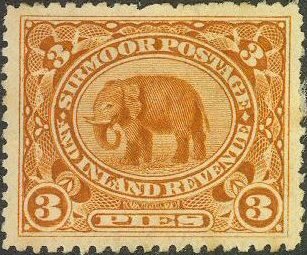
In the 1890s Sirmoor’s stamps changed from lithographs to engraved, recess-printed designs from Waterlow: first an elephant, then a new portrait.
Two dated reports of the elephants
In March 1895 The Philatelic Record reported the three pies, six pies, one anna and two annas elephant stamps; its April follow-up described their inscriptions and reported perforation 15. In April 1899 it recorded the three annas, four annas, eight annas and one rupee elephants, sent by Whitfield, King & Co. These are dates when the stamps were reported, not first days of sale. Other catalogues date the elephants from 1894; Dawson corrected his own period to 1895–99. The high elephant values are not the later portrait stamps of the same values.[28][29][2]
Recess printing and re-entries
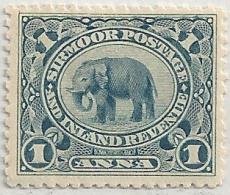
Unlike the lithographed older portraits, the elephant and the 1899 portrait were recess printed by Waterlow. Dawson records seven re-entries on the one-anna elephant and one on the two annas, which is not a census of every plate position.[4][17]
Proofs and the Waterlow archive
Grosvenor records perforated Waterlow proof sheets of 70 for the three pies, six pies, one anna and two annas elephant, with dates and quantities pencilled in the margins, and an issued one-anna sheet with minor re-entries. Spink records a bistre die proof of the three pies with a Waterlow specimen imprint. These establish production at the level of the firm; naming the designer or engraver would need signed artwork, a die register or a job sheet.[18][19][17]
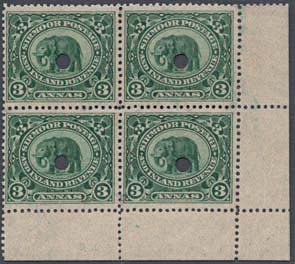
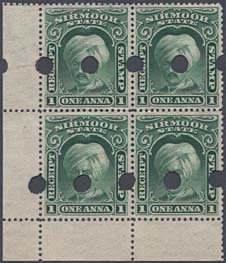
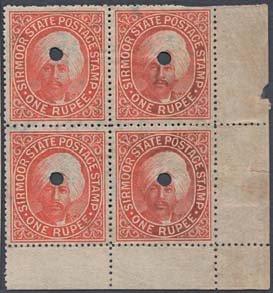
Punched corner blocks from the Waterlow archive are another category. The auctioned lots are described as proofs, with security holes and staining, and the pictures show only selected high values from larger holdings. They are useful for comparing designs but are not ordinary issued stamps. The green one-anna receipt stamp from the same archive is a fiscal design.[8][9]
Postage stamps on fiscal documents
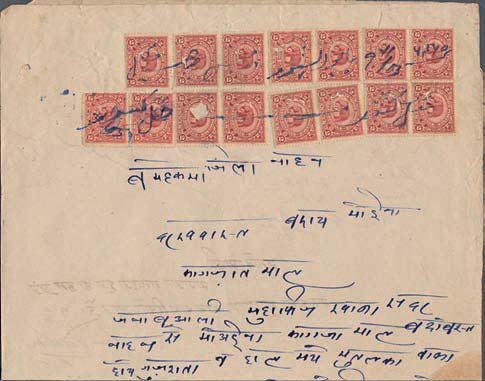
A photographed document carries two-annas elephant stamps cancelled by pen strokes and punch holes. It shows the issued design and value in fiscal use; it is not a postal cover and gives no postal rate.[8]
The new portrait of 1899: whose face?
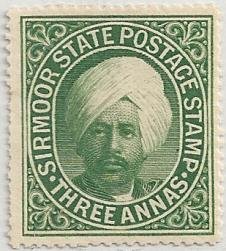
The new portrait set has four values starting at three annas, as listed by StampWorld and Feldman: three annas, four annas, eight annas and one rupee. Grosvenor attributes the portrait to Surendar Bikram Parkash, who reigned in 1899; StampWorld’s heading names Shamsher Parkash. Until the design correspondence or a captioned Waterlow record turns up, “New portrait” is the safer name.[18][16][17]
A report of the time complicates it further. In May 1906 the Philatelic Journal of Great Britain quoted C. A. Howes, who was himself citing the Philatelic Journal of India: the State had meant to keep the late Raja’s head and did not recognise Waterlow’s portrait as anyone in particular. It is reported testimony, not the original instructions, but it warns against naming the full-face sitter only from the new ruler’s accession.[30]
The green three-pies postcard
Sirmoor’s postal stationery includes a green three-pies postcard described by Dawson. Its printed stamp is not the lithographed adhesive design: the card has an ornamental border, the state arms and English inscriptions, with Waterlow’s imprint at the foot. Dawson records an unused card and one he considered genuinely used from Pachhao post office on 28 April, in a year he could not read. That is a reported use, not a first day of issue; no year is supplied here by guesswork, and no picture of a card has yet been found.[4]
Sources
- [2] Evert Klaseboer, Catalogue, “Indian States, Sirmoor”, online catalogue: design groups and denominations.
- [4] L. E. Dawson, “The Indian Feudatory States VIII: Sirmoor (Part 1)”, The Philatelist, January 1966, pp. 101–104.
- [8] Christoph Gärtner, 17th auction, 7 March 2011, Sirmoor lots 1562–1580, descriptions and plates, pp. 94–96.
- [9] Heinrich Köhler, Gems of Indian States 1864–1950, 377th auction, 21 September 2021, Sirmoor lots 11124–11147, pp. 194, 199, 201–203.
- [16] StampWorld, Sirmoor, ordinary postage listing and linked illustrations. Types A/B, C/C1, D and G, plus the Elephant and 1899 headings.
- [17] David Feldman, Indian Princely States, 8 December 2017.
- [18] Grosvenor, sale 153, Sirmoor Elephant, late portrait and officials. Lots 1054–1063.
- [19] Spink, catalogue 22014, Waterlow material.
- [28] The Philatelic Record XVII(195), March 1895, “Novelties, Discoveries, and Resuscitations: Sirmoor”, p. 65; and XVII(196), April 1895, p. 93.
- [29] The Philatelic Record and Stamp News XXI, April 1899, “Novelties and Discoveries, Part I: British Empire, Sirmoor”, p. 99.
- [30] “Philately in India”, The Philatelic Journal of Great Britain XVI, 25 September 1906, p. 168; and “Philately in the States”, 25 May 1906, p. 95.
Notes 0
Add what you know: a cover or stamp in your collection, a date or source, a correction or a question.
No notes yet.
Sign in to add a note.
Notes show straight away. Keep them kind and about the article; anyone can report one that isn't. House rules
