
Wadhwan: the Thakur Sahibs, Their Stamp and the State Post
Wadhwan, a Kathiawar state, issued a single half pice arms stamp from 1888, printed from seven lithographic stones, and agreed in 1893–94 to close its post in favour of the Imperial post.
Updated September 9, 2026
In this article
The state behind the stamp
Wadhwan was a Kathiawar state, in present-day Gujarat, ruled by a Jhala Rajput house from the town of Wadhwan. Next to it lay Wadhwan Civil Station, the headquarters of the Political Agent for the Eastern Kathiawar Agency on land leased from the State; the two must be told apart on a letter. The Government of Bombay reported for 1893–94 that Wadhwan had consented to close its separate post offices, without giving a date.[4][25]
The rulers
A ruler’s reign and the dates a stamp was issued or valid are different kinds of evidence. Daji Raj died in 1885 and his brother Balsinhji, who reigned through the whole stamp period, died in 1910. His cousin Jasvatsinhji followed, then Jasvatsinhji’s son Joravarsinhji, whom Aitchison dates to 1913, invested with full powers on 16 January 1920; a later list gives 1918. Surendrasinhji, who reigned from 1934 in that list, appears in the district court’s history of the return of Wadhwan Camp in 1946 and was ruler at independence.[7][8][9][10]
| Reign | Ruler | Note |
|---|---|---|
| 1875–1885 | Thakur Sahib Daji Raj | The start follows a later chronology; Aitchison records his death in 1885 |
| 1885–1910 | Balsinhji Chandrasinhji | Succeeded his brother; the half pice of 1888 and all its printings belong to his reign |
| 1910–1913 (Aitchison) | Jasvatsinhji (Jashwantsinhji) | Aitchison gives his death as 22 February 1913; a later list gives 22 February 1918 |
| 1913 (Aitchison) – 1934 | Joravarsinhji (Zorawarsinhji) | Full powers 16 January 1920; the year of accession is disputed |
| 1934 – 1947 | Surendrasinhji | Linked with the return of Wadhwan Camp in 1946; ruler at independence |
One stamp, seven stones
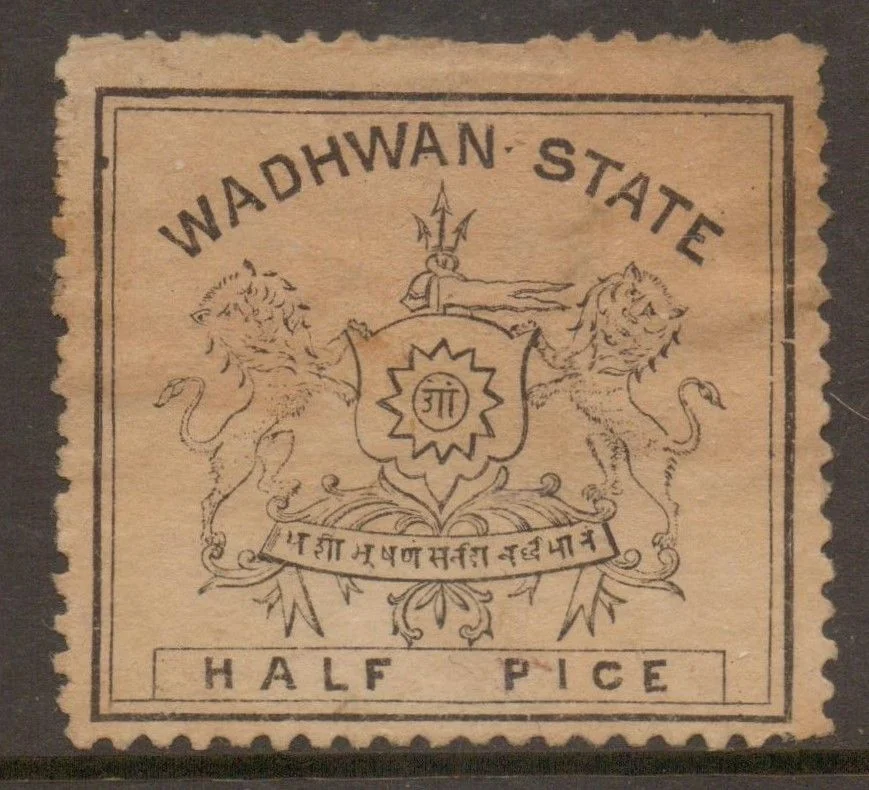
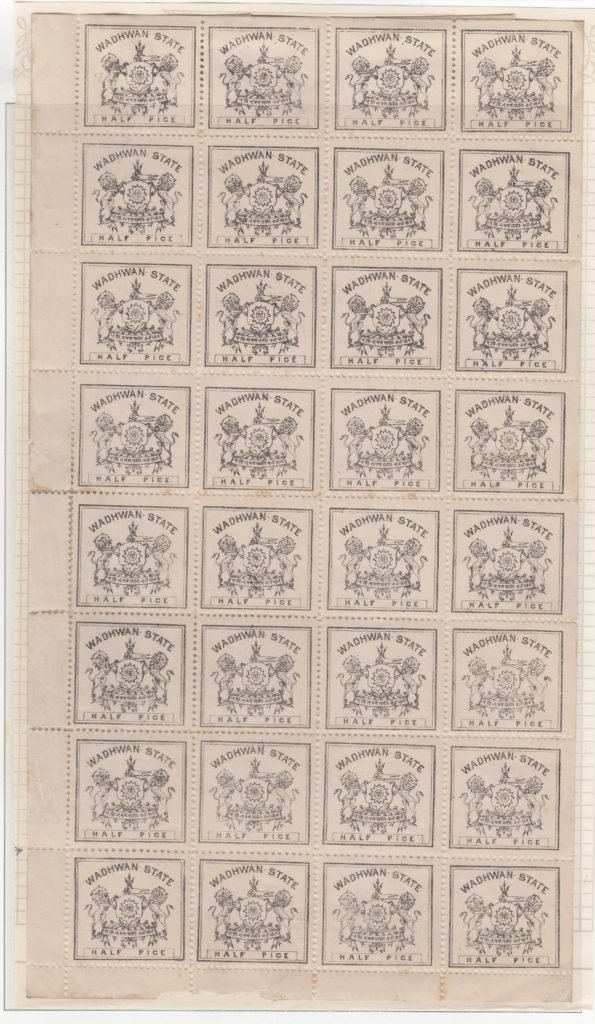
Wadhwan issued one stamp, a half pice in black showing the State’s arms, lithographed from an engraved master die. R. J. Benns sorted it into seven stones by sheet size, paper mesh, perforation and sheet margins. The stamps were reaching collectors in 1888, when The Philatelic Record first doubted and then accepted them, and they are known on covers from 1892 to 1894. A specialist exhibition dates their obsolescence to 1 January 1895, the date of a planned Imperial take-over that contemporaries could not confirm.[1][2][20][24]
Chronology
| Date | Event |
|---|---|
| 1 September 1888 | First published description, in a German journal, according to Benns |
| September 1888 | The Halifax Philatelist reports a specimen sent from Bombay, for inland postage |
| October 1888 | The Philatelic Record illustrates the half pice black and doubts its standing |
| December 1888 | The Philatelic Record accepts it as genuine, supplied through the State Treasury, but thinks it fiscal |
| 2 July 1892 | Stone IV on a cover in Douie’s collection |
| 31 December 1892 | A clearer thick-paper impression, perforated 12, reported received in England |
| 1893–1894 | Dated covers, including Stone VI in June 1893 and Stone VII in May and July 1894 |
| 1893–94 | Wadhwan consents to close its separate post offices (Bombay administration report) |
| 1 January 1895 | Planned Imperial take-over; the stamp obsolete according to a specialist exhibition |
| 30 June 1896 | Stanley Gibbons Monthly Journal still cannot confirm Wadhwan’s transfer |
| October 1990 | R. J. Benns’s handbook, The Stamps of Wadhwan |
The stamps
The issue, from the research checklist; the forgeries are listed only for comparison.
| Period | Issue | Values |
|---|---|---|
| 1888–1894 catalogue period | Arms, half-pice black; Stones I–VII | ½ pice black |
| Specialist comparison material | Forgeries and forged cancellations (forgery comparison) | ½ pice design imitations |
Sources
- [1] R. J. Benns, The Stamps of Wadhwan, Handbook of Indian Philately (India Study Circle for Philately, England, October 1990).
- [2] Indian Feudatory States Stamps, “Wadhwan”, online exhibition.
- [4] Government of India, Memoranda on the Indian States 1932 (corrected to 1 January 1932), Calcutta: Central Publication Branch, 1933, “Wadhwan”, pp. 207–208.
- [7] C. U. Aitchison, A Collection of Treaties, Engagements and Sanads, vol. VI, pp. 106–107, section 17: Wadhwan.
- [8] Rulers.org, “Indian states before 1947, K–W”: Wadhwan.
- [9] District Court Surendranagar, history of the court.
- [10] British Library, Wadhwan Administration Reports, IOR/V/10/2119–2130 (including 1909/10–1925/26 and 1934/35).
- [20] “Wadhwan,” The Philatelic Record, vol. X, no. 117 (October 1888), pp. 174–175, and nos. 119–120 (December 1888), p. 205.
- [24] “India,” Stanley Gibbons Monthly Journal, vol. VI (30 June 1896), p. 204.
- [25] Government of Bombay, Report on the Administration of the Bombay Presidency for the Year 1893–94, Bombay: Government Central Press, 1894, pp. xxxi and 181 (Post Office, Imperial Post, Bombay Circle).
Notes 0
Add what you know: a cover or stamp in your collection, a date or source, a correction or a question.
No notes yet.
Sign in to add a note.
Notes show straight away. Keep them kind and about the article; anyone can report one that isn't. House rules
