
Wadhwan’s Cancellers, Covers and Forgeries
Benns’s seven postmark types including the misspelt WADWHAN STATE, the dated covers that test the order of the stones, the Ralli Brothers letters of 1893, and five forged types.
Updated June 9, 2026
In this article
Dated covers are the best evidence for when each Wadhwan stone was in use, and the cancellations on them need as much care as the stamps.
Cancellers and the wrong spelling
Benns records seven main kinds of postmark, with very different levels of confidence. P 2 is a square grid. P 3 is the common Gujarati circle of about 27–27½ mm. P 4 is a large dated double circle, often on the back of the cover, spelt in English WADWHAN STATE: the misspelling belongs to that device and is no proof of forgery.[1]
His P 1 is tentative and P 5 to P 7 doubtful, and those qualifications matter. A neat P 3 can sit entirely within a stamp without tying it to the envelope, and the handbook discusses doubtful attempts to supply a tie. Record the ink, placement and dates and the whole back of the cover; a crisp circle does not prove itself.[1]
Covers show different kinds of use
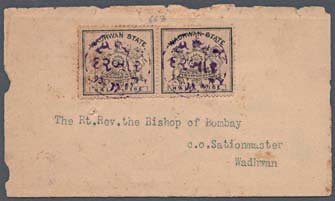
The handbook examines about two dozen covers. A group addressed through Ralli Brothers in Bombay carries dates of 21 June 1893 and Fort Bombay receiving marks of the next day. Other groups have repeated addresses or dates and may be philatelic. They are recorded objects, not a tariff; Benns keeps evidence and suspicion apart, and so do we. His scarcity ratings describe the material he saw, not today’s numbers or prices.[1]
An 1893 local envelope, Gärtner lot 1653, is listed with an ISES certificate and a reverse mark of 24 October; a second, lot 1654, is catalogued as local mail dated 11 May 1893 on the back.[5]
How dated use tests the order of the stones
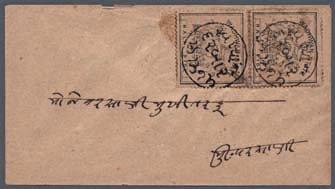
The thick-paper fourth stone was already on a cover dated 2 July 1892 in Douie’s collection, with a large dated circular mark about 45 mm across on the back, although thick-paper stamps first reached England only in December 1892. The cover shows use before that report from abroad; December is not an issue date.[3][1]
Stone VI is known on covers dated 21 June 1893, although an earlier estimate put its appearance in 1894 or 1895. Stone VII is recorded on a single of 6 May 1894 and covers of July 1894. Dated objects like these say more about chronology than the assumption that a higher-numbered stone must be later.[3][1]
The reverse mark also shows why loose stamps lose part of the record: a large receiving or arrival device on the back of an envelope may never touch the stamp. This report gives a dated object and a description of a mark, not the weight, rate, route or commercial character of Wadhwan letters in general.[3][1]
The Rover sale of 2025 lists an irregularly pin-perforated Stone I single as SG 1b, a Stone IV cover of 12 July 1892, a Stone VI positional pair on a cover of 19 May 1893 as SG 5, and a Stone VII cover of 12 July 1894 as SG 6, and calls the July 1892 cover the earliest recorded. Douie reported a cover dated 2 July 1892. Only a comparison of the objects can settle the earliest date; the dates and stones are the catalogue’s, and a cover with two stamps does not give a tariff.[16]
Forgeries
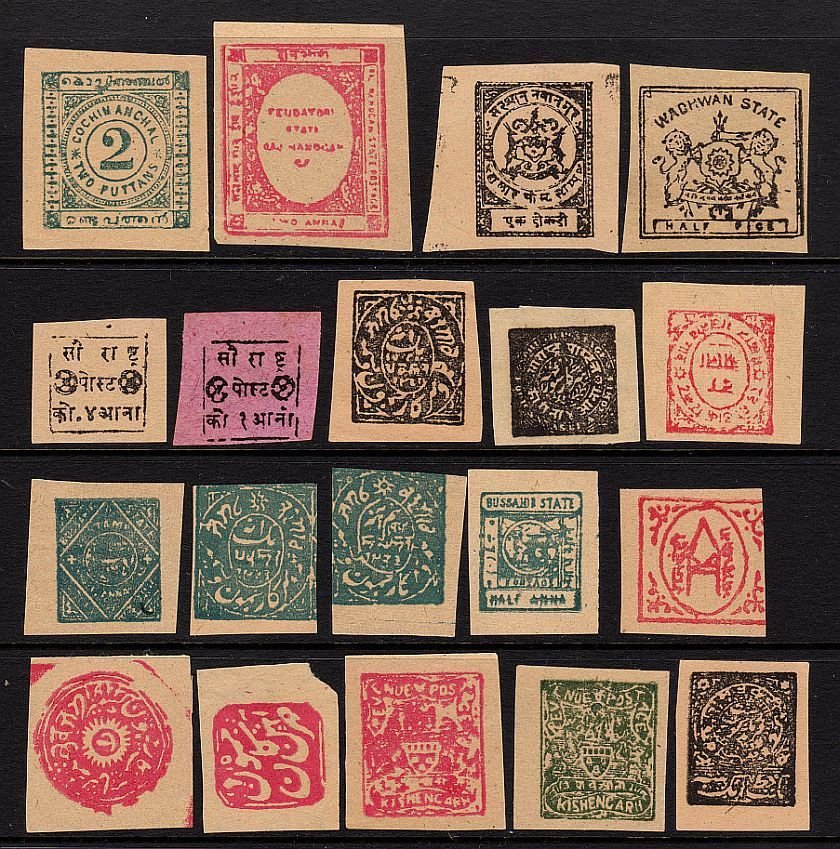
Benns describes five forged types of the stamp and two forged cancellations. One common false design has a squashed sun, an altered ribbon and an incomplete corner to the shield; other forgeries need different tests. Some copy the dot and the pennant shading, which is why no single quick rule works. Compare several features of the design, the paper, the separation and any cancellation with the stone it should belong to.[1]
In the group below, the Wadhwan imitation is at the upper right: crudely lettered and fully imperforate, quite unlike the perforated stamps shown elsewhere. Klaseboer identifies the whole group as forgeries, without showing that one maker produced them all. It adds no value, no postal use and no new stone.[6]
Reading the sources without merging their dates
Benns’s opening text puts the German notice of September 1888 on p. 238 and that of July 1889 on p. 201, while his bibliography reverses the page numbers; until the German journals are seen, neither is preferred. His 1 September 1888 date for the first published description is his report, separate from the English notices of October and December 1888.[1]
The Philatelic Record’s December notice refers back to September, but the earlier passage is in the October issue. Godinho’s heading is “VIII.—Wadhwan”, and Price signed himself E. Dickinson Price. Evans’s account of 1906 is a different publication from his study of February 1914, which later writers quote.[20][22][23][1][3][18]
The work still to do
The most useful remaining work is a dated chronology of the stones, a settlement of the early papers and arrangements of Stone I, a check of the unusual separations, and a modern census of covers. Benns’s catalogue and the questions at the end of his handbook mark out that work without pretending it was finished in 1990. The Smithsonian’s record gives Scott India-Wadhwan 1 for a half pice arms single, and Evans too described a single value.[1][17][18][19]
Sources
- [1] R. J. Benns, The Stamps of Wadhwan, Handbook of Indian Philately (India Study Circle for Philately, England, October 1990).
- [3] Lt.-Col. F. M. Douie, R.E., “The Stamps of the Indian Feudatory States. Wadhwan.” The Philatelic Journal of India, vol. XXXVIII, no. 6 (June 1934), pp. 68–70.
- [5] Christoph Gärtner, 17th auction, 7 March 2011, Wadhwan lots 1653–1654 (descriptions p. 154, plate p. 106).
- [6] Evert Klaseboer, Indian States: Wadhwan, forgery group photograph.
- [16] David Feldman SA, Peter Rover Collection, 30 May 2025.
- [17] Smithsonian National Postal Museum, accession 2011.2005.384.
- [18] E. B. Evans, “My Favourite Country, and Why Not?”, Gibbons Stamp Weekly (1906).
- [19] Rare Indian Stamps, specialist bibliography, Wadhwan entries.
- [20] “Wadhwan,” The Philatelic Record, vol. X, no. 117 (October 1888), pp. 174–175, and nos. 119–120 (December 1888), p. 205.
- [22] Jno. Godinho, “Indian Feudatory States. VIII.—Wadhwan,” The Philatelic Journal of India, vol. XVII, no. 11 (November 1913), p. 280.
- [23] E. Dickinson Price, correspondence dated 30 December 1913, The Philatelic Journal of India, vol. XVIII, no. 2 (February 1914), p. 41.
Notes 0
Add what you know: a cover or stamp in your collection, a date or source, a correction or a question.
No notes yet.
Sign in to add a note.
Notes show straight away. Keep them kind and about the article; anyone can report one that isn't. House rules
