
Faridkot: the Rajas, Their Stamps and the State Post
Faridkot, a Cis-Sutlej Punjab state, had handstruck local stamps from 1879, joined the convention post with overprinted Indian stamps on 1 January 1887, and closed its State post on 31 March 1901.
Updated July 3, 2026
In this article
The state behind the stamp
Faridkot was a small Cis-Sutlej state in the Punjab, ruled by a Brar Sikh house from a capital of the same name. In 1911 its area was given as 642 square miles and its population in 1901 as 124,912. It bordered the British district of Ferozepore to the west and north-east and Nabha to the south. The Rewari–Ferozepore railway crossed it, with a branch from Kotkapura. These are boundaries and railways of that time, not the route of any one letter.
The rulers
A ruler’s reign and the dates a stamp was issued or valid are different kinds of evidence.[7][8]
| Reign | Ruler | Note |
|---|---|---|
| 1874–1898 | Raja Bikram Singh | Ruler during the local stamps and the beginning of the convention |
| 1898–1906 | Raja Balbir Singh | Ruler in the closing years of the convention post; palace additions of 1899–1902 |
| from 11 February 1906 | Raja Brij Indar Singh | Accession date as given by Barnsdall in 1907; after the State post had closed |
Two postal eras
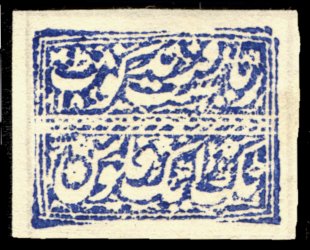
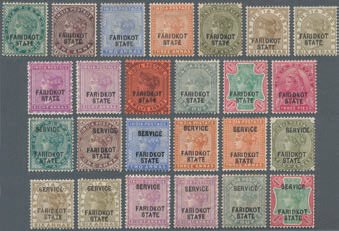
Faridkot’s stamps fall into two chapters. The first post used stamps made in the State and struck by hand, a one folus and a one paisa, both a quarter anna, from about 1879 (the date is disputed). From January 1887 a postal convention with the Imperial post replaced them with British Indian stamps overprinted FARIDKOT STATE, and SERVICE for official mail. The State post closed on 31 March 1901 and the Imperial post took over on 1 April. A third group, labels redrawn from the local designs from 1888, is not postage at all.[1][2][26]
Chronology
| Date | Event |
|---|---|
| 1879, 1880 or 1881 | First local stamps: Haverbeck gives 1879, Evans 1879 or 1880, the Gazetteer 1881 |
| November 1882 | Two blue designs, the oblong and the upright, reported to collectors |
| April 1883 | A blue square design illustrated |
| 1884 | Red half anna models made from an older die, never issued (the State Postmaster) |
| March 1884; October 1885 | A Lahore envelope and a reply card with Faridkot local and Indian postage |
| June–July 1886 | Convention proofs passed in June; first supply in July |
| 1 January 1887 | The convention post begins |
| 5 January 1887 | P. Sheridan signs the notice on exchange, parcel prepayment and inland conditions |
| November 1887 | A modified paisa design reported to collectors, after the local post had ended |
| from 1888 | Photographically redrawn labels of the local designs |
| 1893 | The carmine-and-green rupee replaces the grey |
| September 1900 | Printings of the ordinary three pies and twelve annas; reported October 1900 and February 1901 |
| 31 March 1901 | The State Post Office closes |
| 1 April 1901 | The Imperial post takes over |
The stamps
The issues and their values, from the research checklist. The red half anna model and the later labels are listed for comparison; they were not issued for postage. Official stamps are described in the convention chapter but not listed here.
| Period | Issue | Values |
|---|---|---|
| 1879 onwards in Haverbeck; first-issue year disputed | Original local one-folus handstamp | 1 folus (= 1 paisa = ¼ anna), ultramarine |
| 1882 onwards in Haverbeck; reported November 1882 | Original local one-paisa handstamp | 1 paisa (= ¼ anna), ultramarine |
| 1884 model; dated 1877 in design | Half-anna model (essay / proof) | ½ anna, red |
| 1887–1901; values verified to 1897 | Queen Victoria, FARIDKOT / STATE | ½ anna, 1 anna, 2 annas, 3 annas, 4 annas, 6 annas, 8 annas, 1 rupee, grey |
| 1888 onwards in Haverbeck | Photographic redrawings of the local designs (reprint / collector label) | 1 folus; 1 paisa; ½ anna designs |
| 1893 | Queen Victoria, bicoloured ordinary rupee | 1 rupee, carmine and green |
| Late convention values; reported 1900–1901 | Late Queen Victoria convention values | 3 pies, 12 annas |
Sources
- [1] H. D. S. Haverbeck, “India: The Stamps of the Feudatory States—Faridkot”, The Collectors Club Philatelist, vol. XXXV, no. IV (July 1956), pp. 239–242 and 256.
- [2] C. Stewart-Wilson, British Indian Adhesive Stamps Surcharged for Native States, Part I (Calcutta: Philatelic Society of India, 1897).
- [4] William E. Steiner, India—Convention States, album pages, pp. 14–15.
- [6] StampWorld, Faridkot, 1887–1900 Queen Victoria group.
- [7] District Administration Faridkot, Government of Punjab, “Raj Deori”.
- [8] British Library, Visual Arts, X.249, 3(58), “H. H. Raja Balbir Singh Bahadur, Raja of Faridkot”.
- [9] W. Percy Barnsdall, “Countries of the World: Faridkot”, Gibbons Stamp Weekly, vol. VI, no. 22 (whole no. 152), 30 November 1907, pp. 337–339.
- [10] Grosvenor Philatelic Auctions, auction 107, 24 May 2016, p. 111, lot 873.
- [11] Christoph Gärtner, 46th auction, Asia, 25 February 2020, lot 6541 (photograph p. 26, description p. 95).
- [18] E. B. Evans, “The Stamps of Faridkot”, reprinted in The Philatelic Journal of India, vol. XLIV, September 1940, pp. 143–146 and 158–161, with additional notes by L. E. Dawson.
- [26] Unsigned “Notes”, The Philatelic Journal of India, vol. V, no. 3, March 1901, p.64.
- Encyclopædia Britannica, 11th edition (1911), “Faridkot”.
Notes 0
Add what you know: a cover or stamp in your collection, a date or source, a correction or a question.
No notes yet.
Sign in to add a note.
Notes show straight away. Keep them kind and about the article; anyone can report one that isn't. House rules
