
Caves of Meghalaya

Technical Data
| Date of Issue | August 15, 2017 |
|---|---|
| Denomination | Rs. 20 |
| Quantity | 100,000 |
| Perforation | 13¾ x 13¼ |
| Printer | Security Printing Press, Hyderabad |
| Printing Process | Wet Offset |
| Watermark | No Watermark |
| Colors | Multicolor |
| Credit (Designed By) | Mr. Suresh Kumar Ms. Nenu Gupta |
| Catalog Codes |
Michel IN BL164 Stamp Number IN 2956b Yvert et Tellier IN BF153 Stanley Gibbons IN MS3347 |
| Themes | caves |
Stamps in this Miniature Sheet
Nature’s Subterranean Marvel
Meghalaya, once a coral island formed after the breakup of the supercontinent Gondwanaland, is today one of India’s most spectacular geological treasures. The region is largely composed of the Shillong Plateau, a stable high structural block underlain by Precambrian granites, gneisses, and schists. Along its southern border, younger sedimentary formations rich in limestone developed over time.
Through dramatic geological events—uplift, subsidence, and re-emergence above sea level—the limestone belts were elevated to considerable heights. Combined with high-grade limestone, heavy rainfall, elevation, and a hot, humid climate, these conditions created an ideal environment for the formation of extensive cave systems.
Over the last 25 years of exploration, 1,620 caves have been identified, of which around 1,030 have been explored and mapped, covering nearly 460 kilometres of cave passages—with vast potential still awaiting discovery. Meghalaya’s caves are the longest and deepest in India, including the Krem Liat Prah-Um Im-Labit system (30,397 metres) and Synrang Pamiang (-317 metres).
These caves are also ecologically significant, serving as habitats for rare and endemic troglobitic species such as Heteropoda fischeri and Schistura papulifera, found nowhere else in the world.
To celebrate this extraordinary natural heritage, the Department of Posts issued a Miniature Sheet consisting of four Special Postage Stamps on the Caves of Meghalaya, featuring Krem Blang, Krem Khung, Krem Syndai, and Krem Lymput.
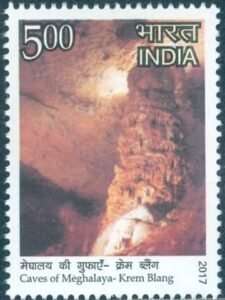
Krem Blang
Location: East Jaintia Hills district
Length: 272.93 metres
Krem Blang is a single large relic passage below a short slope. The cave maintains an impressive and consistent dimension of approximately 7 metres wide and 9 metres high for most of its length.
About 50 metres inside, explorers must pass through calcite formations before entering a straight 200-metre gallery. Features such as Angie’s Chamber, adorned with crystal pools and cave pearls, and Annie’s Ballroom, a richly decorated calcite chamber, make the cave visually stunning. Unique formations like The Fireplace, a grand flowstone structure, add to its geological charm.
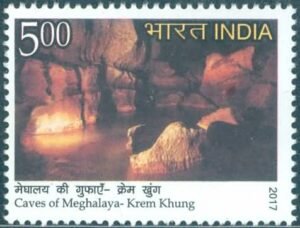
Krem Khung
Location: East Jaintia Hills district
Altitude: 879 metres above mean sea level
Length: 7,349 metres (10th longest in India)
Entered through a triangular sinkhole beneath a cliff, Krem Khung quickly transitions into the dark zone. During the monsoon, it acts as a major water sink for the region, channeling water toward the Kopili River.
A highlight of the cave is the magnificent Paradise Chamber, approximately 50 metres in diameter and 8 metres high, filled with multi-coloured stalactites, stalagmites, and columns. Some formations exhibit bright yellow hues due to sulphuric bacterial activity.
Hosted in Eocene limestone, the cave contains fossils of Nummulites, indicating its geological age.
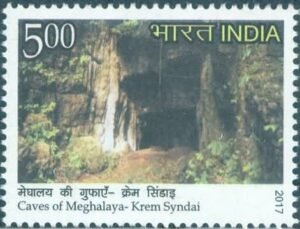
Krem Syndai
Location: West Jaintia Hills district
Length: 400 metres
Located near Sundai village, Krem Syndai opens through a stooping arch into a vast passage measuring nearly 25 metres high and 30 metres wide.
The cave showcases massive calcite formations, including stalactite bosses, stalagmites, columns, and flowstones. The passage continues for over 200 metres before narrowing and finally terminating in a calcite blockage.
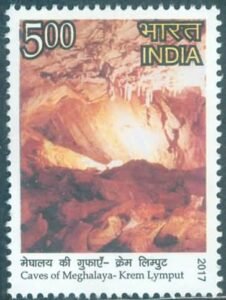
Krem Lymput
Location: East Khasi Hills district
Length: 6,641 metres (12th longest in India)
Hidden within jungle-covered boulders near Nongjri village, Krem Lymput is revealed by the cool air flowing from its entrance. After a descent over rock masses, explorers enter a kilometre-long trunk passage leading toward the challenging climb known as “Way to Heaven.”
The cave contains spacious galleries rich in calcite formations. Its most spectacular chamber, the Mughal Room, measures over 25 metres wide, 25 metres high, and 75 metres long, forming a grand subterranean hall. Numerous side passages create a fascinating maze-like network.
Philatelic Tribute – Miniature Sheet on Caves of Meghalaya
Recognizing the geological, ecological, and aesthetic importance of these caves, the Department of Posts released a Miniature Sheet comprising four Special Postage Stamps dedicated to the Caves of Meghalaya.
This philatelic issue not only honors the natural splendor of Meghalaya’s underground wonders but also highlights India’s rich geological heritage and biodiversity. The miniature sheet serves as a lasting reminder of the state’s remarkable subterranean landscapes and their scientific and environmental significance.
Leave a Comment
You must be logged in to post a comment.