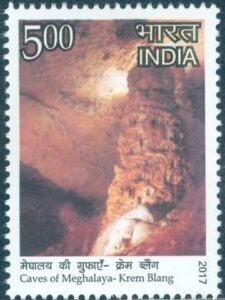
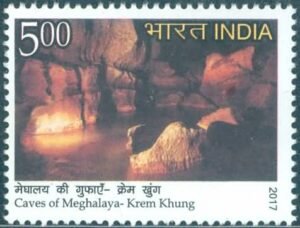
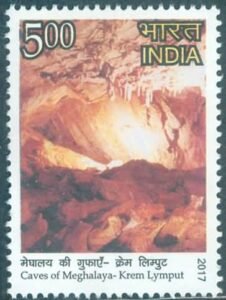
About this stamp
A Majestic Limestone Passage of Meghalaya
Location: Near Sundai village, West Jaintia Hills district, Meghalaya
Coordinates: 25°10’53.8” N, 92°08’15.7” E
Length: 400 metres
Krem Syndai is one of the impressive limestone caves of Meghalaya, a state renowned for its extensive karst landscapes and intricate subterranean systems. Formed under ideal geological conditions of high-grade limestone, heavy rainfall, elevation, and a humid climate, the caves of Meghalaya represent some of the finest natural underground formations in India.
Geological Setting
Meghalaya, once part of a coral island following the breakup of the supercontinent Gondwanaland, is largely composed of the stable Shillong Plateau with underlying Precambrian granites, gneisses, and schists. Along its southern fringe, younger limestone deposits created favorable conditions for cave formation. Over time, dramatic uplift and erosion shaped vast underground networks, including Krem Syndai.
Cave Structure and Features
The entrance to Krem Syndai lies in a small depression about 400 metres from Sundai village. The cave is accessed through a stooping-height arch which immediately opens into a remarkably spacious passage.
Once inside, explorers descend a steep calcite slope to reach the main floor of the cave. The principal passage is striking in scale—approximately 25 metres high and 30 metres wide—creating an awe-inspiring underground gallery. The cave extends eastward for over 200 metres with similar grand proportions.
Krem Syndai is richly adorned with calcite formations, including large stalactite and stalagmite bosses, columns, and extensive flowstone deposits. The floor rises and falls over calcified boulder piles, adding to the dramatic landscape within. Toward its end, the passage gradually narrows and finally terminates in a calcite blockage.
Natural Heritage and Philatelic Recognition
Meghalaya’s caves are not only geological treasures but also habitats for rare and endemic troglobitic species. The state’s extensive cave systems, among the longest and deepest in India, continue to attract researchers and explorers alike.
Recognizing the significance of these subterranean marvels, the Department of Posts issued a Commemorative Postage Stamp on the Caves of Meghalaya, featuring Krem Syndai. The stamp highlights the cave’s grandeur and contributes to promoting awareness of India’s unique speleological heritage.
Krem Syndai stands as a testament to nature’s architectural brilliance—an underground cathedral carved patiently by time and water.