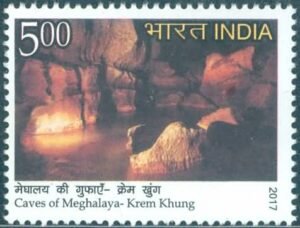
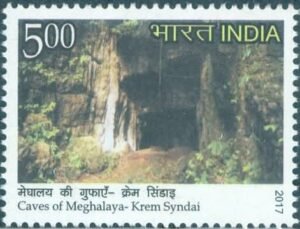
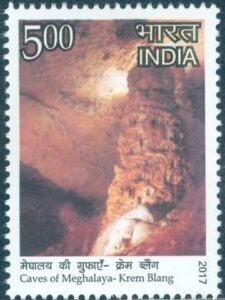
About this stamp
A Subterranean Wonder of Meghalaya
Location: Near Nongjri village, East Khasi Hills district, Meghalaya
Coordinates: 25°10’35” N, 091°47’10” E
Length: 6,641 metres (12th longest cave in India)
Krem Lymput is one of the most remarkable limestone caves of Meghalaya, a state celebrated for its vast and intricate underground systems. Concealed amid jungle-covered boulders about six kilometres from Nongjri village, the cave’s modest entrance is almost hidden, revealing itself only by the cool air flowing outward from its depths.
Geological Background
Meghalaya’s landscape, formed from ancient coral deposits after the breakup of Gondwanaland, is characterized by extensive limestone formations along the Shillong Plateau. Over millions of years, heavy rainfall, elevation, and a humid climate created ideal conditions for the formation of elaborate karst systems. Krem Lymput stands as a fine example of this geological evolution, shaped by continuous water action and mineral deposition.
Interior Highlights
The cave begins with a descent of about ten metres over rocky terrain leading into the main trunk passage. This passage stretches nearly one kilometre westward, with inclined walls and ceilings guiding explorers toward a steep and slippery climb known as the “Way to Heaven.”
Beyond this section lies a network of spacious galleries richly decorated with calcite formations. The most striking feature of Krem Lymput is the magnificent Mughal Room, an enormous chamber measuring over 25 metres in width, 25 metres in height, and 75 metres in length. Its vast dimensions and impressive formations make it one of the most spectacular underground halls in India.
Numerous side passages branch off from the main corridor, forming a maze-like system that adds to the cave’s exploratory significance. Stalactites, stalagmites, columns, and flowstone formations adorn the chambers, reflecting centuries of natural artistry.
Philatelic Tribute
Recognizing its geological importance and natural beauty, the Department of Posts issued a Commemorative Postage Stamp on the Caves of Meghalaya, featuring Krem Lymput among the highlighted caves. The stamp celebrates the cave’s grandeur and draws attention to Meghalaya’s unique subterranean heritage.
Krem Lymput remains a symbol of nature’s hidden splendor—an underground marvel that showcases the timeless interplay of rock, water, and time.