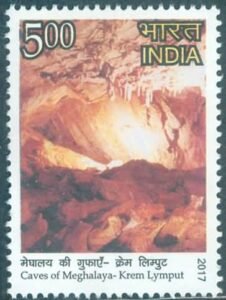
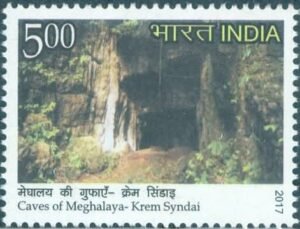
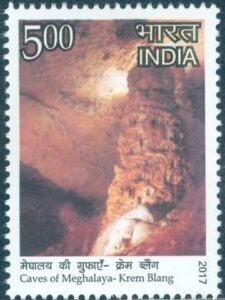
About this stamp
A Meandering Limestone Marvel of Meghalaya
Location: East Jaintia Hills district, Meghalaya
Coordinates: 25°23’21.9” N, 92°34’48.8” E
Altitude: 879 metres above mean sea level
Length: 7,349 metres
Krem Khung is one of the most remarkable limestone caves of Meghalaya, a state celebrated for its vast and intricate cave systems. Formed under ideal geological conditions—high-grade limestone, heavy precipitation, significant elevation, and a humid climate—Meghalaya’s caves represent some of the finest karst formations in India. Among them, Krem Khung stands out for its length, structure, and spectacular speleological features.
Geological Background
Meghalaya, originally part of a coral island following the breakup of Gondwanaland, is largely composed of the Shillong Plateau with ancient Precambrian rocks. Along its southern border, younger limestone formations created perfect conditions for cave development. Over millions of years, cycles of uplift and erosion shaped extensive subterranean networks, including Krem Khung.
Hosted by limestone of Eocene age, the cave contains diagnostic fossils of foraminiferal species such as Nummulites, indicating its geological antiquity.
Entrance and Passage
The cave entrance is triangular in shape, measuring approximately 1.4 metres by 1.6 metres, and is accessed through a sinkhole located below a cliff. Inside, the initial stretch of the cave floor is covered with dry mud and flood debris for about 50 to 60 metres. Beyond this section, numerous pools with slushy to knee-deep water must be negotiated to progress further into the main cave system.
Krem Khung trends in a north-easterly direction toward the Kopili River and serves as a major water sink during the monsoon season. One of its defining characteristics is its pronounced meandering nature, which causes the transitional zone to disappear quickly—the dark zone begins within less than 100 metres from the entrance.
Paradise Chamber
The main passage leads into a spectacular large chamber approximately 50 metres in diameter and about 8 metres high. Named the “Paradise Chamber” by explorers, this section is particularly impressive from a speleological perspective.
The chamber floor is strewn with fallen boulders, while its ceiling and walls display multi-coloured stalactites, stalagmites, and columns. Some stalactites exhibit a striking bright yellow colour caused by sulphuric bacterial activity, adding a unique visual dimension to the cave’s formations.
National Significance and Philatelic Recognition
At 7,349 metres, Krem Khung is currently ranked among the longest caves in India. Meghalaya’s caves, known for their scale, beauty, and biodiversity—including rare endemic troglobitic species—form a significant part of India’s natural heritage.
In recognition of this remarkable subterranean treasure, the Department of Posts issued a Commemorative Postage Stamp on the Caves of Meghalaya, featuring Krem Khung. The stamp celebrates the geological grandeur and ecological importance of this extraordinary cave system.
Krem Khung remains a testament to the power of nature—an underground labyrinth sculpted over millennia by water, stone, and time.