
Warrior Queens of India
 An exhibit plan by Jaspreet Kaur
updated 24 November 2026
About this exhibit
For four hundred years, women ruled, defended and fought for kingdoms across India, from the Gond highlands to the Malabar coast, from Awadh to the Naga hills. Some were born to rule; most took power when a husband or son died and someone, a sultan, a Mughal general, the Portuguese or the East India Company, saw a widow's kingdom as easy to take. They proved otherwise.
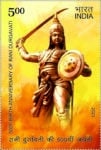
India Post has honoured many of them on stamps, from the 1957 centenary of the rising of 1857 to the 500th birth anniversary of Rani Durgavati in 2023 and a stamp for Rani Chennabhairadevi in 2025. This exhibit tells their stories in order of time, through 17 stamps in the catalogue: eleven women, nine of them rulers, one a soldier who fought beside her queen, and one a Naga leader whom the country called Rani.
Rani Durgavati of Garha-Katanga (1524–1564)
Durgavati was born in 1524 into the Chandela family, at the fort of Kalinjar by most accounts, and married Dalpat Shah, heir to the Gond kingdom of Garha-Katanga in today's Madhya Pradesh. When he died, about 1550, she ruled for their young son, Vir Narayan, for some fifteen years. She beat back Baz Bahadur, the Sultan of Malwa. Reservoirs around Jabalpur still carry the names of her court: Ranital after the queen, Cherital after her maid and Adhartal after her minister, Adhar Kayastha.
In 1564 the Mughal general Asaf Khan invaded. Durgavati led her army herself, on her elephant Sarman, near Narrai, between the hills and the Gaur and Narmada rivers. Wounded by arrows and seeing the battle lost, she took her own life with her dagger on 24 June 1564 rather than be captured. India Post marked that date with a 60 paise stamp in 1988, and her 500th birth anniversary with a ₹5 stamp on 5 October 2023.
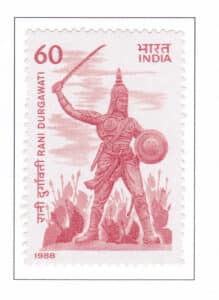
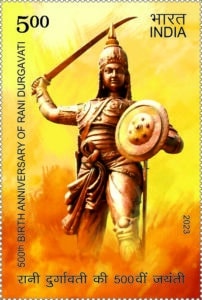
5 October 2023
500th Birth Anniversary of Rani Durgavati
- Commemorative
- Anniversaries and Jubilees
- Famous people
Rani Chennabhairadevi of Gersoppa (ruled about 1552–1606)
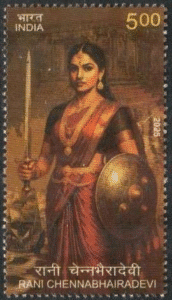
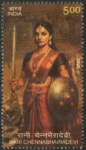
Chennabhairadevi ruled Gersoppa, on the Sharavati river in coastal Karnataka, for more than fifty years, at first under the Vijayanagara empire. Her land grew the finest black pepper on the coast, and the Portuguese, who called her the Rainha da Pimenta, the Pepper Queen, wanted that trade on their own terms. She traded with them, but never on those terms. She sheltered Saraswats, Kharvis and fishermen who fled the Inquisition in Portuguese Goa, and drove off Portuguese attacks on her port of Honnavar in 1558 and again in 1569–70.
Her long reign ended when the Nayakas of Keladi and the chiefs of Bilgi joined forces against her; she died a prisoner of Keladi. India Post issued a ₹5 stamp for her on 24 July 2025.
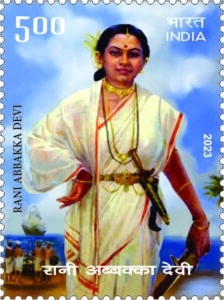
Rani Abbakka of Ullal (16th century)
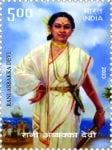
Ullal, a small port just south of Mangaluru, was ruled by the Chowtas, a family remembered as Jain, whose throne passed through the female line. In the sixteenth century its queen, Abbakka, refused to pay the tribute the Portuguese demanded from the coast's rulers. She allied with the Zamorin of Calicut, and her forces fought the Portuguese at sea and on land for years; tradition tells of fire-arrows launched against their ships at night.
The records are thin, and historians now think there was more than one Abbakka: India Post's 2023 folder speaks of a mother (1554–1588) and a daughter (1594–1640) of that name, both of whom resisted the Portuguese; the daughter, helped by Venkatappa Nayaka of Keladi, beat a Portuguese force in 1618. Tulu folk songs and the yearly Veera Rani Abbakka Utsava keep her memory. Her ₹5 stamp was issued on 15 December 2023.
Ahilyabai Holkar of Indore (1725–1795)
Ahilyabai was not born to rule. She married Khande Rao, son of the Maratha general Malhar Rao Holkar, who trained her in the business of the state and the army. Her husband was killed in battle in 1754, Malhar Rao died in 1766 and her only son, Male Rao, in 1767. When others at the Peshwa's court moved to take over the Holkar lands, she asked to rule herself, and won.
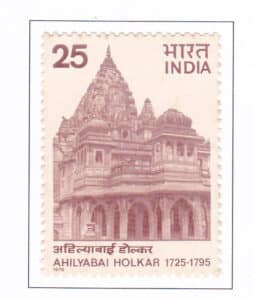
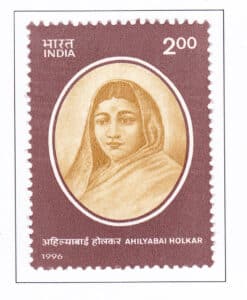
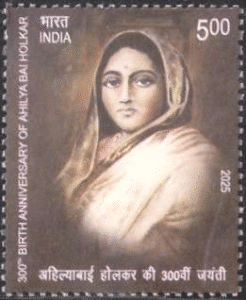
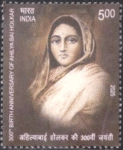
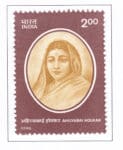
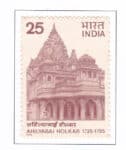
From 1767 until her death in 1795 she governed Malwa from Maheshwar on the Narmada, with Tukoji Holkar commanding her army. She is remembered for justice, for low taxes and for building and restoring temples, ghats, wells and rest houses from the Himalaya to the far south, among them the Kashi Vishwanath temple at Varanasi. She appears on three stamps: 25 paise on 4 September 1975, showing her chhatri (memorial) at Maheshwar, ₹2 in 1996 and ₹5 on 31 May 2025, her 300th birth anniversary.
Rani Velu Nachiyar of Sivaganga (died 1796)
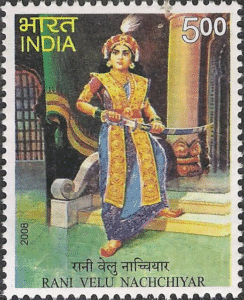
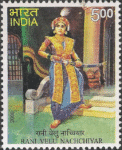
Velu Nachiyar, a princess of Ramanathapuram, was trained in arms, horse riding and several languages. She married Muthu Vaduganatha Thevar, Raja of Sivaganga in today's Tamil Nadu. In 1772 forces of the Nawab of Arcot and the East India Company attacked Sivaganga and killed her husband at Kalaiyar Kovil. She escaped with her daughter and lived in hiding for eight years.
With help from Hyder Ali of Mysore and the Marudhu brothers, she raised an army and retook Sivaganga in 1780, then ruled it herself. Tradition credits her commander Kuyili with a suicide attack on the Company's store of gunpowder. In Tamil Nadu she is remembered as Veeramangai, the brave woman. Her ₹5 stamp was issued on 31 December 2008.
Kittur Rani Chennamma (1778–1829)
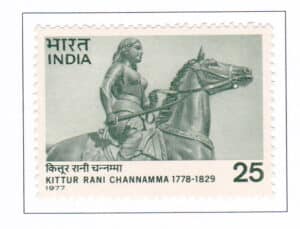
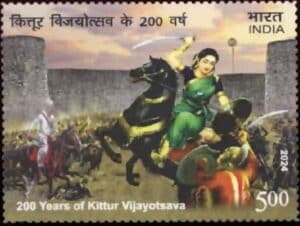
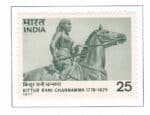
Chennamma was born near Belagavi in 1778 and married Raja Mallasarja of Kittur. After her husband died in 1816 and her son in 1824, she adopted a boy, Shivalingappa, as heir. The East India Company refused to recognise him and sent its collector at Dharwad, St John Thackeray, to take the fort and its treasury.
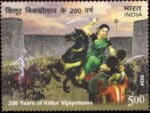
On 23 October 1824 Kittur's men fought back, and Thackeray was killed. The Company returned in December with a larger army; Kittur fell and Chennamma was imprisoned in the fort at Bailhongal, where she died on 21 February 1829. Her soldier Sangolli Rayanna fought on until he was captured and hanged at Nandagad in January 1831. Her 25 paise stamp of 1977 and the ₹5 stamp of 2024, for 200 years of the Kittur victory, were both issued on 23 October, the anniversary of that victory.
Rani Lakshmibai of Jhansi (about 1828–1858)
Manikarnika, born in Varanasi (sources give years from 1827 to 1835), married Gangadhar Rao, Raja of Jhansi, and became Rani Lakshmibai. When he died in 1853, having adopted a son, Damodar Rao, Lord Dalhousie refused the adoption and annexed Jhansi under the doctrine of lapse.
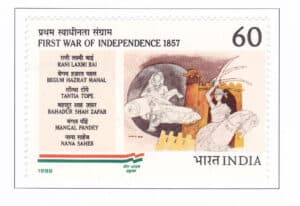
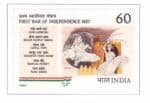
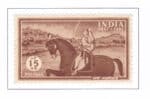
When the rising of 1857 reached Jhansi, the Rani took charge of the state. In March 1858 Sir Hugh Rose's army besieged Jhansi; after the town fell she broke out on horseback, joined Tatya Tope at Kalpi and helped take the fort of Gwalior. She was killed fighting near Gwalior on 17 or 18 June 1858; India remembers her on 18 June. The 15 naye paise stamp of 15 August 1957, for the centenary of the rising, shows her on horseback with sword raised; the 60 paise stamp of 9 May 1988, for the martyrs of the First War of Independence, carries M. F. Husain's painting of her on horseback.
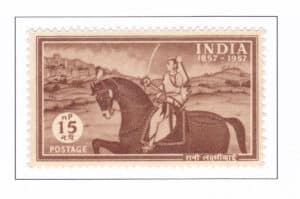
15 August 1957
Centenary of 1857 – Rani Lakshmibai
- Commemorative
- Animals (Fauna)
- Anniversaries and Jubilees
Jhalkari Bai (born 1830)
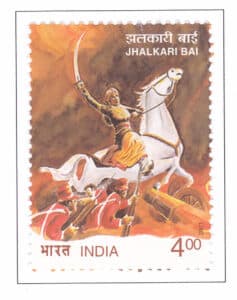
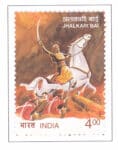
Jhalkari Bai, born in 1830 into a poor Kori family at Bhojla near Jhansi, served in the women's unit of Rani Lakshmibai's army and is said to have looked very like the Rani. In Bundelkhand's story, when Jhansi fell in 1858 she dressed as the Rani and rode out to the British camp, giving the real Rani time to escape.
What became of her is not certain: some accounts say she was killed in 1858, others that she lived to old age; written records of her are few, and she lives mostly in the songs and stories of Bundelkhand. Her ₹4 stamp was issued on 22 July 2001.
Begum Hazrat Mahal of Awadh (about 1820–1879)
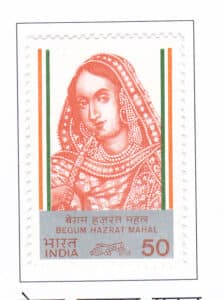
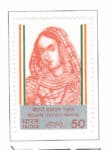
Hazrat Mahal was a wife of Wajid Ali Shah, the last Nawab of Awadh. In 1856 the East India Company annexed Awadh and sent the Nawab to Calcutta. When the rising reached Lucknow in 1857, she had her young son, Birjis Qadr, proclaimed ruler (5 July 1857) and led the government and the rebels for him, while the British held out in the Residency.
After Lucknow fell in March 1858 she fought on in the countryside and refused Queen Victoria's offer of pardon and a pension. She ended her life in Kathmandu, in Nepal, where she died on 7 April 1879. Her 50 paise stamp was issued on 10 May 1984, the anniversary of the rising at Meerut.
Rani Avantibai of Ramgarh (died 1858)
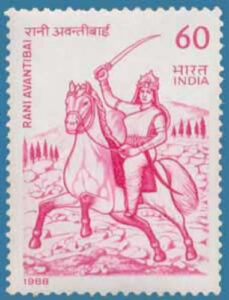
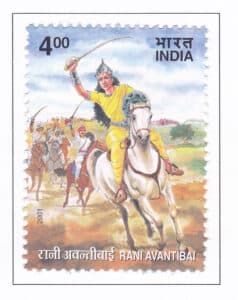
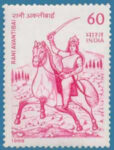
Avantibai was the wife of Vikramaditya Singh, Raja of Ramgarh near Mandla. When he became unable to rule and then died, the British put the state under their Court of Wards, passing over her young sons. In 1857 she raised an army of some four thousand men and defeated a British force at Khairi, near Mandla.
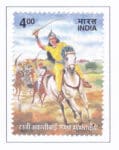
When the British returned in strength, she withdrew to the forests of the Devharigarh hills. Surrounded, she stabbed herself with her own sword on 20 March 1858 rather than surrender. India Post issued a 60 paise stamp on the anniversary of her death in 1988, and a ₹4 stamp in 2001.
Rani Gaidinliu (1915–1993)
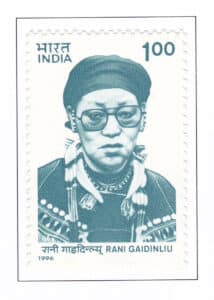
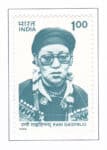
Gaidinliu was not born a queen. A Rongmei Naga from Manipur, she joined her cousin Haipou Jadonang's Heraka movement at thirteen. After the British hanged Jadonang in 1931 she led the movement and its armed resistance herself, until she was captured in 1932 at sixteen and sentenced to life imprisonment.
Jawaharlal Nehru met her in Shillong jail in 1937, called her Rani, queen of the Nagas, and asked for her release. She was freed only after Independence, in 1947, having spent fourteen years in prison. She was awarded the Padma Bhushan in 1982. Her ₹1 stamp was issued on 12 September 1996.
Sources
India Post's issue folders; Encyclopaedia Britannica; Wikipedia; the Press Information Bureau.
Stamps in this plan

Comments 0
No comments yet. Be the first to say something kind or useful.
Sign in to join in.
Comments show straight away. Keep them kind and about the exhibit; anyone can report one that isn't. House rules
