
1947: Independence, Partition and the Post
Independence and partition divided the post: George VI stamps used in two new countries, Pakistan’s Nasik overprints, and the dates of India’s first national stamps.
Updated November 6, 2026
In this article
A new border did not change the stock overnight
Independence and partition divided the postal administration as well as the country it served. India became independent on 15 August 1947; Pakistan marks its national day on 14 August. Stamps, offices, staff, routes and supplies had to keep working through the upheaval. A George VI stamp used after the political change is therefore not necessarily a letter from before independence, or an invalid use.[1][2]
The story has to be read from the place and date of each item. An Indian stamp without overprint used in Karachi after partition can belong to the transitional Pakistan post; a King’s-head stamp used in India can show stock carrying on under the new administration. The portrait alone cannot say which successor post handled a letter.[1][2]
India’s first national designs came later
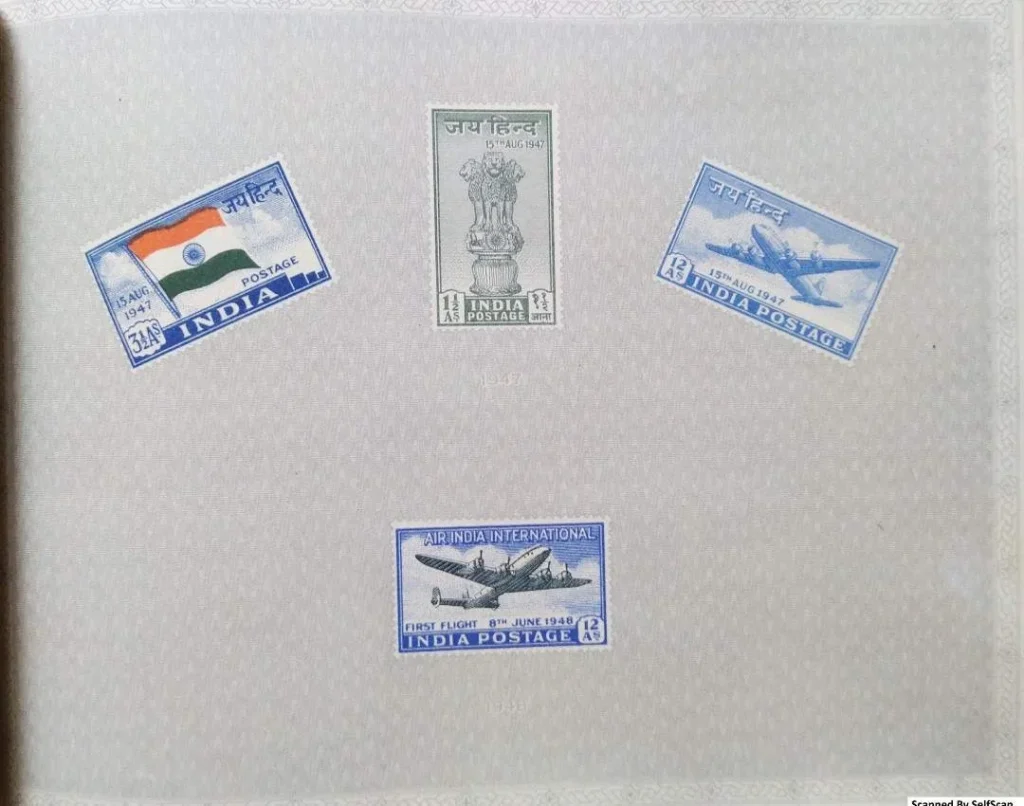
India’s first stamps of its own were issued in two stages. The Department of Posts register dates the 3½ annas National Flag to 21 November 1947, followed by the 1½ annas Ashoka Lion Capital and the 12 annas aircraft under 15 December. All commemorate independence, but the date 15 August printed on them is not the date every stamp was issued.[3][4]
The album of 1954 shortens the story, saying that independence came on 15 August and a set of three was issued to commemorate it. Read literally, that suggests an issue on the same day, which the later official register does not support, so the event and the issue are kept apart here. The designs replace the royal portrait with the flag, the national emblem and an aircraft, a new visual identity, while the post itself went on using the stock it had.[3][4]
| Issued | Value | Design |
|---|---|---|
| 21 November 1947 | 3½ annas | National Flag and Jai Hind |
| 15 December 1947 | 1½ annas | Ashoka Lion Capital |
| 15 December 1947 | 12 annas | Aircraft |
Pakistan’s Nasik overprints
At partition Pakistan first used the Indian stamps it had. A provisional series overprinted PAKISTAN was then prepared at Nasik, the established Indian security press, and issued on 1 October 1947. Roberts describes nineteen ordinary values, from 3 pies to 25 rupees, with official stock overprinted as well; Fraser gives the same opening date and explains the need to keep supplies going.[2][1]
These were not newly designed Pakistan stamps. The George VI designs, the Indian values and most of the original inscription stayed under a new name, so one stamp can be both an Indian-made stamp and a Pakistan issue. Describing only the King, or only the new country name, loses part of its history.[2][1]
Local overprints, and different end dates
Supplies from Nasik could not reach every office. Machine overprints, metal and rubber handstamps, typewritten additions and handwritten forms appeared, with different degrees of authority, and old George V and even Edward VII stamps were used where stock survived. These local issues are not one national setting, and placing one may depend on both the letter shapes and the postal context.[2][1]
Roberts quotes D. R. Martin on a further point: Indian ordinary stamps without overprint were at first valid until 1 November 1947, extended at least in the Punjab and the North-West Frontier Province to 21 December. Official exchange arrangements ran on separately into March 1948, and the Indian stamps overprinted PAKISTAN were not withdrawn until 31 October 1949. These dates concern different things, so one last date for everything would mislead.[2][1]
A Karachi cover of August 1947
Roberts illustrates a letter to London with a large Pakistan Zindabad cancellation of Karachi City, 21 August 1947, tying an Indian 14 annas George VI aircraft stamp. The word Pakistan is in the postmark, not on the stamp, so the cover shows inherited Indian stock used by the new post before the overprinted issue of October.[2]
The cover also carries an air mail label and a Damaged by Seawater cachet, which Roberts links with a flying accident at Bahrain. The markings show why the envelope matters: an accident in transit, the destination and the political change are all on one object, and a loose 14 annas would keep only a small part of that.[2]
The Gulf offices, and where the collection ends
Fraser describes the Gulf offices at Dubai, Muscat and Gwadar as another result of partition: they came under Karachi and used Pakistan stamps for a time. Britain’s takeover of the Dubai and Muscat offices on 1 April 1948 drew a further line, while Gwadar went its own way. These offices should not be assumed to follow India’s later stamps just because they had used Indian stamps before.[1][2][3]
A collection can end British India at the political date and add a clearly labelled section for the transition: stamps still in use, the overprints and the new national designs. Every local Pakistan setting, the regional extensions from the original orders and the handwritten additions still need study. The dates and the covers described here are enough to explain the transition without losing sight of the upheaval lived by the people whose letters the post carried.[1][2][3]
Sources
- [1] Colin Fraser, “Empire Echoes: The Partition of India and Birth of Pakistan”, Stamp News, pp. 57–58.
- [2] Michael J. Roberts, Pakistan Beyond the Catalogue: Birth, Conversion and Divorce, Royal Philatelic Society London display handout, 9 March 2017.
- [3] Indian Posts and Telegraphs Department, India Postage Stamp Centenary 1854–1954: Souvenir Album (1 October 1954), plates 7–17 and printed commentary pp.2–4.
- [4] Department of Posts, “Commemorative Postage Stamps of India”, the official register, entries for 1947.
Notes 0
Add what you know: a cover or stamp in your collection, a date or source, a correction or a question.
No notes yet.
Sign in to add a note.
Notes show straight away. Keep them kind and about the article; anyone can report one that isn't. House rules
