
King George VI: Official Stamps and the SERVICE Design
From black SERVICE overprints on the ordinary definitives to small stamps with SERVICE printed in their own lower panel, and their later life in Pakistan.
Updated June 29, 2026
In this article
Two ways of making official stamps
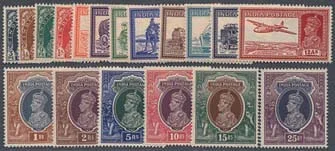
George VI’s officials fall into two clearly different families. The first takes ordinary stamps and adds a black SERVICE overprint. The later small official design has SERVICE in a prominent lower panel as part of the stamp itself. They were made in different ways, even where the King, the value and the colour are the same, and the difference can be seen without a catalogue number.[1]
The public Richter collection shows the contrast directly: its 9 pies of the ordinary arch design has black SERVICE across the portrait, while its later 3 pies and 4 annas carry SERVICE in a bottom tablet designed for it. The collection groups them under 1937 and 1939; those are broad dates for the families, not one first day for every value or colour.[1]
The first overprints, reported at the time
The South African Philatelist of January 1938 reports the George VI 9 pies slate-green with SERVICE. Its March issue records the 1 anna carmine with a typeset overprint, and its May notes the half anna brown with SERVICE. These short reports show the order in which the low-value overprints were noticed; January, March and May are not official release months.[2]
They also show how close these officials are to the first ordinary definitives: the arch portrait, the multiple-star paper and the typographed stamp are all there, with the black word added in a separate operation. Compare such a stamp first with the right ordinary stamp, then with a normal example of the official lettering.[2]
Rupee officials and the top of the range
Higher charges needed rupee officials as well as the small arch values. The first overprinted family is usually collected as the ½ anna, 9 pies and 1 anna, followed by the 1, 2, 5 and 10 rupees elephant designs; the 1947 catalogue lists exactly these seven. The official range should not be stretched to the ordinary 15 and 25 rupees: the George V stock policy had already limited newly supplied officials to 10 rupees.[3][4][1]
This is an administrative distinction, not a claim that the higher ordinary stamps did not exist. In a collection, the six ordinary rupees and the official overprinted group need separate lists. A later territorial SERVICE overprint, for a Convention State for example, belongs to its own administration, and a single list of every impressive elephant stamp with some added wording would hide these different purposes.[3][4][1]
SERVICE built into the design
The later officials make the word part of the stamp. A crowned portrait sits in the centre between architectural side pieces, India Postage runs across the top, value panels sit low at the sides and SERVICE spans the bottom. On Richter’s 3 pies the dark background and pale lettering are one design, and the 4 annas uses the same arrangement in brown.[1]
This lower inscription should not be called a missing or perfectly placed overprint because it resembles the word once added in black: it is part of the design. That matters for errors. A partly missing bottom word may be faulty printing of the stamp or damage, while a missing overprint on the earlier ordinary design is a different claim, and each needs the right normal stamp to compare with.[1]
The values of the SERVICE design
The 1947 catalogue lists nine values under 1939 Engraved Service: 3 pies (slate), ½ anna (red-brown, later mauve), 9 pies (deep green), 1 anna (carmine), 1½ annas (bistre, and plum), 2 annas (vermilion), 2½ annas (bright violet), 4 annas (brown) and 8 annas (slate-violet), the highest of this small group. The two colours of the half anna and of the one and a half annas are stages within those values, not more values. StampWorld also lists 1 anna 3 pies, as no. 110, making ten values, which shows that the dealer’s list of 1947 is not complete.[6][7]
The heading covers a family supplied over several years; it is not evidence that every colour appeared on one day in 1939. Keep these stamps separate from the seven overprinted ordinary stamps, and from the ONE ANNA provisional of 1939 on the older George V 1¼ annas, which is an official conversion but not a value of the new George VI design.[6][7]
Officials, state overprints and Pakistan
An official stamp could itself receive a territorial name, which gives layers to be read in order: the Indian official design, the added state or country name, and the cancellation. Fraser’s account of partition shows official stamps with Pakistan added, including handwritten and typewritten forms linked to shortages, continuing the life of the George VI stamps after British India was divided.[5]
An unusual overprint cannot therefore be placed by the King’s head alone. Its date, place and official sender may put it in an Indian department, a Convention State or Pakistan’s provisional arrangements. Fraser’s examples suggest that some typewritten additions may have been made by the users rather than centrally by postal officials, so an unusual form needs evidence from its context before it is called official.[5]
Identifying a George VI official
First ask whether SERVICE is a black word added on top, or part of the printed lower panel. Then identify the value, the format, the watermark where it can safely be seen, and any territorial name. On a cover, keep the department’s endorsement and the evidence of the route. These steps rest on what can be seen on the stamps rather than assuming every SERVICE marking belongs to one national series.[1][2][5][6]
The overprinted family of seven, ½ anna, 9 pies, 1 anna and 1, 2, 5 and 10 rupees in the 1947 catalogue, should not gain imaginary Indian 15 or 25 rupees officials by analogy with the ordinary series. A full classification of every paper, watermark position and printing state still needs specialised work.[1][2][5][6]
Sources
- [1] Richter Stamps, “India Official Stamps”
- [2] The South African Philatelist, January 1938 pp.12–13, March 1938 p.45 and May 1938 p.68.
- [3] D. Hammond Giles, Essays of the India Provisionals of 1925, Philatelic Society of India, Bombay, 1962.
- [4] Indian Posts and Telegraphs Department, India Postage Stamp Centenary 1854–1954: Souvenir Album (1 October 1954), plates 7–17 and printed commentary pp.2–4.
- [5] Colin Fraser, “Empire Echoes: The Partition of India and Birth of Pakistan”, Stamp News, pp. 57–58.
- [6] Bombay Philatelic Company, Catalogue of Postage Stamps 1947 (Bombay: Bombay Philatelic Company, 1947), India section pp.49–52.
- [7] StampWorld, India Service stamps 1930–1939, entry 110.
Notes 0
Add what you know: a cover or stamp in your collection, a date or source, a correction or a question.
No notes yet.
Sign in to add a note.
Notes show straight away. Keep them kind and about the article; anyone can report one that isn't. House rules
