
Pies, Annas and Rupees: British India Denominations and Catalogue Language
Twelve pies to the anna, sixteen annas to the rupee: a key to the values, worked sums for mixed frankings, and how to write a description that outlives a catalogue number.
Updated October 2, 2026
In this article
Read the value before looking up a number
A footnote in Clarke’s chapter XIX gives twelve pies to the anna, and in this pre-decimal system sixteen annas make a rupee. Three pies is therefore a quarter anna, six pies half an anna, and two annas six pies two and a half annas. A quarter-anna surcharge and a three-pies surcharge can stand for the same value and still belong to different issues.[1][2]
The centenary album gives an example: in 1946 a shortage was met by surcharging the one anna three pies, no longer needed, with “3 pies”, and the album contrasts that wording with the earlier surcharge in fractions of an anna. The same value does not mean the same stamp, overprint or date.[1][2]
A short key to the values
For a mixed franking, turn each stamp into pies, add them up, and then write the total in annas and pies if that is how the tariff gives it. Four half-anna stamps make two annas. A one anna, a two annas six pies and a half anna make 48 pies, or four annas. The arithmetic is a separate question from whether those issues could be used together on the date of the cover.[1][2]
Rupees and annas are just as easy to misread: Rs. 3-8, in that two-part form, means three rupees eight annas, or 3½ rupees. Keep a historical table’s column headings with its figures; modern decimal prices are written differently.[1][2]
| Written value | Equivalent | Check |
|---|---|---|
| 3 pies | ¼ anna | 4 of them make 1 anna |
| 6 pies | ½ anna | 2 of them make 1 anna |
| 9 pies | ¾ anna | Not 0.9 anna |
| 2 annas 6 pies | 2½ annas | 30 pies |
| 6 annas 8 pies | 6⅔ annas | 80 pies |
| 1 rupee | 16 annas | 192 pies |
A catalogue concordance needs an edition and a definition
A catalogue number is an address inside one publication, not a universal name. A useful cross-reference starts with the ruler, inscription, value, colour, watermark, perforation and overprint, and then adds the catalogue’s name, edition and number. A general catalogue may group together material that a specialised one separates.[1][3]
Words change with context too. Clarke calls the eight-pies stamp a value for soldiers’ postage; Higgins & Gage give letter prefixes to the classes of stationery. Neither system can be carried straight over to a list of adhesive stamps, and no checked Stanley Gibbons–Scott–Michel concordance of numbers is offered here.[1][3]
As., a., ps. and fractions are not decimals
The album abbreviates anna and annas in several ways, and older English accounts write pies or pice with spellings that depend on the context. Read the value as printed on the stamp or in the tariff, rather than assuming a small abbreviation explains itself. In a two-part “annas–pies” figure the second number is in twelfths, not hundredths.[2][1]
So one anna three pies is 15 pies, or 1¼ annas, and three annas six pies is 42 pies, or 3½ annas. The album names both as values that came with the changes to inland rates in 1932. Knowing the arithmetic helps tell “3½ annas” from a “3 pies” marking that looks similar at a glance.[2][1]
A description that survives a change of catalogue
A workable description of a Victorian stamp might begin “Queen Victoria; INDIA POSTAGE; 2 annas 6 pies; single-star paper; perforated 14”, followed by the colour and condition you see. That can be compared with any other catalogue, even if the numbers differ; starting with an unexplained number gives the next reader much less to go on.[2][3]
For an official overprint, a Convention State name or an expeditionary mark, the basic description has to be extended. For stationery it also needs the class of object and, where relevant, its size, flap or reply-card arrangement. The class prefixes of Higgins & Gage show that a catalogue’s internal organisation is itself part of the identifier.[2][3]
POSTAGE AND REVENUE describes what a stamp was allowed to do
Clarke explains that the Edward VII half anna and one anna were redesigned in 1906 for use for both postage and revenue, and that higher postal values were added in 1909, when postage stamps replaced the separate telegraph stamps. The inscription and value therefore record a piece of administrative history as well as a design.[1]
A used high value is not necessarily evidence of a very expensive letter: the mark, document or cover has to show postal use rather than telegraph or fiscal use. A concordance can identify a stamp correctly and still describe its use wrongly, so keep the identity of the issue apart from its use, especially when comparing dealers’ lists with specialised collections.[1]
A worked sum
As a second example, add three pies, nine pies and one anna three pies. The last is 15 pies, so the total is 27 pies: two annas three pies, or 2¼ annas. Writing the total first in the units of the tariff avoids confusing a quarter anna with a quarter rupee. This is an exercise in arithmetic, not a claim that these stamps make up a real rate.[1]
If an imagined assessment needed that postage plus a four-anna registration fee paid in stamps, the stamps would total six annas three pies. Under a rule that the registration fee be paid in cash, the stamps could still total only two annas three pies. The date, the service and the way of paying decide which amount should appear on the item.[1]
A small concordance tied to real objects
The table gives reference numbers exactly as printed in the 2011 Gärtner catalogue, so that the advice above comes with real numbers. The catalogue does not say which Stanley Gibbons edition it used, and the numbers are not converted into Scott or Michel; the description of the stamp remains the starting point for checking a current catalogue.[4]
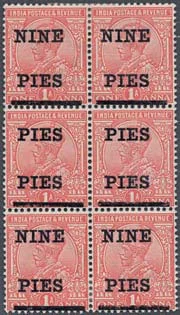
A suffix, qualifier or status cannot be dropped without changing the claim. SG 192b in the catalogue refers to its PIES PIES variety within a block, while SG 195 var (Proof) describes proof material, not an ordinary issued provisional. Keep that difference when you move an identification into an album or an inventory.[4]
| Stamp or family | Number printed by the auctioneer | Lot |
|---|---|---|
| 1854 half anna blue, Die I | SG 2 | Lot 15, a used cover, and lot 16, a retouched unused example |
| 1921 nine pies, PIES PIES variety | SG 192b | Lot 191, two examples in a block of six |
| 1922 quarter-anna surcharge, proof | SG 195 var (Proof) | Lot 194, a marginal block with PROOF handstamps |
| 1926–1933 three annas ultramarine | SG 208 | Lot 199, a double-perforation block; the number identifies the basic stamp |
Sources
- [1] Geoffrey Clarke, The Post Office of India and Its Story, John Lane/The Bodley Head, London, 1921, chapter XIX, pp. 178–187 (footnote 7), and chapters III–IV, pp. 26–47.
- [2] Indian Posts and Telegraphs Department, India Postage Stamp Centenary 1854–1954: Souvenir Album, 1 October 1954, explanatory pp. 1–3 and plates 1–16.
- [3] Higgins & Gage, postal stationery catalogue, India section: introduction (“Sub-Division and Numbering”) and pp. 1–2.
- [4] Auktionshaus Christoph Gärtner, India: Park Collection, auction catalogue, 7 March 2011, lots 15, 16, 191, 194 and 199.
Notes 0
Add what you know: a cover or stamp in your collection, a date or source, a correction or a question.
No notes yet.
Sign in to add a note.
Notes show straight away. Keep them kind and about the article; anyone can report one that isn't. House rules
