
British India Forgeries, Reprints, Repairs and Fraudulent Alterations
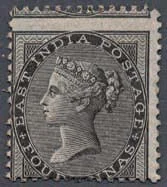
The black four annas forged in 1864, false Convention State overprints and the Singapore bisects: judge the stamp, the overprint, the cancellation and the condition separately.
Updated June 17, 2026
In this article
A forgery that changed a postage stamp
Clarke records that the early De La Rue four annas was changed from black to green at the end of 1864 because the black stamp had been forged. That shows the post responding to a threat to its revenue; it does not make every black four annas doubtful, or every green one genuine.[1]
The stamp itself and any official, expeditionary or state overprint added to it raise separate questions of authenticity. Clarke notes that forged Convention State overprints were numerous. A genuine Indian stamp can carry a false overprint, and a genuine cancellation does not prove an overprint printed over or under it.[1]
Why the whole postal item matters
Clarke describes bisected eight annas and four annas on bluish glazed paper, and four annas, one anna and eight pies on white paper, found on postal articles posted in Singapore. His account ties those items to an Indian post office outside India. It is a dated report of the material he knew, not a modern census, and not a general permission for every bisected value.[1]
A loose half-stamp loses most of that evidence. A complete cover can keep a cancellation running across the cut stamp and the envelope, the office and date, a likely rate, and the address and transit marks of the time. Those features can be judged together; no one of them alone proves genuine postal use.[1]
Reprints, repairs and improved looks
A reprint is a later impression; a forgery imitates something in order to deceive; a repair changes an existing item. For a claimed reprint, its source, date and authority are essential. There is no complete list of British India reprints, and the word should not be used just to explain an unfamiliar impression.[1]
If you suspect an alteration, compare the front and back: thinning, filled holes, joined pieces, changed margins or disturbed ink can change the very evidence used to identify a stamp. An expert opinion should say what it covers — the stamp, the overprint, the cancellation or the whole cover — and whether it takes repairs into account.[1]
| Layer | What to examine | Why it matters |
|---|---|---|
| The stamp | Design, paper, watermark, perforation | It may be genuine even when an overprint is false |
| Overprint or surcharge | Form, ink, setting, order of application | Must be judged on its own |
| Cancellation | Device, date, how it relates to stamp and cover | Cannot on its own prove the whole item genuine |
| Condition | Disturbed paper and ink | Repairs can hide original evidence |
Cheating the post and cheating the collector
The black four annas forgery that Clarke mentions was a way of avoiding postage. Forged Convention State overprints played on collectors’ wish for a scarce variety on a fairly common stamp. Both are forgeries, but their materials, their intended victims and the ways they circulated are likely to differ.[1]
That distinction helps frame an investigation. A postal forgery genuinely used on a cover of the time can itself be a piece of postal history, while still being a counterfeit stamp. A made-up rare overprint on a genuinely used stamp does not become a postal forgery just because the stamp underneath is cancelled. A full claim says which part is original and which is false.[1]
A bisect and a trimmed stamp need different proof
Clarke’s Singapore bisects were found on postal articles, half a stamp used for half its value; the cut is central to the payment claimed. A later stamp trimmed to pass as imperforate also has a cut edge, but there the cut is meant to hide something that was made. The two may look alike as cut paper, but their histories have nothing in common.[1]
For a bisect, the rate, the office and how the cancellation runs all matter together. For a supposed imperforate, the width of the surviving margin, the size of the design and comparison with intact examples matter. In both cases a detached single has lost its context — and a specialist’s report of a few historical covers is no invitation to cut an Indian stamp in half.[1]
The stamp underneath sets a limit, not a certificate
Clarke dates the first SERVICE overprints to 1866, the later wording On H.M.S. to 1874, and a return to Service in 1911. These broad stages can expose an impossible attribution, with the wrong stamp, period or official wording; they do not settle the type and setting of every overprint made in India or London.[1]
Even a combination that fits the dates can be faked, while an untidy genuine impression can differ from a catalogue’s ideal drawing. Compare with genuine examples of the same operation, not just an enlarged typeface from a modern illustration. The test of dates is a first step, not a substitute for expert examination of ink and setting.[1]
Keep the scope of an opinion with the item
An opinion that a stamp is genuine may not cover the envelope it is on, and an opinion on an overprint may not cover the cancellation. Record who gave a certificate, when, and exactly what it covers, rather than shortening it to “certified”. Old opinions can be valuable history even when later research gives a more precise classification.[1]
The historical examples show why: the genuine stamp under a false state overprint, the Singapore bisect and its postal use, the ordinary black four annas beside the postal forgery. Each raises more than one question, and a collection record should keep the answer that was actually given.[1]
Sources
Notes 0
Add what you know: a cover or stamp in your collection, a date or source, a correction or a question.
No notes yet.
Sign in to add a note.
Notes show straight away. Keep them kind and about the article; anyone can report one that isn't. House rules
