
British India Military Mail: Field Post Offices, Censorship and Prisoners of War
The base office and its field offices, 1914 in France, Basra’s Returned Letter Office, C.E.F. and I.E.F. overprints, censor strips and the prisoner-of-war camps of 1914–20.
Updated June 20, 2026
In this article
The base office knew where everyone was
Clarke (chapter XVII, pp. 165–170) describes a military postal organisation in which the Quartermaster-General’s Department said which offices were needed, while the postal staff served under military discipline. The base office kept track of where units were, kept the lists of officers up to date and sent the bags to the right field offices. A field-office number is therefore an identifier within the organisation, not necessarily a fixed town.[1]
His chapter XVIII (pp. 171–177) describes the contingent sent to France in 1914 as one base office and twenty-two field offices. As the Indian troops moved, staff and offices went with them to Egypt and Mesopotamia, and by the end of the war little of the original organisation was left in France. Tie a device number to its date before giving it a place.[1]
A returned letter can show the system at work
In Mesopotamia, Clarke records a Returned Letter Office at Basra in 1916 for mail to men who could not be traced, handling about 200,000 articles a month. A redirected or returned letter may therefore keep evidence of enquiries, reassignment and delay that a letter delivered straight away does not.[1]
The enquiry section of the Base Postal Depot at Bombay kept an index of officers and men sent back or invalided to India. Clarke reports more than 133,000 index cards at the armistice, and about 330,000 letters dealt with every month in that section. These are the workings behind changes of address, not proof that a particular redirected cover passed through Bombay.[1]
Clarke writes with the voice of a senior imperial official. His figures can be used without taking on his social judgements, or assuming that every lost or delayed letter was put right. A surviving returned cover is evidence of its own handling, not a measure of how well the whole system worked.[1]
Military stationery is evidence of its own
Higgins & Gage (India, p. 14) separate military and occupation stationery, including C.E.F. and I.E.F. overprints on the regular forms. They also list a soldiers’ and seamen’s envelope of 1879 with a nine-pies printed value, and its later changes. The thing to study is the whole authorised form, not an overprint cut out of it.[2]
The same page lists airmail envelopes of 1946 for letters to and from H.M. Forces in India, with a heading that includes “TO H.M. FORCES ONLY”, a value of eight annas, and differences of watermark. That restriction is part of the identification: a commercial envelope that looks military should not be given the same status just because it carries an army address.[2]
Censorship and captivity leave a second trail
Clarke notes postal officials taken prisoner when Kut fell, but his short account of the war gives no catalogue of prisoner-of-war camps or censor codes. A censor label, an examiner’s number or a cachet concerns the examination of the letter; on its own it neither identifies a field office nor proves that the writer was a prisoner.[1][2]
For prisoner mail, look at the sender’s status, the camp or internment address, the date, the route by which it was forwarded, any free postage or payment, and the censor marks from each side of the journey. Placing a letter in a camp needs a specialist source for the period. The field-post framework and some documented stationery are set out here; the camp lists, censor allocations and free-postage rules of the Second World War are a separate study.[1][2]
| Evidence | What it records | Its limit |
|---|---|---|
| Field Post Office mark | Handling by the postal organisation | Place it by number and date, not number alone |
| C.E.F. or I.E.F. form | An authorised class of stationery, if genuine | Does not by itself prove a particular theatre of war |
| Censor label or number | Examination of the letter | Not the same as identifying the field office |
| Prisoner-of-war or internment address | The status claimed for sender or addressee | Needs confirming by dated camp and route evidence |
Military mail is not just Service-stamp mail
Clarke deals with official stamps and with the field postal organisation in different chapters. SERVICE or On H.M.S. marks a class of official stamp; a field-post cancellation shows handling through the military postal network. A soldier’s private letter, an official departmental cover and a military stationery form are not the same kind of thing.[1][2]
An ordinary postage stamp can therefore belong to military postal history when the cover shows the field service. And a loose SERVICE stamp with an unclear cancellation does not show service in a particular campaign. Keep the writer or department, the authorised way of paying and the postal organisation that handled it as separate observations.[1][2]
Changes of theatre upset a fixed map of offices
Clarke describes Indian postal staff working in France, Egypt, Palestine, Salonika, Mesopotamia and East Africa, with the organisation changing as operations changed. He dates the civil take-over of the Mesopotamian postal administration to 1 May 1919, and notes that many Indian staff stayed on with the new administration.[1]
The same staff, or a surviving device, can therefore carry on through a change from field service to civil service, and the date of a cover decides which stage it belongs to. A map that gives one office number one place for a whole war wipes out those changes; a sound attribution needs a dated record of movements, not just the name of a campaign.[1]
A cover that separates the army post from the censor
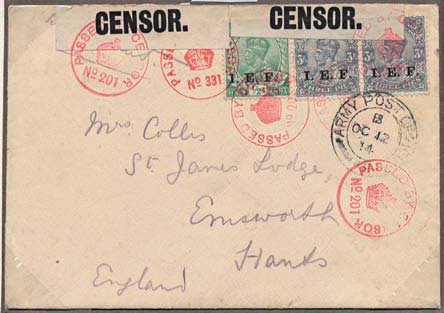
Gärtner’s lot 361 is described as a letter of October 1914 to Britain with an ARMY POST OFFICE cancellation, a first censor mark, and later reopening with a censor strip and more strikes. The photograph shows the layers clearly: the military postal handling, the I.E.F. stamps and the censor marks sit in different parts of the same envelope.[3]
The catalogue links the office with Orleans in France and reports a certificate; its claims of earliest use and rarity are not repeated here. What the photograph shows is more limited and more useful: a censor strip and several examiner’s strikes can record successive examinations, while a field or army office mark concerns the postal channel.[3]
C.E.F.: an overprint against currency profit
Clarke’s account of the China Expeditionary Force ties the overprint of 1900 to sales in dollars. At the postal rate used in Hongkong one anna was four cents, so a dollar bought 25 one-anna stamps, which was more than a dollar was worth in rupees at the field office’s rate. The administration feared that stamps would be bought in China and sent to India at a profit.[1]
He dates the C.E.F. overprint to about the middle of August 1900, and explains that its purpose was to limit where the stamps could be used; he also says sale was limited to officers and soldiers in uniform. That is a concrete administrative reason for a military overprint, not just a decorative campaign abbreviation. His appendix also describes a combined postal and railway-mail service whose clerks accepted and delivered letters as well as sorting them on the way.[1]
Civil censors could handle military and transit mail
Baker and Entwistle divide their catalogue of 1914–20 between civil censorship and prisoner and internee mail, but warn that the two overlap. Belgaum’s devices occur on transit mail from Portuguese India as well as on internees’ letters. Their notes also record Quetta examining mail connected with Persia and the Afghan War of 1919, including a cover of military origin as late as May 1920.[4]
The postal channel, the writer’s status and the censor station each have to be identified separately. A military address does not mean examination by a field censor, and the name of a civil station does not rule out a military link. The dates given are recorded examples, not modern limits of use.[4]
Each camp had its own rules for letters
The same catalogue describes Ahmednagar as a group of camps with civil, prisoner and parole divisions, not a single address. It records limits on the number of letters, while postcards were unlimited, and dates the opening of Bellary to Turkish prisoners to January 1917 — a useful check on any claim of camp use.[4]
The authors also note camp and civil censorship used together, so a second censor strike may come from a second authority, not be a repeated strike of one office. These examples from the First World War strengthen the framework; the camps, censor allocations and free-postage rules of the Second World War still await a catalogue of their own.[4]
Sources
- [1] Geoffrey Clarke, The Post Office of India and Its Story, John Lane/The Bodley Head, London, 1921, chapters XVII–XVIII, pp. 165–177, and chapter XIX, pp. 178–187.
- [2] Higgins & Gage, postal stationery catalogue, India section: introduction (“Sub-Division and Numbering”) and pp. 1–2, 6, 10 and 14.
- [3] Auktionshaus Christoph Gärtner, India: Park Collection, auction catalogue, 7 March 2011, lot 361 (photograph p. 47, description p. 79).
- [4] A. Baker and C. Entwistle, Catalogue of Indian Censorship 1914–20, 1994, pp. 3–11.
Notes 0
Add what you know: a cover or stamp in your collection, a date or source, a correction or a question.
No notes yet.
Sign in to add a note.
Notes show straight away. Keep them kind and about the article; anyone can report one that isn't. House rules
