
British India Postmarks, Obliterators and the Squared Circle
Obliterators and datestamps, red and black marks, Danby’s squared-circle types A to D and their dates of use, and why a catalogue code is not always on the cover.
Updated July 15, 2026
In this article
A killer and a date mark may do different jobs
A mark that cancels the stamp need not carry a readable town and date; a separate office mark may give that. The later squared circle, on the other hand, was designed to combine the cancellation with the place, the date and usually a time code in a single strike, as Danby explains on page 81 of his study of 1960.[1][2]
The colour of the ink could have a set administrative meaning too. Clarke (chapter III, pp. 26–37) says the Manual of 1854 laid down a red date mark for paid letters and black for unpaid ones. That is a rule of one administrative setting, not a key to every red or black mark in India.[1][2]
The squared circle: count the bars before naming the type
Danby describes a central circle with bars of diminishing length forming four square corners. In his corrected classification, Type A has four bars and a circle of about 16–20 mm; Type B three bars and a medium circle of about 19–21 mm; Type C three bars and a larger circle of about 25 mm; and Type D includes a tablet naming a Convention State. His corrections of September (p. 213) put right a misleading summary on p. 81. The subtypes of Type A are told apart by, among other things, a cross dividing a double place-name, a star ornament, and bars that do not touch the circle.[1]
This lettered classification is Danby’s, designed to avoid confusion with the numbered classifications of Renouf and Jal Cooper. A label such as “Type B” means something only when the system is named with it; a rough square outline alone cannot separate the four families.[1]
| Family | Main distinction | In practice |
|---|---|---|
| A | Four bars; circle about 16–20 mm | The subtypes need close study of the name divider and the joins |
| B | Three bars; medium circle, about 19–21 mm | Use the corrected definition, not the first summary on p. 81 |
| C | Three bars; large circle, about 25 mm | Tell it from Type B by size as well as by the bars |
| D | A tablet with the name of a Convention State | Read both the office and the state |
Dates of use are records, not issue dates
Danby’s Abbottabad examples move from a single circle in 1884–1886 to Type B in 1886–1891 and a later Type C. He also records Poona Type A strikes in 1887 and 1891, although Type B was known there in 1888. A new device did not necessarily retire the old one.[1]
His discussion of Type A reports Murree on 15 December 1884, and earlier dates from Aden and Zanzibar. These were the dates known to him in 1960, not the earliest or latest known today, and he invited additions. Copy office names, time codes and spellings as struck before turning them into modern place-names.[1]
Danby corrected his own Type B
The opening classification on Danby’s p. 81 contains a significant error. His corrections in September (p. 213) say that the small-to-medium four-bar family should be Type A, and a medium circle with three bars Type B; the detailed description of June (p. 141) gives Type B as a circle of 19–21 mm with three bars. That corrected definition is the one used here.[1]
The corrections also move the illustrated Umballa mark from Type A(c) to Type B(c), and correct the label of another example — a practical warning against copying an early page or diagram on its own. The last corrections of a study published in parts can change the very classification a collector is trying to apply. They also separate changed readings from newly found strikes, and those qualifications are part of using the classification correctly, even when only a short label appears on an album page.[1]
Type C: why a single stamp may show only part of the mark
On p. 151 Danby gives Type C three bars and a circle of about 25 mm. Because it was so large, a full strike did not usually fit on one small stamp, and the year could be left out or squeezed into small type below the day and month. A partial strike on a single can therefore look less informative than the same mark on a cover.[1]
Danby notes that the large device was well suited to cancelling a pair with one strike, and could be missed by collectors who looked only at singles. The diameter of the circle and the type of the date help confirm it; a small fragment showing three bars cannot by itself tell the medium Type B from the larger Type C.[1]
An earliest date can change within the same study
The additions of September (p. 213) report a possible Simla Type A date in December 1884, earlier than the Murree example discussed before, though the author is unsure of the day. The same additions withdraw a Howrah late-fee report after the mark turned out to be of another type. Both new records and withdrawals are part of the evidence.[1]
A list of dates should keep a clear strike, an uncertain reading and a corrected attribution apart. A device known from 1884 does not mean every office received it that year: its spread has to be traced office by office, and an “earliest recorded” date should always be tied to its source and the source’s date.[1]
An early dotted cancellation on a complete letter
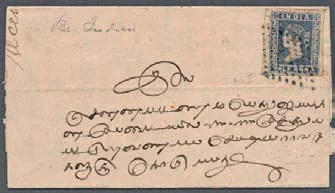
Gärtner’s lot 15 has a blue dotted obliterator on a half-anna stamp, with a boxed AM mark; the auction description dates the use to 27 October 1854. The letter shows why a strike should be broken down by what it does: the dots cancel the stamp, while the other marks and notes give information of a different kind.[3]
This early material comes long before the squared circles. It is shown to compare what marks do, not to stretch Danby’s classification backwards, and the photograph is not used to read a date on the back or to name an office that the description does not give.[3]
A catalogue code is not necessarily on the cover
Baker and Entwistle’s catalogue of censorship makes a useful comparison with classifications of postal devices. Its prefixes name the censor station in the authors’ system — C for Calcutta, BM for Belgaum, BY for Bombay — with H for a handstamp and L for a label, and a P after the station prefix for prisoner-of-war and internee mail. These are addresses in the catalogue, not letters that a cover necessarily bears.[4]
The numeral in a censor device is another matter. The Bombay circular handstamp catalogued BYH 9a, for example, contains an examiner’s number and a place-name, and the authors separate a smaller form, BYH 10, about 22 mm across, from the earlier form of about 32 mm. A number 12 alone cannot make that classification: record the full legend, the size and the date before adding the catalogue label.[4]
Sources
- [1] G. C. Danby, “The Indian ‘Squared Circle’ Cancellation”, India’s Stamp Journal, April–September 1960, pp. 79, 81, 111, 113, 141, 143, 151, 153 and 213 (with the September corrections).
- [2] Geoffrey Clarke, The Post Office of India and Its Story, John Lane/The Bodley Head, London, 1921, chapter III, pp. 26–37.
- [3] Auktionshaus Christoph Gärtner, India: Park Collection, auction catalogue, 7 March 2011, lot 15 (photograph p. 9, description p. 65).
- [4] A. Baker and C. Entwistle, Catalogue of Indian Censorship 1914–20, 1994, pp. 3–11.
Notes 0
Add what you know: a cover or stamp in your collection, a date or source, a correction or a question.
No notes yet.
Sign in to add a note.
Notes show straight away. Keep them kind and about the article; anyone can report one that isn't. House rules
