
British India Sheets, Panes, Margins and Positions
The half anna’s 96 stamps in four groups of 24, the four annas in sheets of 12 and 24: how a repeated flaw or a block can place a stamp in its sheet.
Updated June 14, 2026
In this article
The half anna: 96 stamps in repeated groups
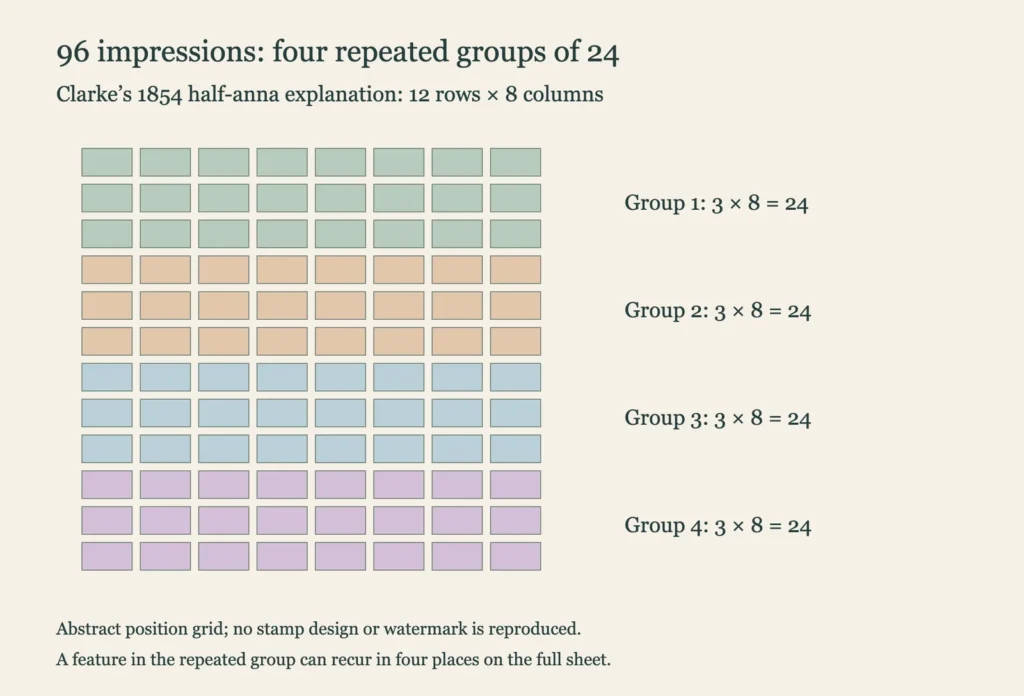
Clarke (chapter XIX, pp. 179–181) describes the half-anna sheets of 1854 as twelve horizontal rows of eight stamps, 96 in all, and reads the sheet as four repeats of a block of 24. The lesson is about structure: a feature that turns up four times may belong to the intermediate transfer block rather than appearing once on the printed sheet.[1]
As evidence of the repetition he points to stamps out of line in the fifth column of the third, sixth, ninth and twelfth rows. He also lists positions with a redrawn chignon (the bun of hair). That list is not a modern, checked plating diagram: his period observations should be tested against the plate, not quietly stretched into a complete reconstruction.[1]
The four annas: changing sheet layouts
Clarke’s account records the first four-anna sheets as twelve stamps, a delivery of 17,170 sheets on 14 October 1854, and a change in April 1855 to twenty-four stamps a sheet. He separates two layouts of twenty-four, with different spacing, which is exactly why the width of the space between two stamps can matter.[1]
A pair or block keeps distance, direction and neighbours; a single does not, and a corner or sheet margin adds a further check. If a claim about position rests on the spacing of the twenty-four layout, compare it with an intact multiple or a documented reconstruction of that layout, not with a cropped picture of unknown scale.[1]
From a feature to a position
Start with the whole object: how many stamps, which way each design faces, the spacing and any surviving sheet edge. Then compare the flaws in the design. A repeated chignon retouch may place a stamp within a repeated group; a margin that occurs only once may place that group within the whole sheet. These are two different levels of identification.[1]
The table sets out only the arithmetic of Clarke’s account; it adds no modern plate numbers, die concordance or plate marks. Pencil notes by later collectors in the margins must also be told apart from marks printed during manufacture.[1]
| Issue or setting | Recorded format | What a multiple can show |
|---|---|---|
| ½ anna | 12 rows × 8 | 96 stamps; four groups of 24 in Clarke’s reading |
| 4 annas, early | 12 stamps | First delivery recorded 14 October 1854 |
| 4 annas, April 1855 setting | 24 stamps | Two layouts with different spacing |
First fix which way the grid runs
A diagram eight by twelve and a description of twelve by eight may show the same 96 positions with the sheet turned. Mahalingeshwar’s watermark plate is printed with the watermark lettering along the top, so the stamps lie sideways to it; Clarke counts rows from the stamp design. Unless you know which is upright, the two can seem to disagree.[2][1]
A note of position should therefore say which diagram it uses, from which side, and in which direction it counts. “Row 3, position 5” can only be repeated by someone else once those conventions are known. Never carry a position number from a watermark diagram over to a plating chart that starts from a different corner or counts the other way.[2][1]
Watermark position and printed position are two maps
The watermark is in the paper before the stamp is printed; a plate flaw belongs to the printing surface. Where they overlap, each kind of evidence can check the other, but a shift in how the paper was laid can move the overlap without any change in the plate.[2]
Mahalingeshwar’s four-anna diagrams show twelve widely spaced positions and twenty-four closer ones against the arms. A fragment of the lion seen under one early layout does not mark the same printed position in the other. His drawings support comparing the layouts; they do not show how closely paper and print were registered on every surviving sheet.[2]
Reading the twelve-stamp plate
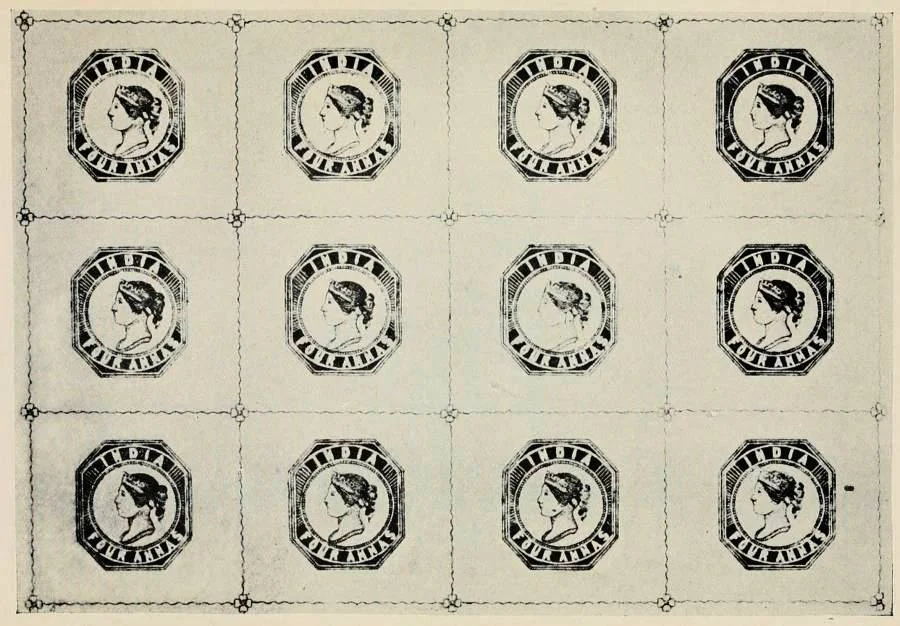
Clarke’s plate of a four-anna sheet shows three rows of four designs inside ornamental borders; counting the designs shows the twelve-stamp format directly. The black-and-white reproduction keeps the spacing and the borders, but not the original red and blue, so it cannot be used to name shades.[1]
The marginal lines are printed evidence and should be described as such, without fitting them to a modern catalogue’s names for frames or settings. A whole-sheet picture teaches the layout; details of the die need a closer, sharper reference.[1]
What the twenty-four-stamp group predicts
If a group of twenty-four was repeated four times to make a sheet of ninety-six, a feature of one stamp in the group should appear at four matching places on the sheet. A later flaw on one part of the finished printing surface need not repeat four times. That difference is what makes Clarke’s explanation useful.[1]
The prediction can be tested with large enough multiples or with plated examples from different sources. Four unrelated loose stamps that merely look alike cannot prove it, and the arithmetic does not show that every printing had the same transfer history. Keep the issue, the setting and the source of the comparison with the recurrence you note.[1]
Twenty-four real stamps beside the grid
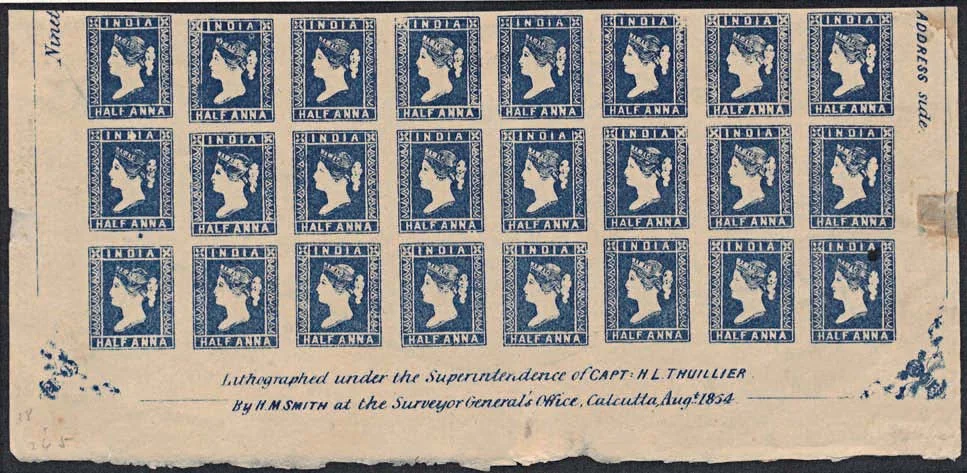
Gärtner’s lot 38 is described as the bottom three rows of a half-anna sheet, positions 73–96, with full margins and the original sheet inscription: twenty-four stamps in three rows of eight. Unlike a numbered grid, the photograph also keeps the differences of impression, alignment, paper and margin.[3]
The catalogue assigns the block to a particular stone and sub-stone and lists several retouches and a flaw between positions 81 and 89. Those assignments are the catalogue’s. The block itself is the physical evidence needed to investigate them, and the photograph is shown as it is, without missing stamps filled in or details redrawn.[3]
Sources
- [1] Geoffrey Clarke, The Post Office of India and Its Story, John Lane/The Bodley Head, London, 1921, chapter XIX, pp. 178–181 and the plate facing p. 178.
- [2] A. Mahalingeshwar, “1854/55 Lithographed Stamps of India: Watermark Study”, Ind Dak, September/October 2001, pp. 125–127 (with a watermark-position plate).
- [3] Auktionshaus Christoph Gärtner, India: Park Collection, auction catalogue, 7 March 2011, lot 38 (photograph p. 10, description p. 66).
Notes 0
Add what you know: a cover or stamp in your collection, a date or source, a correction or a question.
No notes yet.
Sign in to add a note.
Notes show straight away. Keep them kind and about the article; anyone can report one that isn't. House rules
