How British India’s Stamps Were Printed: Methods, Printers and Records
Lithography in Calcutta, typography at the Stamp Office and De La Rue, and the move to Nasik: what the production records do and do not prove.
2027 stamp calendar: 12 princely-state stamps and their stories. A perfect gift for stamp enthusiasts and history lovers.
Pre-order nowPrinting methods and records, paper and gum, watermarks, perforations, sheets and positions, and essays, proofs and specimens.
Lithography in Calcutta, typography at the Stamp Office and De La Rue, and the move to Nasik: what the production records do and do not prove.
A bluish paper, a red paper and a changed colour can have quite different causes: manufacture, an administrative decision, or light, damp and age.
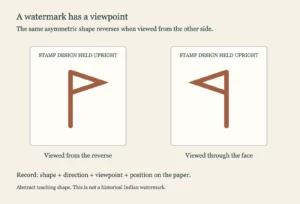
The 1854 sheet watermark, the Elephant’s Head, the single star and the Multiple Star of 1926: how to read a watermark and record which way it faces.
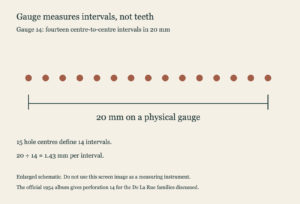
Imperforate 1854 stamps, perforation 14 from De La Rue to 1926 and 13 for the Victory issue: how to measure a gauge and what a cut margin can hide.
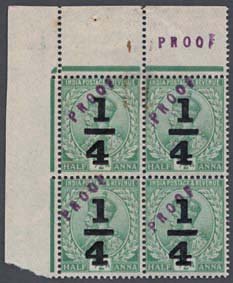
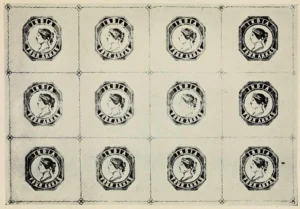
The half anna’s 96 stamps in four groups of 24, the four annas in sheets of 12 and 24: how a repeated flaw or a block can place a stamp in its sheet.
The Lion and Palm Tree essay, the unissued red half anna, die proofs, SPECIMEN handstamps and UPU presentation books: what each kind of material is.