
King George V: The Early Official Stamps, SERVICE Returns
The return of the SERVICE overprint in 1911–1912, the London stamps underneath, and the postal evidence that separates government mail from ordinary letters.
Updated October 5, 2026
In this article
A familiar word returns
George V’s official stamps brought back a word first used in India in 1866, before On H.M.S. replaced it under Victoria. Clarke records that the wording changed back to SERVICE in 1911. The first George V official family is therefore known by the new portrait and the restored overprint together, not by either alone.[1][2]
There is a qualification. Clarke dates the decision to 1911, while the public Richter collection groups the early George V SERVICE stamps it shows under 1912. A general policy date and the release of particular values need not coincide, so the change of 1911–1912 is best described without a single first day for every overprinted value.[1][2]
The stamp under the word
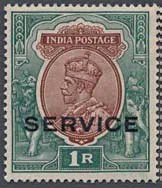
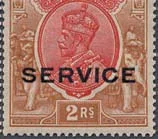
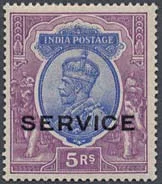
The early officials are made on De La Rue’s typographed George V definitives, on single-star paper with the normal perforation 14. The decorative frames and the postage or postage-and-revenue inscriptions stay visible. The SERVICE overprint did not change the value or turn a 1 anna into another sum; it marked the stamp for official mail.[3][2]
The 3 pies grey is an especially clear example. The crowned portrait, India Postage and Three Pies are part of the stamp, and dark SERVICE lettering crosses the lower part of the portrait. The copy in the Richter collection has a cancellation as well as the overprint. Each belongs to a different operation, the printing of the stamp, its official overprint and its later handling in the post, and where they sit in relation to each other can tell more than the neatness of any one.[3][2]
The values, up to twenty-five rupees
Official mail needed more than the lowest inland rate. Both the ordinary low values and the large elephant high values were overprinted, giving a full range for government business. Keppel illustrates a high-value SERVICE stamp, and Giles confirms that George V 15 and 25 rupees official stocks existed before the reductions of 1925. These high values belong in the story even though later official printings stopped at 10 rupees.[4][5][3][7][8]
The 1947 catalogue gives a firmer basic list than a survey of the whole reign. Its 1912 single-star SERVICE group has 3 pies; ½, 1, 2, 4, 6 and 8 annas; and 1, 2, 5, 10, 15 and 25 rupees. There is no 12 annas in this early group, and one should not be added just because an ordinary 12 annas existed. Later came the one anna chocolate, a change of colour, and NINE PIES on one anna, a change of value; neither is another ordinary value. Exact dates of issue, overprint settings and shades need more specialised evidence.[4][5][3][7][8]
Government letters and what they show
SERVICE stamps were meant for authorised official bodies. On an envelope they should be read together with the department’s heading, the official endorsement, the sender and the addressee. A printed On His Majesty’s Service heading is not a special stamp issue; and SERVICE on a stamp does not by itself say whether a particular letter met the rules. The cover is where these questions can be tested.[6][1]
Lawrence and Northam later list among those allowed to use official stamps the universities, the Vizagapatam Observatory and the film censorship boards, which shows that official use reached well beyond the ministries. Their examples come from their account of 1942 and are not a full list of who was entitled in 1912, but they explain why official mail can come from bodies that do not look like government departments.[6][1]
Reading an overprint as a printing operation
Record the position, shape and length of SERVICE, without treating every small shift as a new issue. An overprint is printed on stamps already made, so it can sit differently from the portrait. A tilted or low overprint is a different sort of feature from a damaged frame or a constant flaw in the original plate. Blocks keep the relation between neighbouring overprints that singles lose.[1][2]
There is not yet a measured, illustrated key to all the early overprint settings, and no single measurement in millimetres applies to them all. Claims of inverted, double or missing overprints need comparison with the right basic setting and, where they matter, an expert’s opinion. A word added later to a genuine unused stamp is not made genuine by the stamp under it.[1][2]
Old stock in the Nasik years
The early London officials outlasted the start of Indian printing. Lawrence and Northam report De La Rue 3 pies SERVICE stock lasting to 1929 and the ½ anna to 1931, a clear warning against naming the printer from the year of the cancellation. A stamp used by a department in the early 1930s can still belong to the single-star family.[6]
That long life gives the early officials a postal history beyond their first appearance: a run of departmental covers can show old stock being used up beside the multiple-star printings. The next article follows the Nasik forms and the later inscriptions. A register of earliest uses value by value, a full key to the overprint types and an illustrated record of certified errors are still to be made.[6]
Sources
- [1] Geoffrey Clarke, The Post Office of India and Its Story (London, 1921), chapter XIX, “Indian Postage Stamps”, pp. 183–184.
- [2] Richter Stamps, “India Official Stamps”
- [3] Indian Posts and Telegraphs Department, India Postage Stamp Centenary 1854–1954: Souvenir Album (1 October 1954), plates 7–17 and printed commentary pp.2–4.
- [4] D. Hammond Giles, Essays of the India Provisionals of 1925, Philatelic Society of India, Bombay, 1962.
- [5] Adrian Keppel, “Emperor of India: India 1910–36”, Stamp Magazine, June 2010, pp.42–47.
- [6] Ian Lawrence and W. H. Northam, “India: A Study of the Nasik Printings”, The Stamp Magazine, July 1942, pp.206–207.
- [7] Bombay Philatelic Company, Catalogue of Postage Stamps 1947 (Bombay: Bombay Philatelic Company, 1947), India section pp.49–52.
- [8] Auktionshaus Christoph Gärtner, India: Park Collection, 7 March 2011, lots 308 and 313–317.
Notes 0
Add what you know: a cover or stamp in your collection, a date or source, a correction or a question.
No notes yet.
Sign in to add a note.
Notes show straight away. Keep them kind and about the article; anyone can report one that isn't. House rules
