
King George V: Later Official Stamps and Overprint Changes
Nasik paper, revised stamps under the SERVICE overprint, the 10-rupee ceiling, and official stamps still being reported after George V’s death.
Updated June 27, 2026
In this article
The same faces on a different paper
The opening of the Nasik press in 1926 began a new family of George V officials. The portraits stayed familiar, but multiple-star paper replaced the single-star paper of the London printings, and SERVICE was added to selected values of the new stock. An official can therefore look almost unchanged while its paper puts it in a different period of printing.[1][2][7][8]
The change was gradual. Lawrence and Northam record London 3 pies officials in stock until 1929 and the London ½ anna until 1931, so a sequence arranged by cancellation year would mix the families. The strongest basic division starts with the watermark and the stamp underneath, then the overprint, then the dated use. StampWorld lists the 1926 family up to 10 rupees with no 5 rupees, and its separate ONE ANNA provisionals on the 1½ annas and 2 annas 6 pies.[1][2][7][8]
A lower ceiling for new officials
Giles explains a limit set when printing in India was being organised: newly supplied SERVICE stamps would go no higher than 10 rupees. The old Edward VII and George V 15 and 25 rupees stocks did not vanish; they became the raw material for the lower-value official surcharges of 1925. The ceiling concerns the supply from then on, not a denial that higher official values had existed.[3]
This separates two series that otherwise look confusing. A plain 10 rupees SERVICE fits the new top of the range; a 15 rupees elephant design overprinted One Rupee is older stock reduced in value. The tablet shows what the stamp was once worth, and the surcharge what it was now worth.[3]
The values of 1932 in official use
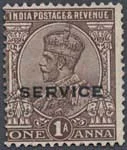
Changes in ordinary postage produced new stamps that were also overprinted for official use. The Richter collection’s George V 1 anna 3 pies has the value written out at the foot, the purple frame and SERVICE across the lower portrait. It shows the official form exists; it does not establish every variety, printing or first day of the value.[2][4]
Lawrence and Northam separate the offset new values from Nasik’s general typographed output, and note that the 9 pies was later printed both ways. Identifying an official’s printing therefore starts beneath the overprint: SERVICE does not turn an offset stamp into a typographed one, and it does not remove the need to tell an original value from a later surcharge.[2][4]
Revenue wording and the smaller two annas
When the combined postage-and-revenue wording was removed from ordinary stamps, the revised stamps mattered for officials too. A 2 annas can differ in its India Postage or India Postage & Revenue inscription as well as in colour and size. The reduced die of 1936 is especially important: Lawrence and Northam give about 18½ by 22 mm for its printed image, against about 19 by 22½ mm for the larger one before it.[1][2][5]
The South African Philatelist of January 1938 confirms it at the time. Its Gwalior notes, continuing from p. 12, record an official overprint on the Nasik multiple-star, re-engraved Die II 2 annas vermilion with the India Postage inscription. This places the revised stamp in an official use of a Convention State, not a separate Indian issue, and shows the late form was being reported by January 1938. It is not an issue date of January 1938.[1][2][5]
Reports after the King’s death
The same issue of the journal records a George V 6 annas bistre with SERVICE and India Postage, and next to it the new George VI 9 pies SERVICE. These short entries show that one reign did not instantly replace all the material of the last. Late George V values and early George VI officials entered the collectors’ record together.[5]
This explains some surprising dates in official collections. A report of 1938 may concern a newly noticed combination, a delayed supply or the continued use of a late printing. Without a departmental notice or a securely documented first-day cover it does not prove when the stamp was first available. Record the date of the report exactly rather than forcing the stamp to end with the reign in 1936.[5]
The later official values and the reduction of 1939
The catalogue of 1947 divides its 1926–1931 multiple-star officials from a 1932–1936 continuation. The earlier group has 3 pies, ½ anna, 1 anna chocolate, 2 annas and 4 annas with the combined revenue wording, 8 annas, 12 annas and the rupee values. The later group adds 9 pies, 1 anna with postage-only wording, 1¼ annas, 2 annas in the postage-and-revenue and small-die forms, 2½ annas orange, 4 annas postage-only and 6 annas bistre. These are combinations the catalogue records; not every ordinary stamp had an official version.[6][2][7]
A further official provisional of 1939 reduced the George V 1¼ annas mauve to ONE ANNA. Although issued in George VI’s reign it still shows George V, so it closes the late George V official sequence and belongs also with the George VI provisionals. Its new value is 1 anna; the old portrait and the old value remain visible on it all the same.[6][2][7]
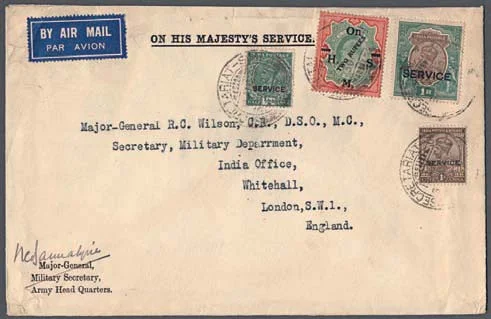
The Simla cover shows why these categories should be read together on mail. An Edward VII official surcharge travels with George V SERVICE stamps, under an On His Majesty’s Service endorsement and a blue airmail label, and the cover keeps the sending office and the London address as well as the franking. Its front alone does not give the rate or the weight.[6][2][7]
Arranging the later officials
A good comparison page puts the ordinary and official versions of the same value together, then separates inscription, watermark and die size. It shows why a 2 annas official may be more complicated than its one black word suggests. On complete covers, the department and the date add another layer: which stock reached a particular office, and how long it stayed in use.[2][3][5]
A measured key to every SERVICE overprint, a full table of watermark positions and an authenticated record of overprint errors are still to come. The change of paper, the 10 rupees ceiling, the place of the 1932 values and the late forms reported at the time are firm ground for an official collection.[2][3][5]
Sources
- [1] Indian Posts and Telegraphs Department, India Postage Stamp Centenary 1854–1954: Souvenir Album (1 October 1954), plates 7–17 and printed commentary pp.2–4.
- [2] Ian Lawrence and W. H. Northam, “India: A Study of the Nasik Printings”, The Stamp Magazine, July 1942, pp.206–207.
- [3] D. Hammond Giles, Essays of the India Provisionals of 1925, Philatelic Society of India, Bombay, 1962.
- [4] Richter Stamps, “India Official Stamps”
- [5] The South African Philatelist, January 1938 pp.12–13, March 1938 p.45 and May 1938 p.68.
- [6] Bombay Philatelic Company, Catalogue of Postage Stamps 1947 (Bombay: Bombay Philatelic Company, 1947), India section pp.49–52.
- [7] Auktionshaus Christoph Gärtner, India: Park Collection, 7 March 2011, lots 308 and 313–317.
- [8] StampWorld, India Service stamps 1920–1929, entries 74–86.
Notes 0
Add what you know: a cover or stamp in your collection, a date or source, a correction or a question.
No notes yet.
Sign in to add a note.
Notes show straight away. Keep them kind and about the article; anyone can report one that isn't. House rules
