
The Later Victorian Low and Middle Values, 1882–1900
Annas, pies and the colour changes of 1899–1900: the working stamps of late Victorian India, how to read their values and what two covers show about using them.
Updated November 10, 2026
In this article
Read the money first
A rupee was sixteen annas, and an anna twelve pies. So three pies is a quarter anna, nine pies three quarters of an anna, two annas six pies two and a half annas, and four annas six pies four and a half annas. A figure read without its unit can make a cover’s sum wrong four or twelve times over.[1][2][3]
The lower values of late Victorian India were put together through a series of changes. The main family of 1882–88 supplied the established values in annas and fractions of an anna. The need for two and a half annas produced a surcharge in 1891 and then a stamp of its own; the need for three pies produced the quarter-anna surcharge of 1898 and the new design of 1899.[1][2][3]
| Printed value | Equal to | In pies |
|---|---|---|
| ¼ anna | 3 pies | 3 |
| ½ anna | 6 pies | 6 |
| 9 pies | ¾ anna | 9 |
| 1 anna 6 pies | 1½ annas | 18 |
| 2 annas 6 pies | 2½ annas | 30 |
| 4 annas 6 pies | 4½ annas | 54 |
| 6 annas 8 pies | 6⅔ annas | 80 |
| 1 rupee | 16 annas | 192 |
Why familiar values changed colour
Clarke links the late changes to the international postal convention on colours: the half anna became yellow-green, the one anna carmine and the two annas six pies ultramarine. Those changes moved other colours along the set, so that the three pies changed from carmine to grey and the two annas from ultramarine to mauve.[1][2][3]
Colour therefore does two jobs for a collector: it separates printings of one design, and sometimes it signals a deliberate rearrangement of the whole set. It is not safe to call every blue two annas “late”, or every carmine low value a one anna; the three pies carmine is a different value with the later portrait.[1][2][3]
| Value | What changed |
|---|---|
| Three pies | Carmine, later grey; the later portrait |
| Half anna | The late yellow-green follows the earlier green and blue-green |
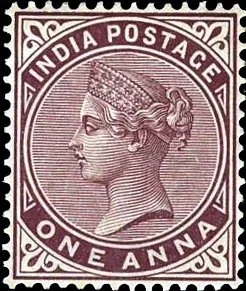
| One anna | Carmine follows the brown-purple or plum group |
| Two annas six pies | Ultramarine, after the earlier yellow-green stamp |
The working values in context
Read the low and middle values as a range serving different weights and kinds of mail, not as a single ladder of inland letter rates. The nine pies and the one anna six pies, for example, stand for three quarters and one and a half annas, and the four annas six pies, four and a half annas, later gave a convenient stock for a surcharge to a lower value.[1][3][2]
A table of values is a starting point for checking a franking, not a table of rates. A letter may carry one ordinary stamp and another for a fee, or several low values because a higher one was not available. The place, date, weight and service are still needed.[1][3][2]
| Value | What it was |
|---|---|
| 3 pies | ¼ anna; a design of its own from 1899 |
| 9 pies | ¾ anna; not to be confused with the older eight pies used for soldiers’ letters |
| 1 anna 6 pies | 1½ annas, printed in words on the stamp |
| 2 annas 6 pies | 2½ annas; the provisional of 1891 followed a change of rate |
| 4 annas 6 pies | 4½ annas; the original value under the surcharge of 1891 |
One anna could pay for more than one thing
Gärtner lot 167 is an ornate cover sent from Bagh Bazar, Calcutta, in July 1899 with two half annas blue-green. The pair adds up to one anna, but the catalogue description alone does not give its weight or exact class. It is useful evidence that an earlier colour was still in use just as the late Victorian colours changed.[5]
Lot 168, a registered cover from Dhoraji of July 1887, carries eight half annas, one of them on the back, four annas in all. A photograph of the front, or a group of stamps taken off, would understate that franking: both sides must be examined before a rate is worked out.[5]
The new colours did not replace the old overnight
The international convention on colours covered the standard classes of foreign postage. Clarke’s explanation accounts for a co-ordinated change in the half anna, one anna and two annas six pies, and the knock-on changes to the three pies and two annas; it does not show that the earlier colours stopped being valid on the same day.[1][2]
The official album groups the late changes over 1899–1900. Use that span for the family unless a more exact notice of the time or a dated first use has been checked. A late cancellation on an earlier colour may simply mean old stock was being used up, not that a printing has been missed.[1][2]
When the figure of value is missing
The design can settle a value that is otherwise hidden. A straight lower tablet and a rectangular frame may separate the two annas from the oval half anna, while the ornamental frame of the four and a half annas is distinctive even under a surcharge. The portrait of the three pies is later than the main head of 1882 and should be compared with a clear example of its own.[4][3]
Write the fraction in words as well as figures in an album caption: “two annas six pies (2½ annas)” avoids reading 2 a. 6 p. as two stamps or as a decimal. The design sequence and the provisionals have articles of their own; this one follows the lower values through their working changes.[4][3]
From value to postal purpose
A face value does not tell you what service a cover paid for. A combination may pay letter postage, registration, extra weight or another charge. Keep the whole envelope, including transit marks on the back and any registration endorsement, before taking stamps off or interpreting a franking.[1][2][3]
For a reference collection, choose one clear example of each value and each main colour change before chasing small differences of shade. A complete table of rates, the exact first days and every intermediate shade are beyond what the sources set out.[1][2][3]
Sources
- [1] Geoffrey Clarke, The Post Office of India and Its Story, London: John Lane, 1921, chapter XIX, pp. 181–184, with passages from chapters III–IV on franking and postal legislation.
- [2] Indian Posts and Telegraphs Department, India Postage Stamp Centenary 1854–1954: Souvenir Album, 1 October 1954, plates 2–6 and commentary pp. 1–2.
- [3] Bombay Philatelic Company, Catalogue of Postage Stamps 1947, Bombay, 1947, India, pp. 47–52.
- [4] G. B. Pai, “Stamps of India—Pre-Independence Issues”, India-80 handbook, pp. 44, 51–62.
- [5] Auktionshaus Christoph Gärtner, India: Park Collection, auction catalogue, 7 March 2011, plates pp. 23, 25, 27 and descriptions pp. 70–72, 82–83.
- [6] Post of India stamp scan of the Victorian one anna INDIA POSTAGE, via Wikimedia Commons (public domain).
Notes 0
Add what you know: a cover or stamp in your collection, a date or source, a correction or a question.
No notes yet.
Sign in to add a note.
Notes show straight away. Keep them kind and about the article; anyone can report one that isn't. House rules
