
Victorian Official Stamps: SERVICE and On H.M.S., 1866–1900
How official stamps turned the government’s postage into accountable stamp use: the SERVICE overprints of 1866, the revenue-stamp provisionals, On H.M.S. from 1874, and what the London printers said they never made.
Updated September 18, 2026
In this article
A way of accounting for government letters
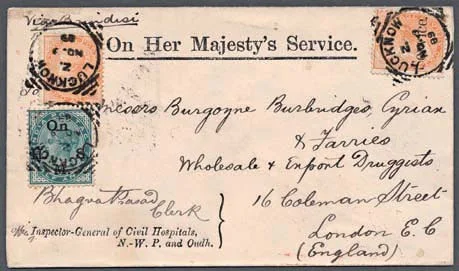
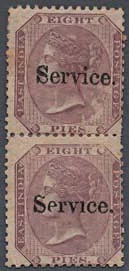
SERVICE stamps first appeared in 1866. Clarke records that the first were overprinted in India while supplies were awaited from England, on the half, one, two and four annas, and that an eight annas came later from London. They were part of the system for charging and accounting for official correspondence; the overprint did not make every government letter free.[1][2][3]
The stamp underneath is essential evidence. Identify its design, watermark and value before the overprint: a genuine ordinary stamp can carry a forged official overprint, and a genuine overprint on what is claimed to be the wrong paper needs looking at again.[1][2][3]
Small SERVICE, large SERVICE and the revenue provisionals
The Bombay catalogue of 1947 separates a group with small SERVICE on unwatermarked and Elephant’s Head paper, then groups of revenue-stamp provisionals in 1866 and 1867, and a group with large SERVICE in 1867–73. From 1874 On H.M.S. replaced SERVICE, first on Elephant’s Head stamps (1874–82) and then on the single-star designs (1883–99), with a few values in the new colours of 1900. These are distinct groups; the word “Service” in a history of the period does not tell us which typeface was used.[1][2][3][6]
The revenue provisionals are especially easy to confuse with the ordinary six annas POSTAGE adaptation. SERVICE and POSTAGE together on a revenue stamp mean an official stamp; POSTAGE alone is the ordinary postal adaptation. Proofs and later official reprints have to be kept apart from the issued originals too.[1][2][3][6]
Official charging came in by stages
Clarke describes the rule of 1866 as compulsory stamping for official letters going beyond the limits of a Presidency town or district, followed in 1873 by the abolition of all remaining franking privileges. There was a real period of change, not one moment when all official mail went from franks to stamps.[1][6]
In the same history, the later official tariff has its own weight steps: half an anna up to half a tola, one anna up to ten tolas, five annas up to twenty tolas, and further steps beyond. That unusual scale is a reminder to check the postage on an official cover against the official rules, not against ordinary letter rates.[1][6]
The revenue provisionals were not all alike
The two annas provisional could be made from a two-rupee Foreign Bill design with the inscriptions above and below cut away and new wording, SERVICE and TWO ANNAS, added. G. B. Pai describes this as a change of both purpose and value. Other provisionals kept a revenue value of two, four or eight annas, had the revenue labels removed, and added SERVICE and POSTAGE.[4][5]
The half anna came from a receipt-duty design with Government of India lettering in a circle; its history and overprint cannot be judged from the ordinary portrait stamps. A sound study records, for each form, the original revenue value, the printed words that survive, the added text, the ink and the final size.[4][5]
What London said it did not supply
Tilleard’s notes keep some important limits set by the printers. They stated that in England SERVICE was applied in one size only, that the eight pies had never been overprinted for service there, and that some revenue provisionals must have been made in India, because nothing was known of them in London. These statements separate where a stamp was made from how alike two types may look.[5]
For On H.M.S., the printers told Tilleard that they had used black ink, not blue, and had not supplied some of the values reported with that overprint. He thought that some forms might have been applied in India. That is historical evidence and a theory, not a certificate of genuineness for every overprint that looks locally made.[5]
A list of the time is a snapshot
The printers’ revised list signed on 11 July 1883, reproduced by Tilleard, says that only the half anna and one anna of the new INDIA POSTAGE series had so far been overprinted. The catalogue of 1947 lists a much fuller official range for 1883–99, eventually three pies, half, one, two, four and eight annas and one rupee. That is change over time, not necessarily a contradiction.[5][3]
Date every statement. The list of July 1883 cannot disprove a later official value, and the catalogue of 1947 cannot prove that every value in its broad range existed in July 1883. The difference matters when testing an unexpectedly early cover or a claim to a newly found official value.[5][3]
On H.M.S. and its limits
The overprint changed to On H.M.S., short for On Her Majesty’s Service, in 1874. The catalogue of 1947 separates black and blue-black overprints in the earlier group and lists the later star-paper designs separately; Clarke notes that a rupee was added in 1883.[1][2][3][6]
Collect clear normal overprints before inverted or double overprints or varieties with a missing stop. An apparently missing stop may be weak inking or hidden by a cancellation, and a constant variety needs comparison and a sound history.[1][2][3][6]
The six annas eight pies SERVICE needs a clear warning. The catalogue of 1947 gives it a separate entry, but Gärtner lot 303 describes it as prepared for use and not issued. It belongs with unissued official material, apart from the ordinary six annas eight pies postage stamp, and should not be counted as an issued official value.[1][2][3][6]
Sources
- [1] Geoffrey Clarke, The Post Office of India and Its Story, London: John Lane, 1921, chapter XIX, pp. 181–184, with passages from chapters III–IV on franking and postal legislation.
- [2] Indian Posts and Telegraphs Department, India Postage Stamp Centenary 1854–1954: Souvenir Album, 1 October 1954, plates 2–6 and commentary pp. 1–2.
- [3] Bombay Philatelic Company, Catalogue of Postage Stamps 1947, Bombay, 1947, India, pp. 47–52.
- [4] G. B. Pai, “Stamps of India—Pre-Independence Issues”, India-80 handbook, pp. 44, 51–62.
- [5] J. A. Tilleard, Notes on the De La Rue Series of the Adhesive Postage and Telegraph Stamps of India, London: Philatelic Society, 1896.
- [6] Auktionshaus Christoph Gärtner, India: Park Collection, auction catalogue, 7 March 2011, lots 280, 301 and 303 (p. 77).
Notes 0
Add what you know: a cover or stamp in your collection, a date or source, a correction or a question.
No notes yet.
Sign in to add a note.
Notes show straight away. Keep them kind and about the article; anyone can report one that isn't. House rules
