
Victorian Printings: Papers, Shades, Dies and Perforations
Paper, die, ink and perforation are separate observations: how to identify a Victorian De La Rue stamp, what the registered plate dates show, and how to tell imperforates, shifted perforations and double prints.
Updated August 18, 2026
In this article
Start with the clearest features
The Victorian De La Rue stamps run across unwatermarked wove and glazed bluish papers, Elephant’s Head paper and single-star paper. The inscription and frame on the face usually narrow down the family first; the watermark then tests the answer. Colour is valuable after those checks, but often a weak first filter.[1][2][3]
The official album gives typography and perforation 14 for the Victorian De La Rue families. An engraved master die fits perfectly well with stamps printed by typography, and a proof taken at an earlier stage of manufacture need not have the paper, gum or perforation of the issued stamp.[1][2][3]
A change of die is not a change of colour
The catalogue of 1947 gives separate headings to the eight annas Die II of 1868 and the half anna Die II, with the wider opening, of 1873. These concern the engraved design, not lighter or darker ink, and no colour chart can replace a sharp comparison of the head and frame.[1][2][3]
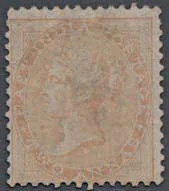
On the other hand, the pink, buff, yellow and orange two annas of the unwatermarked group differ strikingly in colour without each shade being a new design. Ageing, soaking, light and scanning all make colour less reliable. Record a qualified observation rather than forcing an uncertain stamp into a valuable shade.[1][2][3]
What the registered plate dates show
Tilleard’s table of plates gives firm points in production. The one anna begins with a plate registered in June 1855, adds a second in July 1857 and a third in September 1858, and has a fourth on Elephant’s Head paper in December 1865. The two annas runs from green through pink and yellow to orange-yellow on watermarked paper.[5]
The table does not mean that every stamp from a plate was printed in the shade of its registered sheet for the whole life of the plate, and registration is not the first day of postal use. Use these entries to test whether an attribution is plausible, while keeping a stamp’s attribution separate from the date of its cancellation.[5]
Why working dies were altered
John Easton explains that the early Queen’s-head stamps were made from original, subsidiary and working dies, with duplicate electrotypes, and that patching or retouching can be seen in proofs. He notes that the early dies were made at the Mint on the Inland Revenue’s instructions, and that the surviving work records do not show when De La Rue took over making them.[6][5]
Tilleard describes how fine detail could clog with ink and the plates needed frequent cleaning, which led to the working die being modified before replacement plates were made. That gives a practical reason for altered features in the portrait: a change might improve production, not just update the Queen’s likeness.[6][5]
Glazed, tinted and chemically changed paper
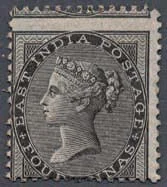
Bluish paper can have more than one cause. The glazed blue paper of the early four and eight annas is an established kind of paper. A bluish cast on another value may come instead from a tint in the paper, the action of the ink, staining or an experimental printing, and its surface and history have to be checked.[5][4]
Discussing telegraph record sheets, Tilleard separates paper that is blue in its substance from paper turned blue by the ink. That cannot identify a postage stamp by itself, but it shows why “blue paper” needs a physical description, not just a colour word. An experimental printing is not a normal issue because its paper looks the same.[5][4]
What a sheet or block adds
A marginal multiple can keep the watermarked lettering, the plate number, the line of perforation and several neighbouring impressions. Gärtner lot 120 combines an imperforate block of the one anna with plate number 2 and part of the marginal watermark inscription, far more evidence than a single imperforate stamp with small margins.[4][5]
For the later series, the printers’ account records a reduction from 320 to 240 stamps a sheet and a larger format. A complete multiple should be studied as a printed arrangement: a flaw claimed to be constant must recur in the same position or be traced through related sheets. One blurred impression is not a plate reconstruction.[4][5]
Imperforates, shifted perforations and double prints
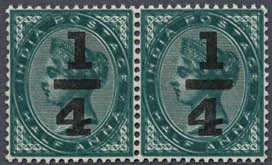
A stamp whose design sits close to one edge may have shifted perforations, as described for Gärtner lot 128, rather than a smaller design. Check every edge and the full size of the paper. A trimmed single is poor evidence of an imperforate variety; a pair, a block or a margin keeping the missing perforations says far more.[2][3][4]
A double impression should show a second complete printed image, not just heavy inking, a crease in the paper or an offset on the back. Marginal multiples can tie a defect to a position and tell a recurring plate feature from an accident. What is given here is an order of examination, not a plate census or a certificate for any stamp shown.[2][3][4]
Sources
- [1] Geoffrey Clarke, The Post Office of India and Its Story, London: John Lane, 1921, chapter XIX, pp. 181–184, with passages from chapters III–IV on franking and postal legislation.
- [2] Indian Posts and Telegraphs Department, India Postage Stamp Centenary 1854–1954: Souvenir Album, 1 October 1954, plates 2–6 and commentary pp. 1–2.
- [3] Bombay Philatelic Company, Catalogue of Postage Stamps 1947, Bombay, 1947, India, pp. 47–52.
- [4] Auktionshaus Christoph Gärtner, India: Park Collection, auction catalogue, 7 March 2011, plates pp. 23, 25, 27 and descriptions pp. 70–72, 82–83.
- [5] J. A. Tilleard, Notes on the De La Rue Series of the Adhesive Postage and Telegraph Stamps of India, London: Philatelic Society, 1896.
- [6] John Easton, The De La Rue History of British and Foreign Postage Stamps 1855 to 1901, India chapter, pp. 177–179.
Notes 0
Add what you know: a cover or stamp in your collection, a date or source, a correction or a question.
No notes yet.
Sign in to add a note.
Notes show straight away. Keep them kind and about the article; anyone can report one that isn't. House rules
